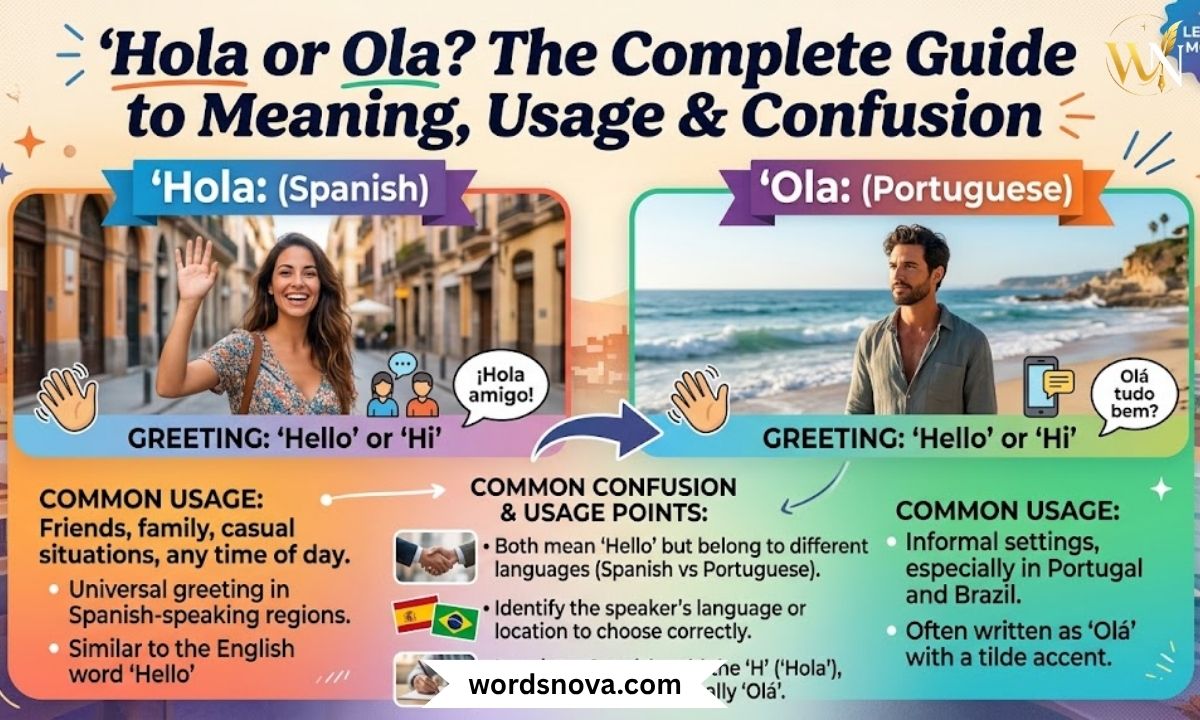
Have you ever wondered whether hola or ola is the right word when greeting someone? The ola meaning can be confusing, especially when comparing hola vs ola, checking the hola meaning, or asking what does ola mean in Spanish.
We will make hola or ola simple and clear. You will learn the difference, understand ola or hola in Spanish, and see when each word is used, so you can use the correct one with confidence.
What “Hola” Means and Why It Matters
Hola (pronounced OH-lah) is the most common greeting in Spanish. It means “hello” or “hi” and works at any time of day, with friends, strangers, or colleagues.
It matters for three reasons:
- It is usually the first word learners study.
- It works in nearly every Spanish-speaking country.
- It is informal enough to be friendly but polite enough for most situations.
Spanish is spoken by hundreds of millions of people, so “hola” is one of the most widely used greetings in the world.
Origins of “Hola”: History, Evolution & Linguistic Roots

Where did “Hola” come from?
“Hola” is an interjection, a word used to call attention or greet someone. Its exact origin is uncertain. Dictionaries generally treat it as an expressive call, similar to English “hello” and “hallo” and French “holà.” Many European languages developed short attention-getting calls like this independently.
Why did the “H” become silent?
Old Spanish had a breathy /h/ sound in many words, usually from the Latin letter F (for example, Latin facere became Spanish hacer). Over the 1500s and 1600s, that sound faded from standard Spanish. The spelling stayed, but the sound disappeared.
In “hola,” the H is simply a spelling tradition. It is not pronounced.
Cultural shift
As Spanish spread across Spain and the Americas, “hola” became the default casual greeting. Today it appears in everyday speech, text messages, advertising, and music.
Pronunciation Essentials: Why the “H” in Hola Is Silent
How to pronounce “Hola”
Say OH-lah, with two syllables:
- O is a pure, short vowel, like the “o” in “go” but without the “w” glide at the end.
- la sounds like “lah.”
Why the H is silent
In standard Spanish, the letter H is silent in almost every word. The sound is gone, but the spelling remains for historical reasons.
Common mistakes to avoid
- Pronouncing the H: “hoh-lah” ❌
- Saying “oh-lay” ❌
- Stretching the O into “ow”: “ohw-lah” ❌
- Putting stress on the second syllable ❌ (the stress is on O)
Hola Around the Spanish-Speaking World
Regional Usage Table
| Region | Common greeting(s) | Notes |
| Spain | Hola, ¿qué tal?, ¿qué pasa? | “Buenas” is common and casual |
| Mexico | Hola, ¿qué onda?, ¿qué tal? | “¿Qué onda?” is very informal |
| Colombia | Hola, ¿quihubo?, ¿qué más? | Friendly and relaxed |
| Argentina / Uruguay | Hola, ¿qué tal?, ¿cómo andás? | Voseo forms are common |
| Dominican Republic | Hola, ¿qué lo qué? | Very informal slang |
| Peru / Chile | Hola, ¿qué tal? | “Aló” is used for phone calls |
Important note
“Hola” is understood and accepted everywhere. Regional alternatives add local flavor, but you will never be wrong using “hola.”
Variations
- Hola a todos: hello, everyone
- Hola, buenas: a casual combined greeting
- ¡Hola, qué tal!: hi, how’s it going?
- Hola, ¿cómo estás?: hello, how are you?
Ola vs Hola: Exact Meaning & Key Differences
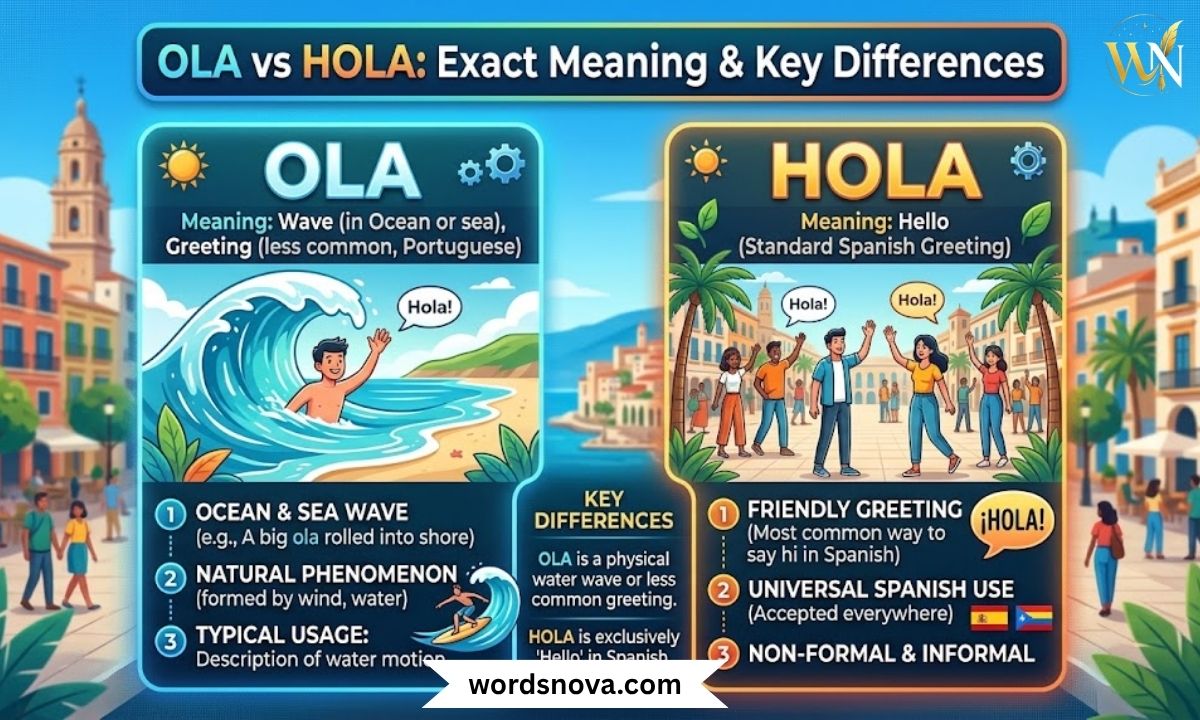
“Hola” = Hello
A greeting, used when you meet or address someone.
“Ola” = Wave
A noun meaning a wave of water. It is feminine: la ola. It also appears in expressions such as la ola (the stadium wave, also called the Mexican wave in English) and ola de calor (heat wave).
Side-by-side comparison
| Feature | Hola | Ola |
| Meaning | Hello / hi | Wave |
| Part of speech | Interjection | Noun (feminine) |
| Spelling | Starts with silent H | No H |
| Pronunciation | OH-lah | OH-lah |
| Plural | None (does not change) | Olas |
Real examples in sentences
| Spanish | English |
| ¡Hola, María! ¿Cómo estás? | Hello, María! How are you? |
| Hola, buenos días. | Hello, good morning. |
| La ola es muy grande hoy. | The wave is very big today. |
| Hay una ola de calor en la ciudad. | There is a heat wave in the city. |
| Dije “hola” y una ola me mojó los pies. | I said “hello” and a wave soaked my feet. |
Quick memory trick: if you are greeting someone, write the H. If you are talking about water, there is no H.
Navigating Spanish Homophones (Including Hola & Ola)
Why homophones exist in Spanish
Spanish spelling is closely tied to sound, but a few letters represent the same sound or none at all. H is silent, and B and V sound the same in standard Spanish. That creates words that sound alike but are spelled differently.
Other common Spanish homophone pairs
| Pair | Meanings | Example |
| hola / ola | hello / wave | Hola, amigo. / Una ola enorme. |
| hasta / asta | until / flagpole, horn | Hasta mañana. / La asta de la bandera. |
| echo / hecho | I throw / done, fact | Echo la basura. / Está hecho. |
| a ver / haber | let’s see / to have (auxiliary) | A ver qué pasa. / Debe haber tiempo. |
| vaca / baca | cow / roof rack | La vaca come pasto. / La baca del coche. |
| tuvo / tubo | had / tube | Ella tuvo suerte. / Un tubo de metal. |
| bello / vello | beautiful / body hair | Un paisaje bello. / Vello en el brazo. |
| hierba / hierva | grass, herb / (it) boils | Hierba fresca. / Que hierva el agua. |
Some pairs, such as casa / caza (house / hunt), are homophones only in regions that use seseo (Latin America, the Canary Islands, parts of Andalusia).
Tips for learners
- Learn words in full phrases, not alone.
- Use context to decide the spelling.
- Note the silent-H words you meet and review them regularly.
- Read short texts aloud and write them from dictation.
Hola in Other Languages & Global Usage
Where “Hola” appears globally
- Spanish: the home of “hola”
- Catalan: “hola” is also the standard hello
- Philippines: “hola” is occasionally heard in English or Filipino speech because of Spanish influence
- English-speaking countries: used playfully or in places with large Spanish-speaking communities
- International branding: many companies and apps use “Hola” in their names
Comparison table
| Language | Common “hello” | Note |
| Spanish | Hola | Standard greeting |
| Portuguese | Olá / Oi | “Olá” is the formal-neutral form; “oi” is casual |
| Italian | Ciao / Salve | Different origin |
| French | Bonjour / Salut | Different origin |
| English | Hello / Hi | “Hola” borrowed informally |
Portuguese olá looks similar to “hola,” but it is a separate word. Avoid mixing them up when writing.
How English Speakers Can Use “Hola” Naturally

When it feels natural
- Greeting Spanish-speaking friends or neighbors
- Traveling in Spanish-speaking countries
- Starting a Spanish conversation, even a short one
- Casual messages to bilingual friends
When it feels forced
- Using it as a joke with people who don’t speak Spanish
- Mixing it into otherwise English formal writing without a reason
- Using it to mock or stereotype
Examples of natural integration
- “Hola! Welcome, come on in.” (to a Spanish-speaking guest)
- “Hola, Mr. García, thanks for coming.” (when you know the person speaks Spanish)
- “Hola, ¿cómo estás?” (a full Spanish greeting, if you can continue)
Professional use
In business settings, use “hola” when your contact speaks Spanish or the context is bilingual. In an email to Spanish-speaking clients, “Hola [Name],” is friendly and acceptable. For more formal contexts, “Estimado/a [Name]” is the safer choice in Spanish.
Hola in Pop Culture, Media & the Internet
Key influences
- Music: many Latin pop and reggaeton songs open with or feature “hola.”
- Television and film: “hola” is a quick way to signal a Spanish-speaking character or setting.
- Social media: hashtags, captions, and comments use “hola” as a friendly opener.
- Tech culture: the phrase “Hola Mundo” is the Spanish version of the programmer’s classic “Hello, World.”
Case Study: Bilingual Social Media
Bilingual creators often open posts with “Hola, amigos!” before switching to English. This code-switching builds rapport with both audiences and signals cultural identity. It works best when the creator uses Spanish genuinely, not as decoration.
Frequently Asked Questions
What is the difference between hola or ola?
The difference between hola or ola is simple. “Hola” means hello, while “ola” means wave in Spanish. They have different meanings and uses.
What is the hola meaning?
The hola meaning is “hello” in Spanish. When discussing hola or ola, use “hola” when greeting someone or starting a friendly conversation.
What is the ola meaning?
The ola meaning is “wave” in Spanish. In hola or ola, “ola” describes a wave in water, such as an ocean or sea wave.
What does ola mean in Spanish?
What does ola mean in Spanish? It means “wave.” In hola or ola, remember that “ola” refers to a wave, not a greeting.
What does hola mean in Spanish?
“Hola” means “hello” in Spanish. When choosing hola or ola, use “hola” to greet someone politely, casually, or warmly in everyday conversations.
Is hola or ola correct in Spanish?
Both are correct Spanish words, but they have different meanings. Hola or ola depends on your message. “Hola” means hello, while “ola” means wave.
How do you use hola in Spanish?
Use “hola” when greeting someone in Spanish. If you are learning hola or ola, remember that “hola” is the correct word for saying hello.
How do you use ola in Spanish?
Use “ola” when talking about a wave. In hola or ola, “ola” describes water movement, while “hola” is used as a friendly Spanish greeting.
Why do hola and ola sound similar?
Hola or ola sound similar because they share the same basic vowel and ending sound. However, “hola” has an initial silent “h” in Spanish.
How can I remember hola or ola?
Remember hola or ola with their meanings. “Hola” is for hello, while “ola” means wave. This simple difference makes Spanish spelling easier.
Conclusion
Choosing between hola or ola is easy once you know the difference. Hola or ola are not the same in Spanish. Hola is the common Spanish greeting and means “hello.” The hola meaning is simple and useful in daily conversations. If you are asking about the ola meaning, it usually means “wave” in Spanish. So, hola vs ola depends on what you want to say. What does ola mean in Spanish? It means “wave,” while hola means “hello.”
When you want to greet someone, use hola, not ola. Hola or ola in Spanish have different meanings and uses. Remember, hola or ola can look similar, but one letter changes the meaning. Now you know the hola meaning and ola meaning clearly. Understanding hola vs ola helps you write and speak Spanish correctly. So, choose hola for “hello” and ola for “wave” every time.