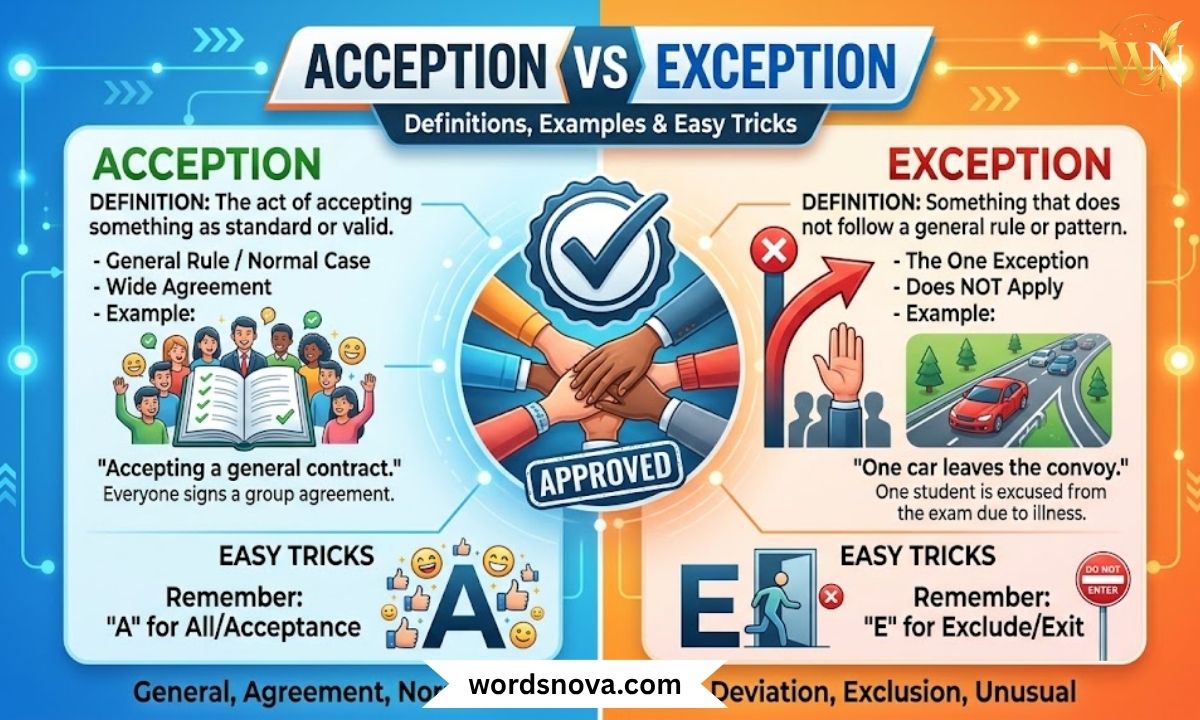
Have you ever paused while writing and wondered whether acception or exception is the right word? The acception vs exception question can be confusing, especially when you are unsure about the acception meaning and how acception is used. Understanding acceptions vs exceptions can make your writing much clearer.
We will explain acception vs exception in simple English. You will learn the correct meanings, usage, spelling, and easy examples, so you can confidently choose the right word whenever you come across this confusing pair.
Quick Answer
Exception is the word you almost always want. It means something that doesn’t follow the general rule ,”Every student passed, except one.” Acception is an archaic, almost-extinct English word that historically meant “the accepted or received meaning of a word” (similar to today’s “acceptation”). If you’re not writing historical or specialized linguistic text, “acception” is very likely a typo for either exception or acceptance.
| Word | Status Today | What It Means | Use It When |
| Exception | Common, standard | A case that doesn’t follow the rule | You’re excluding something from a general statement |
| Acceptance | Common, standard | The act of agreeing to or receiving something | You mean someone said “yes” or took something willingly |
| Acception | Rare, archaic | The traditionally understood meaning of a word (historical) | Almost never ,mostly seen in old texts or etymology discussions |
What are You Looking For?
Most people who type “acception” are actually searching for one of two things:
- How to spell or use “exception” correctly: the word meaning an exclusion or exemption from a rule.
- The difference between “accept” and “except” :two commonly confused verbs.
A smaller group of readers ,often students of etymology, linguistics, or historical English ,are genuinely looking for the old, obsolete word “acception,” once used to mean the recognized sense of a word. This guide covers both, so whichever one brought you here, you’ll get a clear answer.
What Does “Exception” Mean?

Simple Definition:
An exception is a person, thing, or situation that is left out of a general rule, statement, or pattern. It’s a noun, and it comes from the Latin exceptio, meaning “a taking out” or “exclusion.” When something is an exception, it doesn’t behave the way the rest of the group does.
Examples of “Exception”
- “All employees must clock in by 9 a.m., with no exceptions.”
- “She’s usually late, but today was an exception ,she arrived early.”
- “Most birds can fly; the ostrich is a notable exception.”
- In programming: “The function threw an exception when it received invalid data.”
- In law: “The contract includes an exception for cases of natural disaster.”
Common Phrases With “Exception”
- With the exception of:meaning “except for” (e.g., “Everyone attended, with the exception of Tom.”)
- Make an exception:to allow something that would normally not be allowed.
- Take exception to: to object to or feel offended by something.
- Without exception: meaning “in every single case, no exclusions.”
- The exception proves the rule:a common (if debated) saying suggesting that an unusual case confirms the rule generally holds.
What Does “Acception” Mean?
Definition of “Acception”
Acception is a now-obsolete English noun, historically defined as “the received or accepted meaning of a word or phrase” ,essentially what modern English calls “acceptation.” It comes from the Latin acceptio, meaning “a receiving.” In older texts, it was also occasionally used the way we use “acceptance” today, meaning the act of receiving something favorably.
Example of “Acception” (Linguistic Use)
Older English writing used “acception” the way a modern writer might use “sense” or “meaning” ,for example, describing a word’s “usual acception” instead of its “usual acceptation” or “usual meaning.” This usage largely disappeared from English by the 18th century, replaced first by “acceptation” and later by simpler words like “meaning” or “sense.”
Important Note
Outside of historical texts, dictionaries of archaic English, or discussions of word etymology, “acception” is not considered correct modern usage. If it appears in your writing today, a spell-checker or editor will almost always flag it ,and rightly so, since virtually every modern style guide and dictionary treats it as obsolete or nonstandard. In nearly all everyday, business, or academic writing, what you actually want is “exception” or “acceptance.”
Acception vs Exception: Side-by-Side Comparison
| Feature | Exception | Acception |
| Part of speech | Noun | Noun (archaic) |
| Meaning | Something excluded from a general rule | The traditionally understood meaning of a word |
| Current usage | Extremely common, standard English | Obsolete; found mainly in historical texts |
| Origin | Latin exceptio (“a taking out”) | Latin acceptio (“a receiving”) |
| Typical modern replacement | N/A ,it’s the correct word | “Acceptance” or “meaning/sense” |
| Example sentence | “Everyone left except her ,she was the exception.” | “The word was used in its usual acception” (historical) |
Why People Confuse Acception and Exception
1. Similar Spelling
Both words share the “-ception” ending and a similar letter pattern, which makes them easy to mix up when typing quickly or writing from memory.
2. Sound Similarity
When spoken casually, “acception” and “exception” can sound close enough ,especially in fast speech or with certain accents ,that a listener transcribing the word might guess wrong.
3. Confusion With “Acceptance”
Because “acception” looks like a shortened or misspelled version of “acceptance,” many people assume it’s simply a typo for that word. In most modern cases, that assumption is correct ,the writer meant “acceptance,” not a rare historical term.
Common Mistakes (And How to Fix Them)
Incorrect:
“We made an acception for late applicants.”
Correct:
“We made an exception for late applicants.”
Incorrect:
“His acception of the award was met with applause.”
Correct:
“His acceptance of the award was met with applause.”
Incorrect:
“There is no acception to this policy.”
Correct:
“There is no exception to this policy.”
American vs British English Differences
Neither American nor British English treats “acception” as standard vocabulary ,it’s obsolete in both varieties and doesn’t appear in major contemporary dictionaries like Merriam-Webster or the Cambridge Dictionary as an active entry.
“Exception” and “acceptance,” on the other hand, are used identically in both American and British English, with no spelling or meaning differences. The confusion around “acception” isn’t a regional dialect issue; it’s simply an old word that fell out of use everywhere English is spoken.
When Should You Actually Use “Acception”?
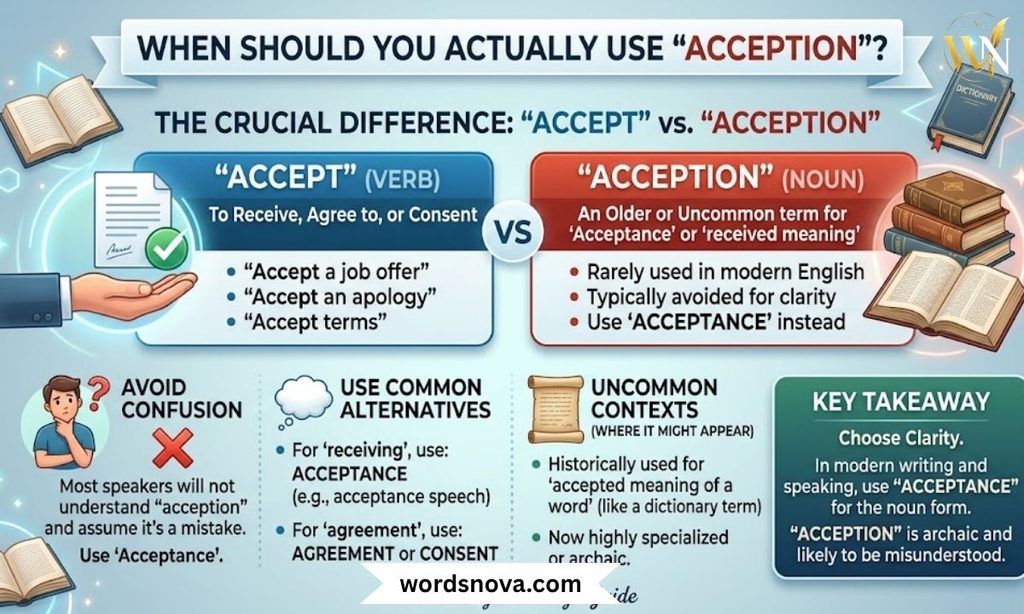
In practice, almost never. The only contexts where “acception” might reasonably appear are:
- Quoting or discussing historical English texts (for example, 16th- or 17th-century writing).
- Academic work on etymology or the history of the English language.
- Deliberate stylistic or archaic writing, such as historical fiction dialogue.
For everyday writing ,emails, essays, business documents, social media ,always use “exception” or “acceptance” instead.
Real-World Usage Scenarios
In Business Writing
Business writing almost always calls for “exception,” not “acception.” Phrases like “policy exception,” “exception request,” or “with the exception of the Q3 report” are standard in professional communication. Using “acception” in a business document is very likely to read as a spelling error to your audience.
In Academic Writing
Academic writing follows the same rule, with one caveat: if you’re studying historical linguistics, older literature, or the evolution of English vocabulary, you may legitimately encounter or cite “acception” in its original 16th–17th century sense. In that narrow context, it’s accurate ,just be sure to clarify for readers that it’s a historical term, since most won’t recognize it.
Synonyms and Related Words
Synonyms for Exception
- Exclusion
- Exemption
- Anomaly
- Irregularity
- Deviation
- Special case
Related Words
- Except (preposition/conjunction)
- Exceptional (adjective)
- Accept (verb)
- Acceptance (noun)
- Acceptable (adjective)
- Acceptation (archaic noun, closest modern relative of “acception”)
Quick Memory Trick
Remember it this way: “Exception” has an X, and X marks what’s excluded. If you’re describing something left out of a rule, you want the word with the X ,exception. If you’re talking about someone saying “yes” to something, you want accept/acceptance ,no X involved. “Acception” doesn’t fit either mental shortcut, which is your signal that it’s probably not the word you need.
Frequently Asked Questions
What is the difference between acception and exception?
Acception vs exception have different meanings. Acception refers to a particular meaning or interpretation, while exception describes something excluded from a general rule.
Is acception a real word?
Yes, acception is a real word, but it is uncommon today. In acception vs exception, acception usually refers to a specific meaning or interpretation.
What does acception mean?
Acception means a particular meaning, sense, or interpretation of a word. In acception vs exception, it is less common in everyday English writing.
What does exception mean?
Exception means something that does not follow a general rule. In acception vs exception, exception is the much more common word in modern English.
Is acception commonly used in English?
Acception is rarely used in modern English. When comparing acception vs exception, remember that exception is far more common in everyday speech and writing.
When should I use exception?
Use exception when something does not follow a rule or general statement. In acception vs exception, exception is correct for exclusion from a general rule.
Can acception and exception be used interchangeably?
No, acception and exception have different meanings. Acception concerns meaning or interpretation, while exception concerns something that differs from a general rule.
What is the correct spelling: acception or exception?
Both spellings are correct words, but they have different meanings. Acception vs exception depends on whether you mean interpretation or something excluded from a rule.
How can I remember acception vs exception?
Remember that acception relates to meaning or interpretation, while exception relates to rules. This simple difference makes acception vs exception easier to remember.
Which word is more common, acception or exception?
Exception is much more common in modern English. In acception vs exception, choose exception when discussing something outside a rule, condition, or general statement.
Conclusion
Understanding acception vs exception can make confusing English words far easier. The key is knowing that acception is a rare word related to acceptance or approval in some contexts. When asking about acception or exception, check the meaning and sentence carefully. The acception meaning is not the same as the meaning of exception. Remember that acception is uncommon, while exception is widely used in everyday English.
In acception vs exception, exception usually means something that does not follow a rule or a special case. This simple difference can help you avoid mistakes. If you see acception in older or specialized writing, look at the context. Also, remember that acception is different from exceptions. Reviewing acception vs exception examples can improve your spelling and word choice. Keep practicing acception or exception, and these terms will become easier to understand and use correctly.