Have you ever stopped while writing and wondered whether demasculate or emasculate is the right word? The difference can feel confusing, especially when checking the emasculate vs demasculate meaning, demasculate meaning, or asking demasculate or emasculate is correct. If you have seen demasculated in writing, it is easy to wonder which form is standard.
We will explain emasculate vs demasculate in simple English. You will learn what each word means, how they differ, and when to use them correctly. We will also look at demasculate meaning, demasculate or emasculate, and common examples so you can write with confidence.
What Does Emasculate Mean?
Emasculate is a verb that means to deprive someone (traditionally a man) of strength, power, vigor, or a sense of masculine identity. It carries both a literal and a figurative meaning.
The word traces back to the Latin emasculare, built from e- (“out of” or “away from”) and masculus (“male”). In its literal, clinical sense, emasculate refers to the physical removal of male reproductive organs, a meaning still used in veterinary, medical, and biological writing. Far more common today, though, is the figurative sense: to weaken someone’s authority, confidence, or perceived power, often through criticism, humiliation, or a loss of control.
Example: “The board’s decision to strip him of decision-making authority effectively emasculated his role as director.”
Although the word has masculine roots, its figurative meaning is often applied more broadly, describing any situation, institution, or policy that is weakened or stripped of its force.
Related Word Forms: Emasculate
Like most verbs, emasculate has several grammatical forms you’ll encounter in writing:
| Form | Part of Speech | Example |
| Emasculate | Verb (base form) | Harsh criticism can emasculate even a confident leader. |
| Emasculated | Past tense / adjective | He felt emasculated after being publicly overruled. |
| Emasculates | Present tense (third person) | The new policy emasculates the committee’s authority. |
| Emasculating | Present participle / adjective | It was an emasculating experience for the whole team. |
| Emasculation | Noun | The emasculation of local government power sparked debate. |
Emasculate Beyond Personal Identity
While emasculate is often discussed in terms of personal confidence or masculinity, professional and journalistic writing frequently uses it in a broader, non-gendered sense to describe an institution, law, policy, or agreement being stripped of its power or effectiveness.
Example: “Critics argued the amendment would emasculate the regulatory agency, leaving it unable to enforce its own rules.”
This figurative, institutional usage is common in political and business journalism, where “emasculate” simply means “to weaken or neutralize.”
Context Examples of Emasculate
Seeing the word used across different contexts makes its meaning clearer:
- Personal/psychological: “Constant public criticism from his boss left him feeling emasculated.”
- Political/institutional: “The court ruling was seen as an attempt to emasculate the agency’s enforcement powers.”
- Literary/figurative: “The novel explores how war can emasculate even the most resilient soldiers.”
- Literal/medical: “The procedure to emasculate the animal was performed by a licensed veterinarian.”
What Does Demasculate Mean?
Demasculate is not found in major standard dictionaries such as Merriam-Webster, Oxford, or Cambridge. It shows up occasionally in casual writing, online forums, and slang dictionaries, where it’s generally used to mean “to remove masculinity from someone” essentially covering the same ground as emasculate’s figurative sense.
The word likely arose from a logical but mistaken assumption: since prefixes like de- typically signal removal or reversal (as in defrost or deactivate), people reasoned that de- plus masculate should mean “to remove masculine qualities.” The problem is that “masculate” isn’t a standalone root word in English, and emasculate already contains the meaning of removal built into its own prefix. Adding “de-” on top is grammatically redundant rather than corrective.
Example of how it appears (non-standard): “Fans complained that the reboot seemed to demasculate the character.”
Because demasculate lacks dictionary recognition, spell-checkers typically flag it, and it does not appear in style guides like AP, Chicago, or MLA.
Emasculate vs Demasculate Comparison Table
| Feature | Emasculate | Demasculate |
| Dictionary status | Recognized in Merriam-Webster, Oxford, Cambridge | Not recognized in major dictionaries |
| Word origin | Latin emasculare (17th century) | Informal coinage from de- + “masculate” |
| Style guide acceptance | Accepted by AP, Chicago, MLA | Not accepted in formal style guides |
| Common usage | Formal writing, journalism, literature, medicine | Casual speech, informal online writing |
| Meaning | To weaken, strip of power, or (literally) castrate | Same general idea, but non-standard phrasing |
| Recommended use | Safe for all formal and professional contexts | Best avoided in writing meant to be taken seriously |
The Key Difference Between Emasculate vs Demasculate
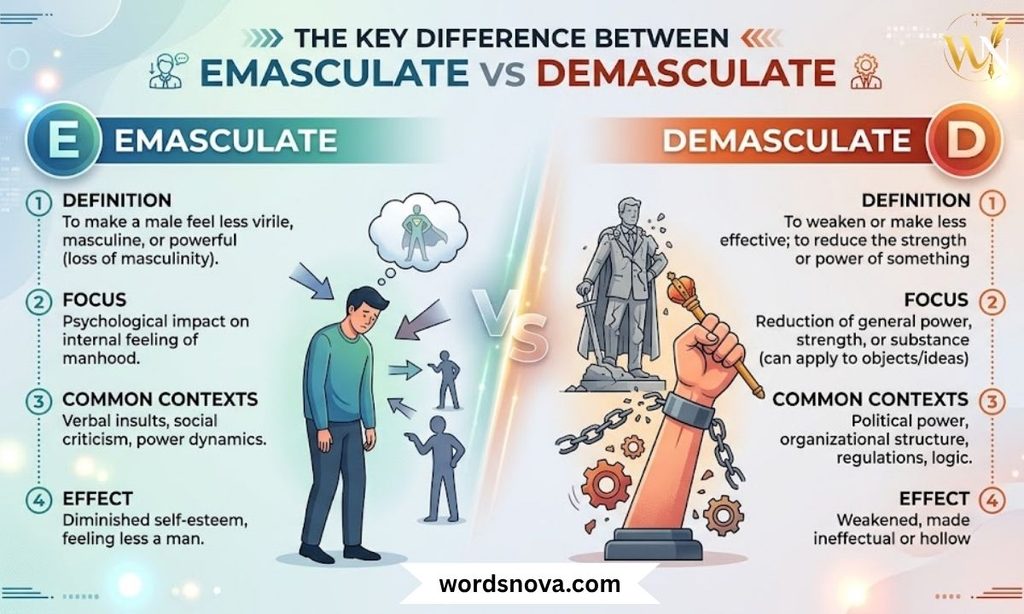
The core difference isn’t really about meaning , both words are used by people trying to express the same basic idea. The real difference is standing: one is an established, dictionary-recognized English word, and the other is not.
Standard vs Non-Standard — That Is the Core Issue
Emasculate has centuries of documented use, a clear Latin etymology, and universal dictionary recognition. Demasculate has none of that. It functions more like an eggcorn or a redundant coinage , a word people reach for because it feels logically constructed, even though it isn’t linguistically necessary.
Why Do People Demasculate?
A few reasons explain why demasculate keeps appearing despite not being standard:
- Prefix pattern-matching: English speakers are used to de- meaning “reverse” or “remove” (defrost, deactivate, decode), so de- + “masculate” feels intuitive even though “masculate” isn’t a real root.
- Unfamiliarity with emasculate’s built-in meaning: Many writers don’t realize the e- prefix in emasculate already carries the sense of “removal,” which makes “demasculate” logically redundant.
- Casual or humorous online usage: The word circulates in informal contexts, including slang dictionaries, where accuracy matters less than getting the point across quickly.
When to Use Emasculate vs Demasculate
Always Use “Emasculate” When:
- Writing formal, academic, journalistic, or professional content
- Describing a loss of power, authority, or confidence, literal or figurative
- Writing content that needs to pass a spell-check or editorial review
- Following AP, Chicago, MLA, or any other recognized style guide
Avoid “Demasculate” In All Contexts
Because demasculate isn’t standard English, there’s no context where it’s the “correct” choice over emasculate. If you’re aiming for precision in an essay, article, business document, or anywhere your writing will be evaluated, emasculate is always the safer and more accurate option. If you specifically need a more clinical or technical alternative (for example, in academic or social-science writing about gender), demasculinize is a more widely accepted term than demasculate.
Common Mistakes to Avoid
- Using “demasculate” in formal writing. It will likely be flagged by editors, spell-checkers, and style guides.
- Assuming the “de-” prefix is needed. Emasculate already means “to remove masculine strength or power” , no extra prefix required.
- Confusing emasculation with unrelated words. Emasculate is not the same as “demean,” “diminish,” or “humiliate,” though it can overlap with these ideas in context. Emasculate specifically implies a loss of masculine-associated strength, power, or confidence.
- Overusing the word in gendered contexts only. Remember that emasculate is frequently used in political, institutional, and organizational writing without any reference to a specific person’s masculinity.
Frequently Asked Questions
What is the difference between emasculate vs demasculate?
The emasculate vs demasculate difference is simple. Emasculate is common English, while demasculate is rare. Both can relate to removing masculine strength or qualities.
What does emasculate mean?
In emasculate vs demasculate, emasculate means to make someone feel less masculine, powerful, or confident. It can also mean removing male reproductive organs in some contexts.
What is the demasculate meaning?
The demasculate meaning is related to reducing or removing masculine qualities. In emasculate vs demasculate, demasculate is much less common and may sound unusual.
Is demasculate a correct word?
In emasculate vs demasculate, demasculate can be found in English usage, but it is uncommon. Emasculate is the more established and widely recognized word.
Should I use demasculate or emasculate?
When choosing demasculate or emasculate, emasculate is generally the more familiar choice. In emasculate vs demasculate, context still matters when selecting the appropriate term.
Is emasculate more common than demasculate?
Yes. In emasculate vs demasculate, emasculate is far more common in standard English. Demasculate is rare and may not sound natural to many English speakers.
What does demasculated mean?
Demasculated means having masculine qualities reduced or removed. In emasculate vs demasculate, this form is uncommon, while emasculated is much more familiar in regular English.
Can emasculate and demasculate mean the same thing?
They can have similar meanings in some contexts. However, emasculate vs demasculate shows that emasculate is the standard, familiar term, while demasculate is rarely used.
Which word is better for everyday English?
For everyday English, emasculate is usually more natural. Understanding emasculate vs demasculate helps you avoid unusual wording and choose the term most readers will easily understand.
How can I remember emasculate vs demasculate?
Remember that emasculate vs demasculate mainly differs in common usage. Emasculate is familiar and established, while demasculate is uncommon. This makes the choice easier.
Conclusion
Understanding emasculate vs demasculate can help you use these words correctly. Emasculate is the standard English word and is more common in everyday writing. It can describe taking away strength, confidence, or masculine qualities. Demasculate is much less common, so knowing the demasculate meaning can prevent confusion when reading or writing. Learning emasculate vs demasculate also helps you choose the right word for different contexts.
When deciding between demasculate or emasculate, emasculate is usually the more familiar choice in standard English. The word demasculated may appear in some contexts, but it is uncommon. Understanding emasculate vs demasculate makes word choice easier and clearer. Always check the context before using either term. With a clear understanding of demasculate, demasculate meaning, and demasculate or emasculate, you can use these words with greater confidence in everyday English.