Sometimes, you want to share information without sounding too direct or rude. Finding other ways to say just so you know can help you sound more natural and polite. Understanding the just so you know meaning can also make your message clearer, while just letting you know synonyms gives you more choices.
You will find simple and professional alternatives for different situations. These other ways to say just so you know will help you write better emails, messages, and everyday conversations. You can choose the phrase that fits your tone and situation.
What Does “Just So You Know” Mean?
“Just so you know” is an informal expression used to introduce a piece of information the speaker believes the listener should be aware of. It typically signals that what follows is a clarification, a warning, a fact, or a personal opinion that the speaker wants on record , often before a decision is made or a situation unfolds.
At its core, the phrase means “I want to make sure you’re aware of this.” It can be neutral and helpful (“Just so you know, the meeting moved to 3 PM”) or slightly pointed, used to assert a boundary or opinion (“Just so you know, I don’t appreciate being spoken to that way”).
When to Use “Just So You Know”

This phrase fits naturally in several everyday situations:
- Sharing new information: Letting someone know about a change, update, or fact they weren’t previously aware of.
- Setting expectations: Clarifying something in advance so there’s no confusion later.
- Offering a warning or heads-up: Alerting someone to something before it affects them.
- Expressing a personal stance: Making your opinion or boundary clear, often diplomatically.
- Casual conversation: Adding context to a story or explanation in an informal setting.
Because it’s conversational, it works best in spoken English, texts, and casual emails. In more formal writing, a substitute usually reads better.
Is It Professional/Polite to Say “Just So You Know”?
“Just so you know” is not inherently rude, but it can come across as blunt, curt, or even slightly confrontational depending on tone, context, and delivery , especially in text-based communication where tone is harder to read. In casual settings among friends or close colleagues, it’s perfectly polite. In formal emails, client communication, or professional reports, however, it can feel abrupt or unpolished.
For that reason, many professionals prefer softer, more polished alternatives such as “for your information,” “I wanted to let you know,” or “for your awareness” , phrases that convey the same intent with a more courteous, professional tone.
Synonyms for “Just So You Know”
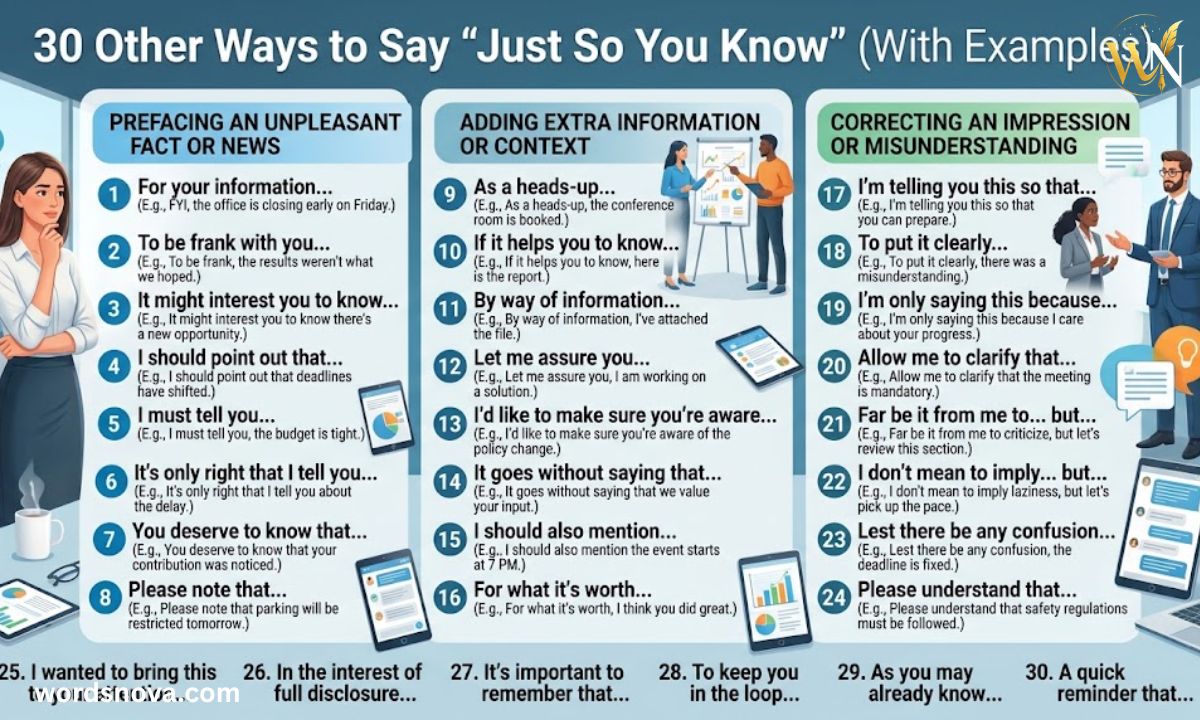
Here are 30 alternative expressions you can use in place of “just so you know,” ranging from formal and professional to casual and friendly.
1. For Your Information
Meaning: A formal way of introducing a fact or update the listener should know, often abbreviated as FYI.
Scenario: Used in emails, memos, or reports when sharing information relevant to the recipient’s work or decisions.
Best Use: Professional and workplace communication, especially written correspondence.
Tone: Formal, neutral, matter-of-fact.
Explanation: “For your information” signals that the information is being shared for awareness rather than for immediate action. It’s commonly used to introduce updates, policy changes, or clarifications in a professional tone without sounding overly casual.
Examples:
- For your information, the budget report is due by Friday afternoon.
- For your information, the office will be closed on Monday for maintenance.
- For your information, I’ve already spoken with the vendor about the delay.
- For your information, your package was delivered to the front desk.
- For your information, the policy was updated last month.
- For your information, the client requested a revised proposal.
- For your information, the system will undergo maintenance tonight.
2. FYI
Meaning: An abbreviation of “for your information,” used to quickly flag information as relevant but not urgent.
Scenario: Ideal for quick emails, chat messages, or notes where brevity matters.
Best Use: Informal workplace communication, group chats, or forwarded emails.
Tone: Casual to semi-formal, brisk and efficient.
Explanation: FYI is one of the most widely used business shorthand terms. It’s typically placed at the start of a message or forwarded email to indicate the content is informational rather than a request for action.
Examples:
- FYI, the meeting has been moved to Thursday.
- FYI, I forwarded the contract to legal for review.
- FYI, your flight has been delayed by two hours.
- FYI, we’re switching software providers next quarter.
- FYI, the printer on the third floor is out of order.
- FYI, the client approved the final design.
- FYI, I’ll be out of office next week.
3. I Wanted to Let You Know

Meaning: A polite, personal way of introducing information, often used to soften news or updates.
Scenario: Suitable for personal conversations, emails, or messages where a warmer tone is appropriate.
Best Use: Sharing updates with friends, family, or colleagues in a considerate way.
Tone: Warm, courteous, personal.
Explanation: This phrase emphasizes intention and care, making it feel more thoughtful than a blunt statement of fact. It works well when delivering both good and slightly difficult news.
Examples:
- I wanted to let you know the trip has been rescheduled to next month.
- I wanted to let you know I really appreciated your help today.
- I wanted to let you know the invoice has been paid in full.
- I wanted to let you know I won’t be able to make it tonight.
- I wanted to let you know your order has shipped.
- I wanted to let you know I’ve updated the shared document.
- I wanted to let you know the results came back positive.
4. Thought You Should Know
Meaning: A casual phrase implying the speaker felt the information was important enough to share.
Scenario: Used when passing along information that might affect the listener, often unsolicited.
Best Use: Informal conversations, texts, or quick updates between coworkers or friends.
Tone: Direct but considerate, slightly informal.
Explanation: This phrase suggests the speaker made a deliberate choice to share the information because it’s relevant or useful, rather than simply mentioning it in passing.
Examples:
- Thought you should know the client called while you were out.
- Though you should know the parking lot is closed this weekend.
- Thought you should know I mentioned your project to the manager.
- Thought you should know the price went up last week.
- Thought you should know she’s planning to resign soon.
- Thought you should know the file was updated this morning.
- Though you should know the weather forecast has changed.
5. I’d Like to Inform You
Meaning: A formal expression used to officially communicate information, often in writing.
Scenario: Common in official letters, business emails, and formal notifications.
Best Use: Formal or official communication, such as HR notices or legal correspondence.
Tone: Formal, respectful, official.
Explanation: This phrase is often used at the start of formal letters or emails to introduce important information in a professional, structured way, commonly seen in customer service or administrative contexts.
Examples:
- I’d like to inform you that your application has been approved.
- I’d like to inform you that the meeting location has changed.
- I’d like to inform you that your subscription will renew next week.
- I’d like to inform you that the shipment has been delayed.
- I’d like to inform you that your account has been updated.
- I’d like to inform you that the refund has been processed.
- I’d like to inform you that the deadline has been extended.
6. Please Be Aware
Meaning: A formal way of alerting someone to important information, often used as a caution.
Scenario: Frequently used in notices, signage, instructions, or professional emails.
Best Use: Formal warnings, policy notices, or instructional communication.
Tone: Formal, cautionary, direct.
Explanation: “Please be aware” is often used to highlight information that requires attention, such as a rule, risk, or important detail the reader must not overlook.
Examples:
- Please be aware that the office closes early on Fridays.
- Please be aware that late submissions will not be accepted.
- Please be aware of the wet floor near the entrance.
- Please be aware that prices are subject to change.
- Please be aware that the deadline is strictly enforced.
- Please be aware that parking is limited during construction.
- Please be aware that the system may be slow during updates.
7. In Case You Didn’t Know
Meaning: A casual phrase used to share information the listener may not already have.
Scenario: Common in conversations, social media, or casual writing to fill in a knowledge gap.
Best Use: Informal explanations, trivia, or clarifying misunderstandings.
Tone: Friendly, casual, informative.
Explanation: This phrase gently assumes the listener may be unaware of the information, making it useful for clarifying facts without sounding condescending.
Examples:
- In case you didn’t know, the store closes at nine tonight.
- In case you didn’t know, the recipe calls for two eggs.
- In case you didn’t know, he used to work at the same company.
- In case you didn’t know, the event was moved indoors.
- In case you didn’t know, the software update fixed that bug.
- In case you didn’t know, the museum is free on Sundays.
- In case you didn’t know, she’s fluent in three languages.
8. Heads Up
Meaning: An informal way of warning or alerting someone to something in advance.
Scenario: Ideal for quick, casual warnings among friends or coworkers.
Best Use: Informal workplace chats, texts, or spoken conversation.
Tone: Casual, friendly, brief.
Explanation: “Heads up” is typically used to prepare someone for something upcoming, such as a change, risk, or piece of news, without going into excessive detail.
Examples:
- Heads up, the Wi-Fi will be down for an hour tonight.
- Heads up, traffic is heavy on the main road today.
- Heads up, the boss wants to see you before lunch.
- Heads up, the price of tickets goes up tomorrow.
- Heads up, it might rain during the game.
- Heads up, the file was renamed in the shared folder.
- Heads up, the client pushed the deadline forward.
9. Just a Heads Up
Meaning: A slightly softer, more conversational version of “heads up,” used to introduce a friendly warning or reminder.
Scenario: Common in casual texts, emails, or spoken conversation between colleagues or friends.
Best Use: Light, informal alerts that don’t require urgency.
Tone: Casual, relaxed, considerate.
Explanation: Adding “just” softens the statement, making it feel less abrupt and more like a friendly courtesy rather than a formal warning.
Examples:
- Just a heads up, I’ll be a few minutes late today.
- Just a heads up, the printer is out of toner.
- Just a heads up, the elevator is under maintenance this week.
- Just a heads up, the meeting notes were updated.
- Just a heads up, we’re low on supplies in the kitchen.
- Just a heads up, the guest speaker changed at the last minute.
- Just a heads up, the app requires an update before it works.
10. Let Me Fill You In
Meaning: A conversational phrase used to catch someone up on information they missed.
Scenario: Useful when someone joins a conversation late or needs background context.
Best Use: Informal storytelling, updates, or catching someone up on events.
Tone: Friendly, informal, engaging.
Explanation: This phrase implies the speaker is about to provide a more detailed explanation, often used when summarizing events the listener wasn’t present for.
Examples:
- Let me fill you in on what happened at the meeting.
- Let me fill you in on the changes to the schedule.
- Let me fill you in before you talk to the client.
- Let me fill you in on why the project got delayed.
- Let me fill you in on the new office policy.
- Let me fill you in on how the negotiation went.
- Let me fill you in on the latest project updates.
11. I Thought I’d Mention

Meaning: A gentle way of bringing up information casually, as if in passing.
Scenario: Suitable for softly introducing a fact, opinion, or observation.
Best Use: Polite, low-pressure conversations or emails.
Tone: Gentle, casual, unassuming.
Explanation: This phrase downplays the importance of the statement, making it feel like a casual aside rather than a formal announcement, which can help avoid sounding demanding.
Examples:
- I thought I’d mention the report has a small typo on page two.
- I thought I’d mention the restaurant gets busy on weekends.
- I thought I’d mention he’s new to the team.
- I thought I’d mention the software has a free trial.
- I thought I’d mention the flight was rebooked for Monday.
- I thought I’d mention your subscription is expiring soon.
- I thought I’d mention the venue changed its opening hours.
12. So You’re Aware
Meaning: A concise, semi-formal way of introducing information the listener should know.
Scenario: Often used in professional or semi-formal settings to flag important details.
Best Use: Business emails, meetings, or professional conversations.
Tone: Neutral, professional, straightforward.
Explanation: This phrase works similarly to “just so you know” but feels slightly more polished, making it a good fit for workplace communication.
Examples:
- So you’re aware, the contract renews automatically each year.
- So you’re aware, the budget was approved this morning.
- So you’re aware, the client requested a call tomorrow.
- So you’re aware, the office will operate remotely next week.
- So you’re aware, the invoice was sent to the wrong address.
- So you’re aware, the project timeline shifted by two weeks.
- So you’re aware, the vendor raised their prices.
13. For Your Awareness
Meaning: A formal phrase used to highlight information relevant to the listener, without requiring action.
Scenario: Common in professional emails or reports when sharing updates.
Best Use: Corporate communication, status updates, or formal notices.
Tone: Formal, professional, informative.
Explanation: Similar to “for your information,” this phrase emphasizes that the update is meant for general knowledge rather than immediate action, and it’s often seen as slightly more polished.
Examples:
- For your awareness, the server will be down for maintenance tonight.
- For your awareness, the policy changes take effect next month.
- For your awareness, the client meeting was moved to Tuesday.
- For your awareness, the report includes updated figures.
- For your awareness, the new hire starts on Monday.
- For your awareness, the deadline was extended by one week.
- For your awareness, the office relocated to a new building.
14. I Wanted to Make You Aware
Meaning: A courteous way of introducing information the speaker feels is important for the listener to know.
Scenario: Suitable for professional or personal conversations involving sensitive or important updates.
Best Use: Emails, formal conversations, or situations requiring tact.
Tone: Considerate, respectful, formal-leaning.
Explanation: This phrase highlights the speaker’s intention to be transparent and proactive, often used when the information could affect the listener directly.
Examples:
- I wanted to make you aware that the invoice was overdue.
- I wanted to make you aware of the schedule conflict.
- I wanted to make you aware that the policy has changed.
- I wanted to make you aware of some concerns raised in the review.
- I wanted to make you aware that the flight was cancelled.
- I wanted to make you aware of the upcoming price increase.
- I wanted to make you aware that the deadline moved up.
15. Here’s Something to Note

Meaning: A neutral phrase used to draw attention to a specific detail or piece of information.
Scenario: Useful in written instructions, guides, or explanations.
Best Use: Educational content, instructions, or clarifications.
Tone: Informative, neutral, instructional.
Explanation: This phrase works well for highlighting a detail that might otherwise be overlooked, especially in written or instructional formats.
Examples:
- Here’s something to note: the form requires a signature on page three.
- Here’s something to note: the discount only applies online.
- Here’s something to note: the product ships in two separate boxes.
- Here’s something to note: the deadline falls on a public holiday.
- Here’s something to note: the app needs Wi-Fi to update.
- Here’s something to note: the warranty excludes water damage.
- Here’s something to note: the recipe requires overnight chilling.
16. Just to Keep You Posted
Meaning: A friendly phrase indicating the speaker is providing an update on an ongoing situation.
Scenario: Common when following up on a previous conversation or project status.
Best Use: Progress updates, status reports, or ongoing communication.
Tone: Friendly, informative, considerate.
Explanation: This phrase signals continuity, implying the speaker is keeping the listener in the loop about something that’s still developing.
Examples:
- Just to keep you posted, the shipment is on schedule.
- Just to keep you posted, we’re still waiting on approval.
- Just to keep you posted, the repair should be done by Friday.
- Just to keep you posted, the numbers look better this week.
- Just to keep you posted, the interview went well.
- Just to keep you posted, the issue has been resolved.
- Just to keep you posted, the team is finalizing the design.
17. To Keep You in the Loop
Meaning: A phrase used to indicate that the speaker is sharing information to keep the listener informed about ongoing matters.
Scenario: Common in team communication, project updates, or group discussions.
Best Use: Workplace updates, group emails, or team check-ins.
Tone: Collaborative, informative, friendly.
Explanation: This phrase emphasizes inclusion, suggesting the speaker values keeping the listener informed as part of an ongoing conversation or project.
Examples:
- To keep you in the loop, the proposal was sent to the client.
- To keep you in the loop, we rescheduled the launch date.
- To keep you in the loop, the team added two new members.
- To keep you in the loop, the budget was revised slightly.
- To keep you in the loop, testing starts next week.
- To keep you in the loop, the vendor confirmed the order.
- To keep you in the loop, feedback is due by Wednesday.
18. A Quick Note
Meaning: A brief, informal way of introducing a short piece of information.
Scenario: Useful for short messages, emails, or reminders.
Best Use: Concise communication where brevity is valued.
Tone: Casual, efficient, friendly.
Explanation: This phrase signals that what follows will be brief and to the point, making it ideal for quick clarifications or reminders.
Examples:
- A quick note: the meeting starts ten minutes earlier than usual.
- A quick note: the file was renamed for clarity.
- A quick note: lunch orders are due by noon.
- A quick note: the password was recently updated.
- A quick note: the event has a new dress code.
- A quick note: parking passes are required this week.
- A quick note: the survey closes tomorrow.
19. I Thought You Might Like to Know
Meaning: A polite, considerate phrase used to share information the speaker believes will interest the listener.
Scenario: Suitable for sharing good news, interesting facts, or relevant updates.
Best Use: Friendly conversations, emails, or casual updates.
Tone: Warm, thoughtful, friendly.
Explanation: This phrase frames the information as something beneficial or interesting to the listener, rather than simply a fact to report.
Examples:
- I thought you might like to know the article was published today.
- I thought you might like to know your favorite show got renewed.
- I thought you might like to know the event sold out.
- I thought you might like to know the store restocked your size.
- I thought you might like to know she mentioned you in her speech.
- I thought you might like to know the flight prices dropped.
- I thought you might like to know the book is finally available.
20. Bringing to Your Attention

Meaning: A formal phrase used to highlight important information that requires the listener’s awareness.
Scenario: Common in official reports, formal emails, or business correspondence.
Best Use: Formal notices, official communication, or important updates.
Tone: Formal, serious, professional.
Explanation: This phrase is often used when the information carries some weight or importance, signaling that the listener should take note.
Examples:
- I’m bringing to your attention a discrepancy in the invoice.
- I’m bringing to your attention some concerns from the client.
- I’m bringing to your attention the updated safety guidelines.
- I’m bringing to your attention a delay in the shipment.
- I’m bringing to your attention an error found in the report.
- I’m bringing to your attention the new compliance requirements.
- I’m bringing to your attention a change in leadership.
21. For Clarity
Meaning: A phrase used to introduce information meant to prevent confusion or misunderstanding.
Scenario: Useful when clarifying instructions, terms, or details.
Best Use: Instructional writing, explanations, or clarifying communication.
Tone: Neutral, precise, helpful.
Explanation: This phrase signals that the following information is intended to make something clearer or more precise, often used to avoid ambiguity.
Examples:
- For clarity, the deadline refers to 5 PM local time.
- For clarity, the discount applies only to new customers.
- For clarity, the meeting is virtual, not in person.
- For clarity, payment is due before the service begins.
- For clarity, the warranty covers parts but not labor.
- For clarity, the form must be submitted in PDF format.
- For clarity, the event starts at seven, not eight.
22. I’d Like to Share
Meaning: A polite way of introducing information, often used when offering personal insight or updates.
Scenario: Suitable for presentations, personal updates, or thoughtful communication.
Best Use: Formal or semi-formal settings where a respectful tone matters.
Tone: Respectful, warm, professional.
Explanation: This phrase emphasizes openness and willingness to communicate, often used when the speaker wants to contribute something meaningful to the conversation.
Examples:
- I’d like to share some feedback from last week’s survey.
- I’d like to share an update on the project’s progress.
- I’d like to share a few thoughts before we begin.
- I’d like to share some good news about the funding.
- I’d like to share the results from our latest test.
- I’d like to share a concern I noticed during the review.
- I’d like to share how the training session went.
23. You Might Find It Useful
Meaning: A helpful phrase used to introduce information that could benefit the listener.
Scenario: Common when offering tips, resources, or practical advice.
Best Use: Advice-giving, recommendations, or helpful suggestions.
Tone: Helpful, friendly, supportive.
Explanation: This phrase frames the information as practical or beneficial, making it a good choice when offering suggestions rather than stating plain facts.
Examples:
- You might find it useful to back up your files first.
- You might find it useful to check the reviews before buying.
- You might find it useful to arrive fifteen minutes early.
- You might find it useful to read the manual before setup.
- You might find it useful to save a copy of the receipt.
- You might find it useful to compare both options side by side.
- You might find it useful to book in advance this time.
24. For Your Consideration
Meaning: A formal phrase used to present information or a suggestion for the listener to think about.
Scenario: Common in proposals, formal requests, or decision-making contexts.
Best Use: Business proposals, formal recommendations, or official documents.
Tone: Formal, respectful, professional.
Explanation: This phrase is often used when presenting an option, suggestion, or piece of information that the listener is expected to evaluate or reflect on.
Examples:
- For your consideration, I’ve attached two pricing options.
- For your consideration, here are the candidate’s qualifications.
- For your consideration, the proposal includes a revised timeline.
- For your consideration, we’ve outlined three possible solutions.
- For your consideration, the report highlights key risks.
- For your consideration, please review the attached contract.
- For your consideration, the committee suggested an alternative date.
25. I Thought It Worth Mentioning

Meaning: A phrase used to introduce information the speaker felt was important or relevant enough to bring up.
Scenario: Suitable for adding relevant context or clarifying a point.
Best Use: Conversations, emails, or discussions requiring added context.
Tone: Thoughtful, considerate, informative.
Explanation: This phrase signals that the speaker made a deliberate choice to share the information because of its relevance or usefulness to the situation.
Examples:
- I thought it worth mentioning that the vendor changed their terms.
- I thought it worth mentioning that she has experience in this area.
- I thought it worth mentioning that the price includes tax.
- I thought it worth mentioning that the route has road closures.
- I thought it worth mentioning that the results were inconclusive.
- I thought it worth mentioning that the contract auto-renews.
- I thought it worth mentioning that the app has a dark mode.
26. Just a Quick Reminder
Meaning: A phrase used to briefly bring something back to the listener’s attention.
Scenario: Common when following up on deadlines, appointments, or tasks.
Best Use: Reminders about dates, tasks, or previously discussed information.
Tone: Friendly, casual, helpful.
Explanation: This phrase is specifically used for reminding rather than introducing new information, making it ideal for follow-ups.
Examples:
- Just a quick reminder that the invoice is due tomorrow.
- Just a quick reminder that the store closes early today.
- Just a quick reminder about our call at three o’clock.
- Just a quick reminder to submit your timesheet by Friday.
- Just a quick reminder that the trial ends this weekend.
- Just a quick reminder to bring your ID to the event.
- Just a quick reminder that parking is limited on-site.
27. I Want to Highlight
Meaning: A phrase used to draw special attention to a specific point or piece of information.
Scenario: Useful in presentations, reports, or discussions emphasizing key details.
Best Use: Formal presentations, summaries, or important updates.
Tone: Confident, clear, professional.
Explanation: This phrase signals that the following information is especially important or noteworthy, often used to emphasize a key takeaway.
Examples:
- I want to highlight the significant growth in this quarter’s sales.
- I want to highlight a risk we identified during testing.
- I want to highlight the team’s effort on this project.
- I want to highlight a change in the return policy.
- I want to highlight an opportunity we haven’t explored yet.
- I want to highlight the positive feedback from customers.
- I want to highlight a gap in our current process.
28. As a Friendly Reminder
Meaning: A polite phrase used to remind someone of something without sounding demanding.
Scenario: Common in emails, notices, or messages about deadlines or expectations.
Best Use: Professional or semi-formal reminders.
Tone: Polite, warm, professional.
Explanation: The word “friendly” softens the reminder, making it feel considerate rather than pushy, which is especially useful in professional communication.
Examples:
- As a friendly reminder, the report is due by end of day.
- As a friendly reminder, please confirm your attendance by Friday.
- As a friendly reminder, the office will be closed for the holiday.
- As a friendly reminder, payment is due within thirty days.
- As a friendly reminder, the survey closes at midnight.
- As a friendly reminder, badges are required for entry.
- As a friendly reminder, the deadline was moved up by a day.
29. Worth Noting
Meaning: A concise phrase used to point out a relevant or important detail.
Scenario: Useful in explanations, summaries, or clarifying details.
Best Use: Informative writing, instructions, or professional summaries.
Tone: Neutral, informative, concise.
Explanation: This phrase is often used mid-sentence or as an introductory clause to flag a detail that adds useful context without requiring a full explanation.
Examples:
- It’s worth noting that the offer expires at the end of the month.
- It’s worth noting that the results may vary by region.
- It’s worth noting that the update requires a restart.
- It’s worth noting that the fee is non-refundable.
- It’s worth noting that the venue has limited seating.
- It’s worth noting that the software supports multiple languages.
- It’s worth noting that the policy applies retroactively.
30. I Wanted to Bring Up

Meaning: A conversational phrase used to introduce a topic or point the speaker wants to discuss.
Scenario: Suitable for meetings, discussions, or conversations involving a specific topic.
Best Use: Casual to semi-formal conversations, team discussions, or meetings.
Tone: Direct, conversational, respectful.
Explanation: This phrase signals that the speaker has something specific in mind to discuss, often used to steer a conversation toward a particular topic.
Examples:
- I wanted to bring up the delay in last week’s shipment.
- I wanted to bring up a few ideas for the next campaign.
- I wanted to bring up the feedback from the client call.
- I wanted to bring up scheduling conflicts for next month.
- I wanted to bring up the budget overrun from last quarter.
- I wanted to bring up a concern about the new process.
- I wanted to bring up the possibility of extending the deadline.
Frequently Asked Questions
What are other ways to say just so you know?
Other ways to say just so you know include “for your information,” “please note,” “just letting you know,” and “I wanted to inform you.”
How can I say just so you know professionally?
Other ways to say just so you know professionally include “for your information,” “please be aware,” “I wanted to let you know,” and “please note.”
What is a polite way to say just so you know?
Other ways to say just so you know politely include “just wanted to let you know,” “for your awareness,” and “I thought you should know.”
What is a synonym for just so you know?
Other ways to say just so you know include “just letting you know,” “for your information,” “please note,” “for your awareness,” and “I wanted to inform you.”
How do you say just so you know in an email?
Other ways to say just so you know in an email include “I wanted to let you know,” “please note,” and “for your information.”
What is a formal way to say just so you know?
Other ways to say just so you know formally include “for your information,” “please be advised,” “please note,” and “I would like to inform you.”
Can I use just so you know at work?
Yes, but other ways to say just so you know can sound more professional at work, especially in formal emails, reports, and business messages.
Is just so you know rude?
Just so you know is not always rude, but other ways to say just so you know may sound softer, friendlier, and more professional.
What does just so you know mean?
The phrase means you are sharing information for someone’s awareness. Other ways to say just so you know can communicate the same message politely.
What can I say instead of just so you know?
Other ways to say just so you know include “just wanted to mention,” “for your awareness,” “please note,” “I wanted to let you know,” and “for your information.”
Conclusion
Learning other ways to say just so you know can improve your daily communication. Just so you know the meaning is simple, but different situations may need different words. You can also use a just letting you know synonym to sound polite and natural. These options make your messages clearer, friendlier, and more professional.
Other ways to say just so you know can be useful in emails, chats, and conversations. You can choose a phrase based on your tone and the person you are speaking to. Knowing other ways to say just so you know gives you more choices when sharing information. With these simple alternatives, your writing can sound fresh, clear, and natural.