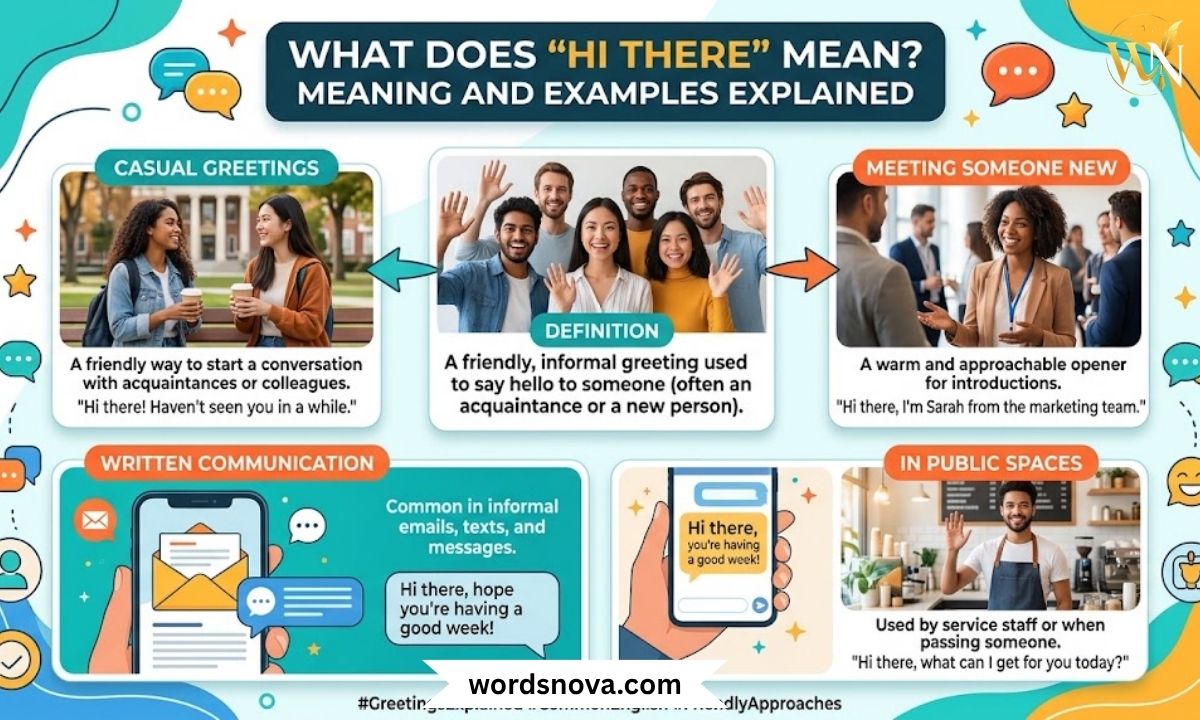
Have you ever received a simple “hi there” and wondered what it really means? If you are confused about the what does hi there mean, understanding the hi there meaning can help. You may also wonder about the hey there meaning and what hey there means in casual conversations.
We will explain what does hi there mean in simple English. You will learn how “hi there” and “hi there” are used in chats, texts, and everyday conversations, with clear examples to make the meaning easy to understand.
What Does “Hi There” Mean?

“Hi there” is a friendly, informal greeting. It means the same thing as “hello,” but it sounds a little warmer and more personal.
Simple Definition of “Hi There”
“Hi there” is a casual way to say hello to someone. You can use it face to face, in writing, or online.
Example: “Hi there! Can I help you find anything?”
Why People Add “There” After “Hi”
Adding “there” softens the greeting. A bare “Hi” can sound quick or flat, especially in writing. “Hi there” sounds like you are turning your attention toward the other person.
The Core Message Behind the Greeting
The message is simple: “I notice you, and I’m being friendly.” It works as a polite opening that invites a response without asking for anything.
Quick Meaning Summary
| Element | Meaning |
| Hi | An informal greeting, short for “hello” in feel |
| There | Directs the greeting toward the listener; adds warmth |
| Hi there | A friendly, approachable greeting |
The Origin of “Hi There”
Where the Word “Hi” Comes From
“Hi” appears in English as far back as the 1400s, when it was used to call attention to someone, much like “hey.” Its exact roots are uncertain, but it is closely related to “hey.” Using “hi” as an everyday greeting became common much later, especially in American English.
How “Hi There” Became a Common Greeting
Speakers have long added “there” to greetings and calls, as in “Hello there” and “Hey there.” “Hi there” followed the same pattern. It spread as casual speech became more acceptable in everyday communication.
Evolution of the Phrase in Modern English
Today “hi there” appears in customer service scripts, email openers, chatbots, and social media replies. Its friendly but polite tone suits digital communication, where tone is easy to misjudge.
Why the Expression Has Remained Popular
- It is short and easy to say or type.
- It sounds warm without being overly personal.
- It works with both known and unknown people.
- It fits spoken and written English equally well.
Understanding the Linguistic Meaning of “There”
Is “There” Referring to a Place?
Not really. In its ordinary use, “there” points to a location (“Put it over there”). In “hi there,” it does not name a real place. It simply directs the greeting toward the person you are addressing.
The Function of “There” in Greetings
Grammatically, “there” here works as an adverb used in an address or greeting. It adds no new factual information. Its job is social: it makes the greeting sound more direct and attentive.
How It Changes the Tone of “Hi”
| Greeting | Feel |
| Hi | Quick, neutral |
| Hi there | Warm, welcoming |
| Hi, [Name] | Personal, direct |
Why Native Speakers Use It Naturally
Native speakers pick it up as a set phrase (a fixed expression) rather than analyzing its parts. It feels natural because it is so common, and it fills the gap when you want to be friendly but do not know the person’s name.
What Tone Does “Hi There” Convey?
Friendly and Welcoming Tone
The phrase sounds open and approachable. It signals that you are happy to interact.
Casual but Respectful Communication
It is relaxed without being rude. This is why businesses often use it in customer messages.
Warmth Without Excessive Familiarity
“Hi there” is friendlier than “Hello” but less intimate than “Hey you” or a nickname. That balance makes it safe with strangers.
Why It Feels Less Abrupt Than “Hi”
In text, “Hi” alone can read as curt. The extra word adds a small pause and a friendlier rhythm.
Is “Hi There” Formal or Informal?

It is best described as informal to semi-formal. It is more relaxed than “Dear Sir or Madam” but usually acceptable in professional settings that are not strict.
Situations Where It Sounds Professional
- Customer support chats
- Emails to clients you have a friendly relationship with
- Introductions in modern workplaces
Situations Where It Sounds Casual
- Texting friends
- Replying to comments on social media
- Greeting a neighbor
Comparing Formality Levels of Common Greetings
| Greeting | Formality | Example |
| Dear Mr. Khan, | Very formal | Formal letters |
| Good morning | Formal to neutral | Meetings, emails |
| Hello | Neutral | Almost anywhere |
| Hi there | Informal to semi-formal | Customer service, friendly emails |
| Hi | Informal | Chats with colleagues |
| Hey | Very informal | Friends and family |
Key Takeaway
Use “hi there” when you want to sound friendly and polite, but not stiff.
When Should You Use “Hi There”?
Starting an Email
It works well when you do not know the recipient’s name or when the tone is friendly.
Hi there,
Thank you for reaching out about your order.
Customer Service Conversations
Support agents use it to sound approachable: “Hi there! How can I help you today?”
Online Messaging
In chat apps and forums, it is a quick, friendly opener.
Social Media Interactions
Brands and creators often greet followers this way: “Hi there, thanks for the comment!”
Meeting Someone for the First Time
It is a safe, friendly greeting: “Hi there, I’m Sara. Nice to meet you.”
When Should You Avoid Using “Hi There”?

Highly Formal Business Communication
In letters to senior executives or in traditional industries, choose “Dear [Title and Name].”
Academic or Legal Correspondence
Professors, courts, and law firms usually expect formal language. Use “Dear Professor Ahmed” or “To whom it may concern.”
Government and Official Documents
Applications and official notices call for a formal salutation.
Situations Requiring Greater Professional Distance
When delivering serious news, such as a complaint response, a rejection, or a legal notice, a more neutral opener is better.
“Hi There” in Different Types of Relationships
| Relationship | Is “Hi there” suitable? | Notes |
| Friends | Yes | Sounds warm, though “hey” is more common |
| Coworkers | Yes | Fine in most modern workplaces |
| Customers and businesses | Yes | Very common in support and marketing |
| Strangers | Yes | Friendly and low-risk |
| Romantic interests | Yes | Can sound sweet or flirty, depending on tone and context |
Between Friends
It can sound playful, especially when said with enthusiasm.
Between Coworkers
It is polite and relaxed, which suits everyday workplace messages.
Between Customers and Businesses
It creates a welcoming first impression and avoids sounding robotic.
Between Strangers
It is a gentle way to open a conversation without being pushy.
Between Romantic Interests
Tone decides the meaning. A bright “Hi there!” reads as friendly; a slow, quiet “Hi there…” can read as flirtatious.
Frequently Asked Questions
What does hi there mean?
What does hi there mean? It is a friendly greeting used to say hello. It sounds warm, casual, and polite in everyday conversations with others.
What is the hi there meaning?
The hi there meaning is simply a friendly hello. People use it when starting conversations, sending messages, or greeting someone in a relaxed way.
Is “hi there” friendly?
Yes, “hi there” sounds friendly and welcoming. If you ask what does hi there mean, it usually shows warmth without sounding too formal.
What does hi there mean in texting?
In texting, what does hi there mean usually depends on context. It commonly means hello and can start a casual, friendly conversation.
Can I use hi there with friends?
Yes, you can use hi there with friends. What does hi there mean here? It simply works as a relaxed and cheerful greeting.
What does hey there mean?
The hey there meaning is similar to hi there. It is a casual greeting that sounds friendly, natural, and slightly playful in conversations.
What does hey there mean?
Although “hey there means” is grammatically incomplete, people often use it when asking about the phrase. It generally refers to a friendly greeting.
Is he there formal or casual?
Hi there it is mostly casual, but it can still sound polite. Understanding what does hi there mean helps you choose it for relaxed conversations.
What should I reply to him there?
You can reply with “Hi,” “Hey,” or “Hi there.” Knowing what does hi there mean makes it easy to respond naturally and warmly.
Why do people say hi there?
People say hi there to greet someone in a friendly way. What does hi there mean? It usually creates a warm and comfortable opening.
Conclusion
In simple words, what does hi there mean? It is a friendly and casual way to greet someone. The hi there meaning is close to saying hello in a warm way. People often use “hi there” in chats, texts, social media, and everyday conversations. What does hi there mean can depend on the situation, but it usually shows friendliness. The phrase is easy, polite, and natural to use.
Now you know what does hi there mean and when to use it. The phrase hi there can sound more cheerful than a simple hello. The hey there meaning is also friendly and casual. In most cases, hey there means almost the same thing as hi there. Understanding what does hi there mean can help you reply with confidence. So, when someone says hi there, you can simply respond with “Hi!” or “Hey there!”.