Have you ever stopped while typing and wondered, “Is it messege or message?” You may have seen messege online and felt unsure, especially when asking how do you spell message correctly. This quick guide to messege vs message will clear up the confusion and make message vs messege easy to understand.
You will learn the correct spelling, meaning, and simple examples of messege vs message. We will also explain why messege is a common spelling mistake and show you easy ways to remember the correct word. By the end, choosing the right spelling will feel simple and natural.
Quick Answer
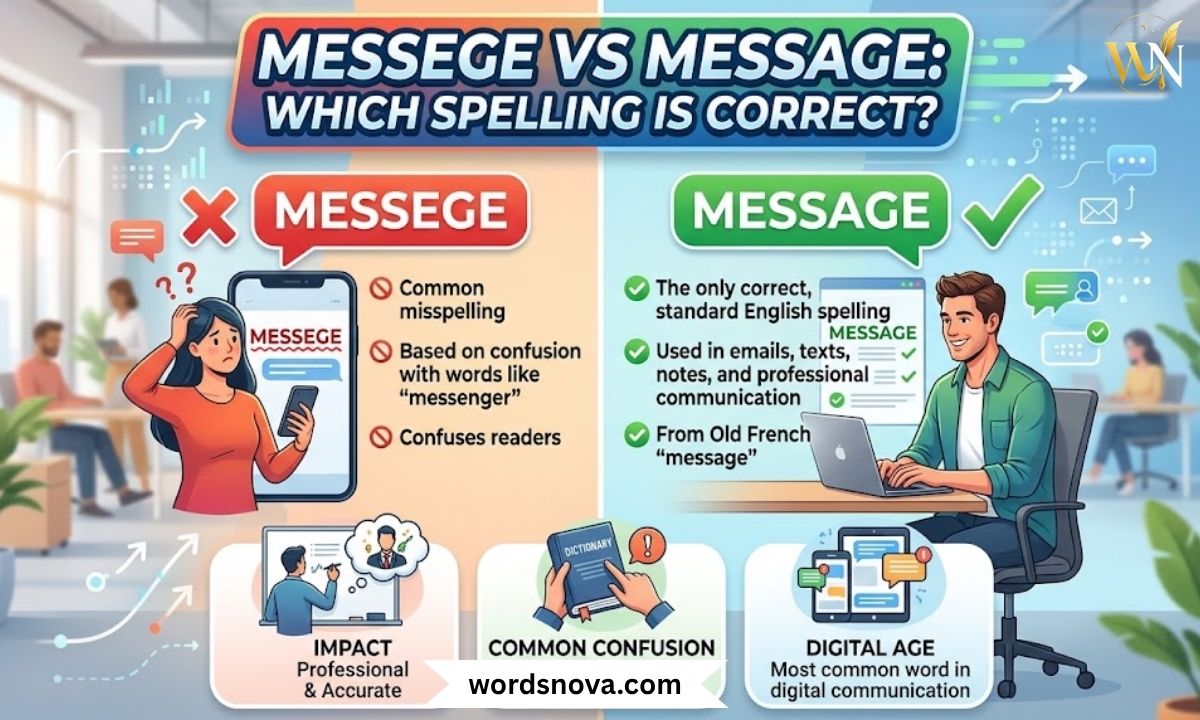
“Message” is the correct spelling. “Messege” is incorrect and has no meaning in English.
The mistake happens because the “a” in a message is unstressed when spoken, so it can sound like an “e.” But in writing, only one version is recognized by dictionaries, spell-checkers, and style guides: message, spelled with an a , M-E-S-S-A-G-E.
Meaning of “Message”
A message is a piece of information, an idea, or a communication that one person sends to another, whether spoken, written, typed, or signaled in some other way.
Messages can take many forms:
- A text message sent from a phone
- A verbal message passed on by a friend or colleague
- A written note left on someone’s desk
- An email, voicemail, or direct message on social media
- A symbolic or non-verbal message, such as a warning sign or a gesture
In short, whenever information travels from a sender to a receiver, that piece of communication is called a message.
Example sentences:
- She left a message on my voicemail this morning.
- Please make sure the message reaches him before the meeting.
- The movie’s message about kindness stayed with me for days.
What Are You Looking For?
If you landed here typing “messege,” there’s a good chance you’re trying to do one of the following:
- Confirm the correct spelling of the word before sending an email, text, or document
- Understand what the word “message” actually means
- Check the difference between “message” and similar-looking words like “massage” or “messenger”
- Learn a simple trick to stop misspelling it in the future
Whatever brought you here, this guide covers all of it.
Why People Write “Messege” Instead of “Message”
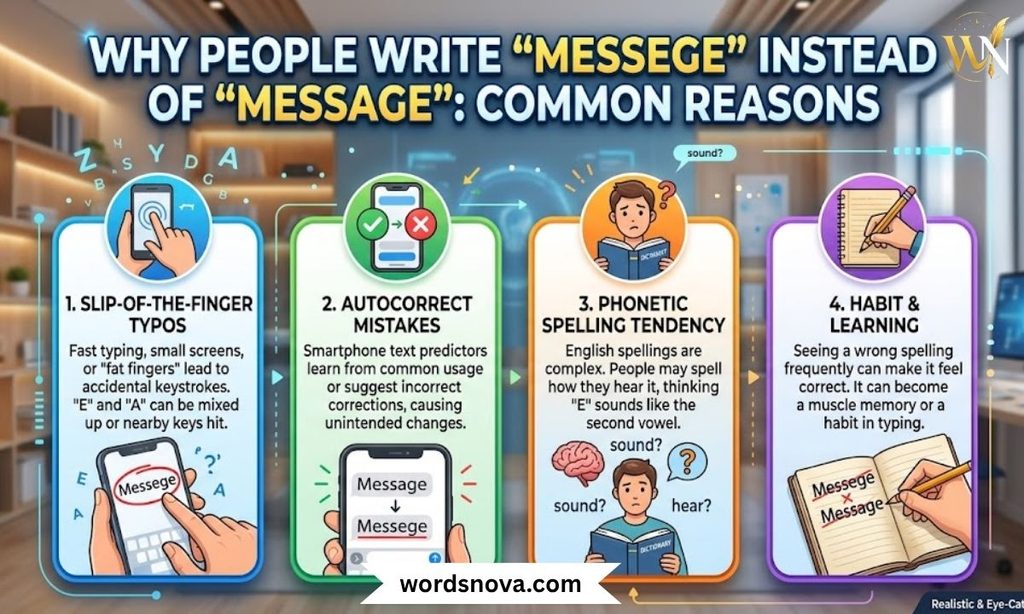
This spelling error is extremely common, and it isn’t a sign of poor language skills , it’s a predictable result of how English pronunciation works. Here’s why it happens:
- Unstressed vowel sound: In natural speech, the “a” in “message” is barely pronounced. It comes out as a soft, neutral sound (called a schwa), which can easily be mistaken for an “e.”
- Visual similarity: “A” and “e” are both vowels that appear constantly in English spelling, making it easy to swap one for the other, especially when typing quickly.
- Autocorrect and muscle memory: Once someone types “messege” a few times without correction, the wrong spelling can start to feel familiar.
- Influence from similar words: Words like “messenger” (which correctly uses an “e”) may cause confusion, leading writers to assume “message” follows the same pattern.
- Non-native English patterns: In some languages, vowel sounds map more directly to spelling, which can make English’s less predictable spelling rules trickier to internalize.
None of these reasons make “messege” acceptable in formal or professional writing , but understanding why the mistake happens makes it much easier to avoid.
Messege vs Message Comparison Table
| Spelling | Correct? | Meaning | Notes |
| Message | Yes | Correct English word for a piece of communication | Standard spelling in both American and British English |
| Messege | No | No meaning; not a recognized word | Common misspelling caused by vowel confusion |
Correct Usage of “Message” in Sentences
Seeing the word used correctly in different contexts makes it easier to remember. Here are several examples across everyday, professional, and digital settings:
- I sent you a message on WhatsApp , did you see it?
- The company released a message to all employees about the new policy.
- Her speech carried a powerful message about resilience.
- Can you pass this message along to the manager?
- He listened to the voice message twice before replying.
- The app lets you message your friends for free.
Notice that “message” can also function as a verb, as in “message your friends,” meaning to send someone a message.
Common Mistakes Related to “Message”
Beyond “messege,” writers sometimes stumble on related forms of the word. Here are frequent errors worth watching for:
- Messeging instead of messaging (the correct present-participle form)
- Messeges instead of messages (plural form)
- Mesage dropping a letter entirely
- Massage used by mistake when “message” was intended (these are different words with different meanings)
- Messanger instead of messenger (a related but separate word for someone who delivers a message)
A quick proofread or spell-check catches most of these before they make it into a final document.
Spelling Rule Behind “Message”
The word “message” follows a spelling pattern common to many English words that end in the suffix -age, which is used to form nouns, often related to a state, action, or collection of something.
Words following this same “-age” pattern include:
- Postage
- Baggage
- Luggage
- Heritage
- Package
- Village
In every one of these words, the ending is spelled with an a, never an e. If you can remember one word in this family correctly, you can use it to double-check the others, including “message.”
American vs British English Differences
Unlike many words that shift between American and British English (such as “color” vs “colour” or “organize” vs “organise”), “message” is spelled identically in both varieties of English.
| Feature | American English | British English |
| Spelling | Message | Message |
| Pronunciation | /ˈmɛsɪdʒ/ | /ˈmɛsɪdʒ/ |
| Common usage | Text message, direct message | Text message, direct message |
The only variation you’ll typically encounter is in pronunciation emphasis, which can differ slightly by region and accent, but the spelling itself never changes.
Related Words and Variations

Understanding words connected to “message” can help reinforce the correct spelling pattern:
- Messages plural form
- Messaging the ongoing act of sending messages, or a gerund/verb form
- Messaged past tense of the verb “to message”
- Messenger a person or app that delivers messages
- Messianic unrelated in meaning, but sometimes confused visually due to similar letters
All correctly spelled forms retain the a from the root word “message.”
Easy Memory Tricks
If the spelling still trips you up, try one of these simple memory aids:
- Think “age”: Message contains the word “age” at the end , just like postage, baggage, and luggage. If you remember the “-age” family, you’ll remember the “a.”
- Say it slowly: Pronouncing the word deliberately as “mess-AGE” (rather than blending the syllables) can help reinforce the correct vowel.
- Visual anchor: Picture a “message in a bottle” , the phrase itself reinforces the spelling through repetition and familiarity.
- Spell-check habit: If you’re prone to this typo, get in the habit of double-checking any word ending in “-ege” or “-age” before sending important messages.
When “Messege” Might Appear
Even though “messege” isn’t a real word, you may occasionally come across it in specific situations:
- Typos in casual texting or social media, where speed matters more than accuracy
- Non-native English writing, where vowel sounds don’t map the same way as in the writer’s first language
- Old or low-quality software, where placeholder text or poorly translated interfaces contain spelling errors
- Scam or phishing messages, which frequently contain spelling mistakes, including this one, as a red flag of unprofessional or fraudulent content
In every one of these cases, “messege” remains an error rather than an alternate spelling.
Why Correct Spelling Matters
Getting “message” right isn’t just about avoiding embarrassment , it has real, practical value:
- Professional credibility: Spelling errors in emails, resumes, or business communication can create an impression of carelessness.
- Clarity: Correct spelling ensures your reader isn’t distracted or confused by the text.
- Search and digital accuracy: Correctly spelled content is more discoverable and trustworthy online, whether in search engines or messaging platforms.
- Trust and safety: As noted above, misspellings like “messege” are sometimes used in scam communications, so correct spelling also signals legitimacy.
Frequently Asked Questions
What is the correct spelling in messege vs message?
The correct spelling in messege vs message is “message.” Messege is a common spelling mistake that should be avoided in formal writing.
Is messege a correct English word?
In messege vs message, “messege” is not the standard English spelling. The correct word is “message,” which means written or spoken information.
What does message mean?
In messege vs message, “message” means information sent to someone. It can be written, spoken, or shared digitally through different communication methods.
Why do people write messege instead of message?
The messege vs message confusion happens because the word’s pronunciation can make the spelling difficult. Many people mistakenly replace the “a” with “e” when writing.
How do you spell message correctly?
When checking messege vs message, remember that “message” is correct. It contains “age” at the end, while “messege” uses the wrong vowel.
Is messege or message correct for texting?
For texting, messege vs message has one clear answer: “message” is correct. Use “message” when referring to texts or information sent to someone.
What is the difference between messege and message?
The messege vs message difference is simple. “Message” is the correct spelling and a standard English word, while “messege” is an incorrect spelling.
Can I use messege in formal writing?
In messege vs message, you should never use “messege” in formal writing. Always choose “message” for emails, documents, assignments, and professional communication.
How can I remember the correct spelling?
To remember messege vs message, focus on the “a” in “message.” Writing the word correctly several times can make the spelling easier to remember.
Which spelling should I use: messege or message?
For messege vs message, always use “message.” It is the accepted spelling in English, while “messege” is simply a common spelling error.
Conclusion
Understanding messege vs message can help you avoid a common spelling mistake. The correct spelling is message, not messege. If you are asking messege or a message, always choose a message in standard English. The word messege is simply a misspelling. Knowing the difference in message vs messege can make your writing clearer. It also helps you feel more confident when writing emails, texts, and posts. Remember that messege vs message is not really a choice between two correct words. Only message is the correct spelling.
If you still wonder how do you spell message, the answer is M-E-S-S-A-G-E. Keep this spelling in mind whenever you write. Messege vs message becomes easy once you remember the correct form. Use message every time, and avoid messege in formal and casual writing. This simple tip can help you write with confidence and fewer spelling errors.