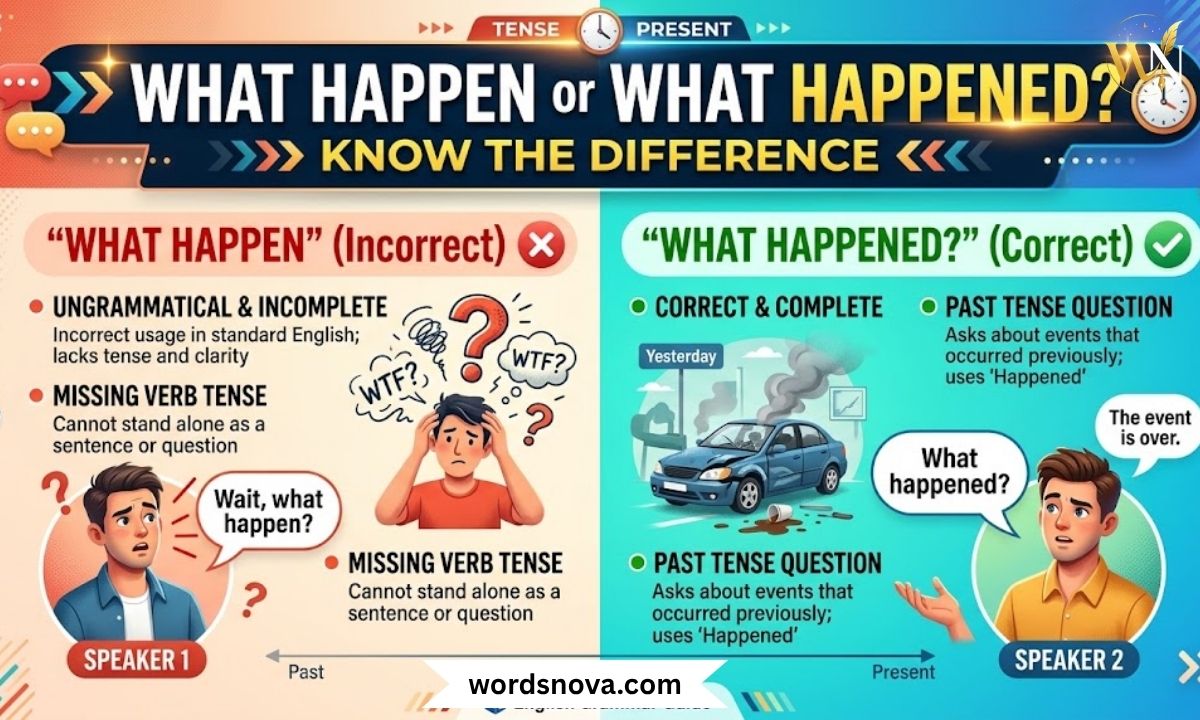
Have you ever stopped while writing a sentence and wondered, “Is it what happen or what happened?” This small grammar confusion can make your English sound unclear, especially when you are unsure about what happen, what happened or what happen, or why what happened is correct.
We will explain what happen or what happened in simple English. You will learn when to use what happens, understand the difference between these forms, and see easy examples that make the correct choice clear.
Understanding Why “What Happen” Feels Right
Many people say “what happen” because it mirrors how we casually speak in everyday conversation. Spoken English often drops word endings, especially the “-ed” sound, which can be hard to hear clearly in fast speech.
For example, in rapid speech, “What happened?” can sound almost like “What happen?” because the “-ed” at the end blends into the next sound. This is purely a pronunciation habit, not a grammar rule , and it’s the main reason the incorrect version spreads so widely, especially in informal writing, texting, and social media.
How Verb Tenses Communicate Time
Verb tense tells your listener or reader when something happened. English verbs change form to show whether an action is happening now, happened in the past, or will happen in the future.
| Tense | Form | Example |
| Present | Base verb | It happens every year. |
| Past | Verb + “-ed” | It happened last year. |
| Future | will + base verb | It will happen next year. |
Since “what happen” and “what happened” are almost always used to ask about something that has already occurred, the past tense form is required. That’s the core of the entire issue.
Understanding the Verb “Happen”
“Happen” is an intransitive verb, meaning it doesn’t take a direct object. It simply describes an event occurring.
- Base form: happen
- Past tense: happened
- Past participle: happened
- Present participle: happening
- Third-person singular: happens
Because “happen” is a regular verb, its past tense is formed by simply adding “-ed.” There’s no irregular spelling to memorize, which makes the rule even easier to apply consistently.
Why “What Happen” Is Grammatically Incorrect
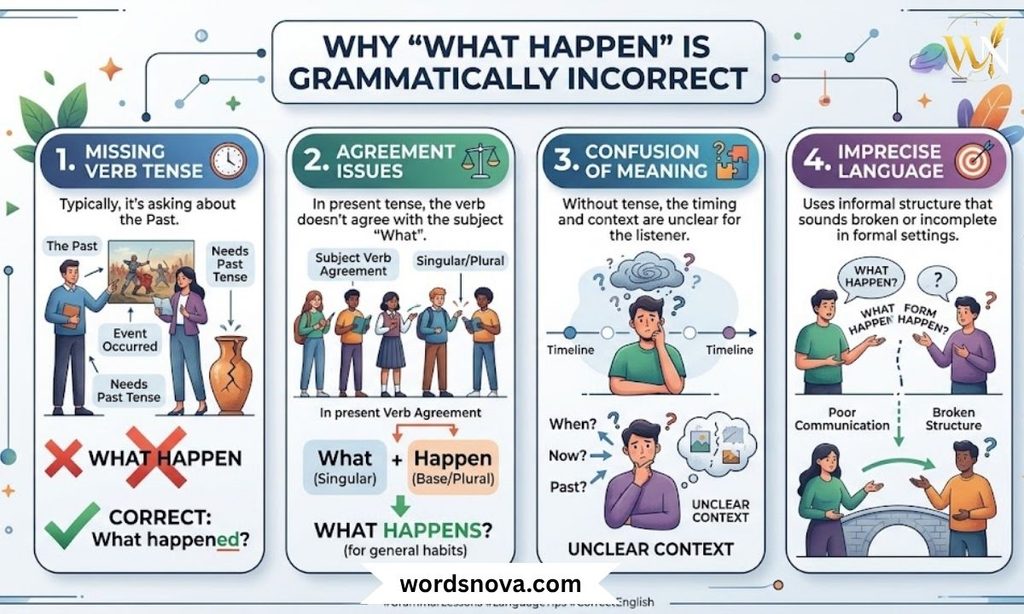
“What happen” is incorrect because it uses the base form of the verb to ask about a past event. In English, when you’re referring to something that already occurred, the verb must shift into its past tense form.
Saying “What happen?” is similar to saying “What occur?” instead of “What occurred?” , the sentence structure signals a need for the past tense, but the verb stays in its uninflected, present form. This mismatch between meaning and grammar is what makes the phrase incorrect, even though it’s widely used in casual speech and text messages.
Why “What Happened” Works
“What happened?” is correct because it properly pairs a past-tense verb with a question about a completed event. The sentence structure is:
What + happened (past tense verb)
This follows the standard pattern for forming simple past-tense questions about an unknown event, similar to “What broke?” or “What changed?” The verb agrees with the time frame being discussed, which is what makes the sentence grammatically sound.
Subject Questions vs Object Questions
One reason “what happened” doesn’t need an auxiliary verb like “did” is that it’s a subject question , “what” is asking about the subject of the sentence, not the object.
| Question Type | Structure | Example |
| Subject question | What + verb (past tense) | What happened? |
| Object question | What + did + subject + base verb | What did you do? |
In subject questions, “what” itself performs the action, so the verb stays in its simple past form without “did.” This is why “What happened?” is correct, while “What did happen?” , though sometimes used for emphasis , is far less natural in everyday use.
When to Use “What Happened”
Use “what happened” whenever you’re asking about an event that has already taken place. Common situations include:
- Asking someone to explain a past event: “What happened at the meeting?”
- Expressing concern or confusion: “What happened to your arm?”
- Following up on a story: “So, what happened next?”
- Asking about an unexplained change: “What happened to the files?”
In every one of these cases, the action is already complete by the time the question is asked, which confirms the need for the past tense.
Why “What Happen” Should Be Avoided
“What happen” should be avoided in any formal or written context because it signals a grammar error to careful readers, teachers, and employers. Using it can:
- Undermine credibility in professional emails or documents
- Confuse readers about the intended time frame
- Lower the quality of academic or business writing
- Create a poor impression in exams or standardized tests
While it may pass unnoticed in casual texting, relying on it can reinforce the habit and make it harder to switch to correct grammar when it matters most.
Spoken English vs Written English
Spoken English is often more relaxed than written English. Native speakers frequently blend or shorten sounds, which is why “what happened” can sound like “what happen” in fast, casual conversation.
However, this pronunciation shortcut doesn’t change the actual grammar rule. Written English demands the full, correct form because there’s no tone of voice or context to soften a mistake , the words on the page must stand on their own. A good habit is to always write “what happened” correctly, even if your spoken pronunciation naturally softens the ending.
Common Mistakes Related to “What Happened”
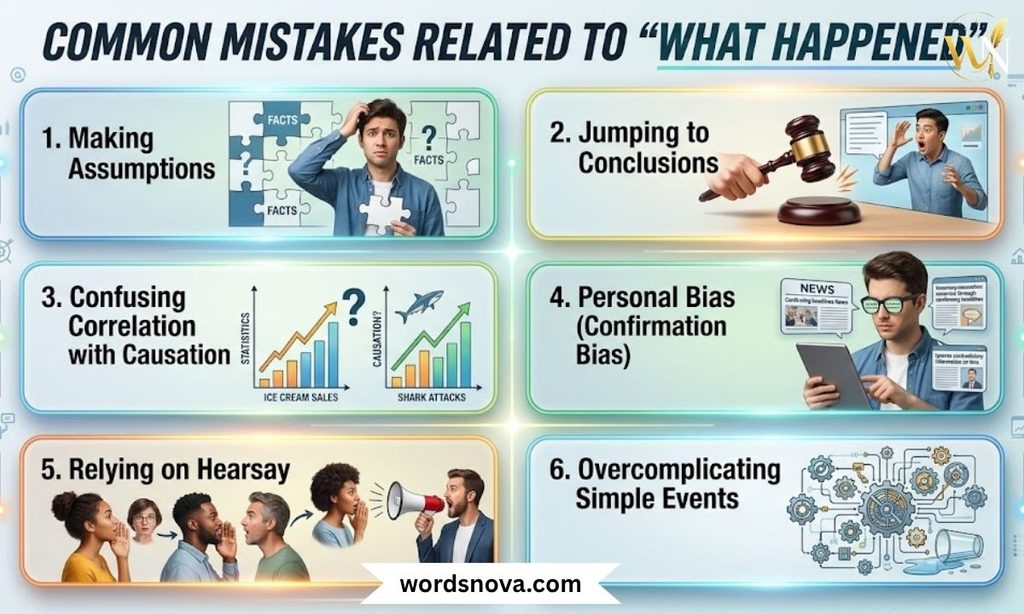
Beyond dropping the “-ed,” learners often make a few related errors:
- “What is happened?” Incorrect; unnecessarily adds “is” to a simple past question.
- “What did happened?” Incorrect; doubles the past tense by using both “did” and “happened.”
- “What happens?” when referring to the past Incorrect tense for a completed event.
- “What has happen?” Incorrect; the past participle should be “happened,” not “happen.”
The safest and simplest rule is to stick with the plain past tense: “What happened?”
Real-Life Examples: Correct vs Incorrect Usage
| Incorrect | Correct |
| What happen to your phone? | What happened to your phone? |
| I don’t know what happen yesterday. | I don’t know what happened yesterday. |
| Tell me what happen at work. | Tell me what happened at work. |
| What happen next in the story? | What happened next in the story? |
| Nobody knows what happen to him. | Nobody knows what happened to him. |
Notice how each correction simply adds “-ed” to shift the verb into the past tense, matching the time frame the sentence is describing.
Quick Rule to Remember
If you’re ever unsure which form to use, remember this simple test:
If the event is already over, add “-ed.” Always say or write “what happened,” never “what happen.”
You can also ask yourself: Could I replace “happened” with another past-tense verb, like “occurred” or “took place”? If yes, “happened” is the correct choice.
Frequently Asked Questions
What is the difference between what happen or what happened?
What happen or what happened depends on the sentence and time. “What happened” refers to the past, while “what happens” refers to something occurring regularly or currently.
Is what happen grammatically correct?
What happen or what happened can be confusing. “What happen” is usually incorrect alone, but it can appear after helping words such as “did” in questions.
When should I use what happened?
Use what happen or what happened carefully. “What happened” is correct when asking about something that already occurred, such as an event earlier today or yesterday.
When should I use what happens?
In what happen or what happened, “what happens” is correct for regular actions, situations, or things that occur generally, such as “What happens next?”
Is it correct to say what happen?
What happen or what happened has different uses. “What happen” is normally incorrect when used alone because “what” needs the correct verb form based on sentence structure.
Why do people confuse what happen and what happened?
People often confuse what happen or what happened because both forms sound similar. The main difference is grammar, especially the tense and helping verb used.
What happened or what happen in a question?
When choosing what happen or what happened, use “what happened” for past events. For example, “What happened at school?” asks about something already finished.
Can I say what happen in English?
What happen or what happened requires attention to sentence structure. “What happen” is generally not correct by itself, while “what happened” is correct for past events.
Why is what happened usually correct?
What happen or what happened depends on the meaning. “What happened” uses the past tense and asks about an event that took place before the present.
How can I remember what happen or what happened?
To remember what happen or what happened, think about time. Use “what happened” for the past and “what happens” for regular or present situations.
Conclusion
Understanding what happen or what happened is important for clear and correct English. The correct choice depends on the time of the action. Use “what happened” when asking about something that already took place. “What happen” is usually incorrect in standard English. Knowing the difference between what happen or what happened can help you speak and write with confidence. It also helps avoid common grammar mistakes.
When you ask what happened or what happen, remember that “happened” is used for the past. If you are asking about a general or repeated event, “what happens” may be correct. If you wonder why what happened, use “what happened” for a past event. Learning what happen or what happened becomes easy with practice. Keep these forms in mind: what happen, what happen or what happened, what happened or what happen, why what happened, and what happens.