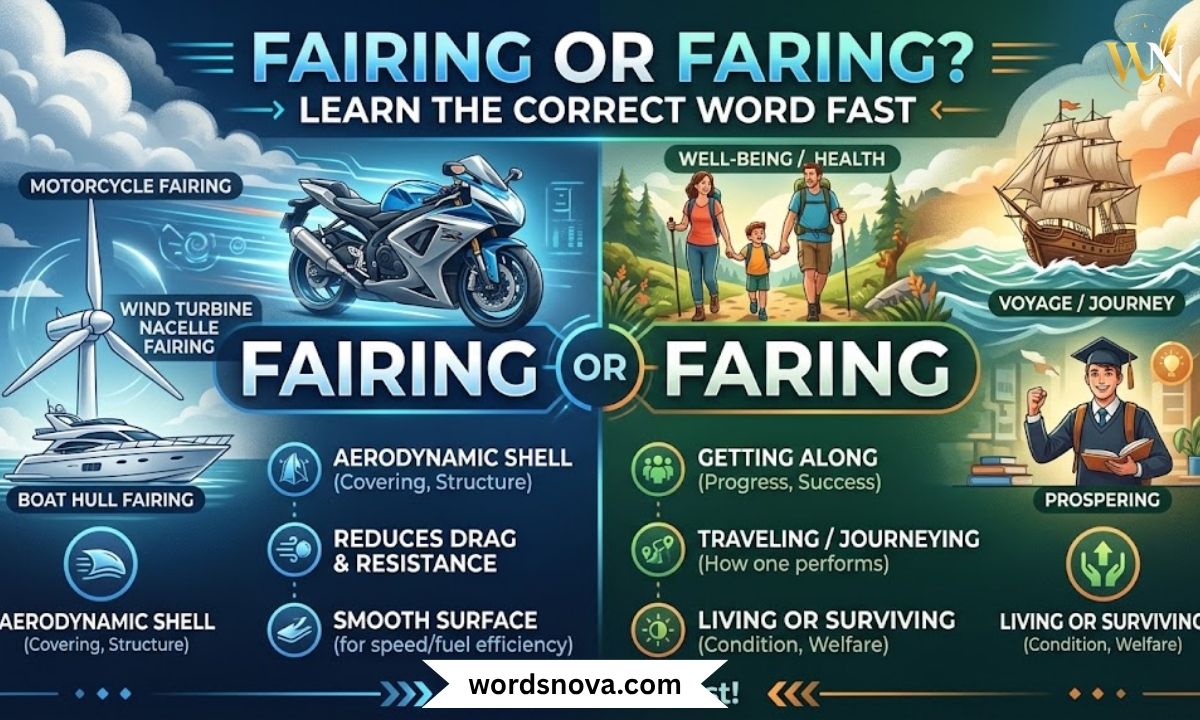
Have you ever paused while writing and wondered about fairing or faring? If you searched how you are faring, you may also be confused about how are you faring meaning, fairing vs faring, and how are you faring or fairing. These words sound alike, but they have very different uses.
We will explain fairing or faring in simple English with clear meanings and examples. You will learn when to use each word and why faring is correct in phrases like “how are you faring.” By the end, the difference should feel easy and clear.
Quick Answer: Fairing or Faring?
Here’s the short version before we dig into the details:
- Faring is a verb , the present participle of “fare,” meaning to get along, progress, or manage in a situation. Use it in phrases like “How are you faring?”
- Fairing is almost always a noun. It refers to a smooth, streamlined structural covering used on vehicles like motorcycles, cars, aircraft, and rockets to reduce drag.
In everyday writing , questions about someone’s wellbeing, progress at work, or how a situation is unfolding , faring is almost always the word you want. Fairing belongs in technical and engineering contexts.
| Word | Part of Speech | Core Meaning | Example |
| Faring | Verb (present participle of “fare”) | Progressing, coping, getting along | “How is the new hire faring?” |
| Fairing | Noun | A streamlined protective covering | “The motorcycle’s fairing cracked in the crash.” |
What are You Looking For?
Before choosing between these two words, it helps to know which situation you’re in:
- Asking about someone’s wellbeing or progress? You want faring (“How are they faring after surgery?”).
- Describing part of a vehicle, aircraft, or rocket? You want fairing (“The rocket’s payload fairing separated on schedule.”).
- Writing about how a business, team, or plan is doing? You want faring (“The startup is faring better than expected this quarter.”).
- Talking about smoothing or blending a surface? You’re in rare territory , fairing can occasionally function as a verb in shipbuilding and aerospace contexts, meaning to shape a structure into a smooth, continuous surface.
Meaning of “Fairing”
Fairing is primarily a noun that refers to a structure , usually rigid and aerodynamically shaped , added to a vehicle to reduce drag, protect components, or improve airflow. It’s a term rooted in engineering and design rather than everyday conversation.
Common uses include:
- Motorcycles: The plastic or fiberglass shell covering the frame and engine (a “motorcycle fairing”).
- Aircraft: Covers that smooth the junction between the wing and fuselage, or between the landing gear and body.
- Rockets and spacecraft: The nose cone-like structure that protects the payload during launch (the “payload fairing”).
- Boats: A smooth covering used to reduce water resistance on a hull.
Less commonly, “fairing” also functions as a verb in specialized shipbuilding or aerospace contexts, meaning to shape or smooth a surface so it blends seamlessly with the surrounding structure. This usage is technical and rarely appears outside engineering documentation.
Example sentences:
- The racing bike’s fairing was custom-painted before the season started.
- Engineers inspected the payload fairing for cracks after the failed launch.
- A cracked fairing on a motorcycle can affect both aerodynamics and rider protection.
Meaning of “Faring”
Faring is the present participle (the “-ing” form) of the verb fare, which means to get along, perform, progress, or experience a particular outcome in a situation. It’s most often used to describe how someone or something is doing, especially in the context of health, progress, or performance.
“Fare” itself has older roots tied to the idea of travel or journeying, which is why the noun “fare” (as in “bus fare” or “taxi fare”) also comes from the same word family , the cost of your journey.
Example sentences:
- How are you faring after the move?
- The company is faring well despite the economic slowdown.
- Farmers in the region are faring poorly this season due to drought.
- She wondered how her old classmates were faring years later.
Faring is common in both spoken and written English, appearing frequently in news writing, casual conversation, business updates, and personal check-ins.
Key Differences Between Fairing and Faring
| Feature | Fairing | Faring |
| Part of speech | Noun (mostly); rare technical verb | Verb (present participle of “fare”) |
| Common context | Engineering, vehicles, aerospace | Everyday conversation, business, wellbeing |
| Frequency of use | Low , specialized vocabulary | High , common in daily English |
| Typical sentence pattern | “The [noun] fairing…” | “[Subject] is/was faring…” |
| Root word | Related to “fair” (smooth, even) | From “fare” (to travel, get along) |
The simplest way to remember the difference: fairing is a thing you can touch, while faring is something you do or experience.
Common Mistakes People Make

Because the two words are pronounced the same in most English accents, mistakes happen frequently , usually in one of these patterns:
- Writing “fairing” when asking about wellbeing :”How are you fairing?” should be “How are you faring?”
- Writing “faring” when referring to a vehicle part: “The car’s faring was damaged” should be “The car’s fairing was damaged.”
- Confusing both with “fare” and “fair” more broadly: since fair (just/reasonable, or an event) and fare (a price, or to progress) are themselves separate homophones, the confusion often compounds.
- Assuming fairing can replace faring in casual writing:because fairing looks like it could be the “-ing” form of “fair,” some writers assume it works the same way faring does. It doesn’t.
Memory Tricks to Never Confuse Them Again
- “Faring = Fare + ing.” If you can substitute “doing” or “getting along” in the sentence, you want faring. (“How are you doing?” = “How are you faring?”)
- “Fairing has ‘air’ in it , think aerodynamic.” Fairings are physical shapes designed to move smoothly through air or water, so associate the word with the “air” hidden inside it.
- Ask “Can I touch it?” If the word describes a physical object, it’s fairing. If it describes a condition or progress, it’s faring.
- Picture a motorcycle. The plastic shell on a motorcycle is a fairing , a solid, visible object. There’s nothing to picture for faring except a person or situation changing over time.
American vs British English Differences
Both words are used the same way in American and British English , there’s no regional variation in meaning or spelling. However, usage frequency differs slightly:
- Faring appears in both American and British writing at similar rates, especially in journalism and business reporting (“How is the economy faring?”).
- Fairing is more commonly seen in British and international engineering and motorsport writing, partly due to the popularity of motorcycle racing (MotoGP, British Superbikes) in UK media, where “fairing” is a frequently used technical term.
Spelling remains identical across both dialects , there is no British “faireing” or American “fairring” variant to worry about.
When to Use Fairing in Technical Writing
Reach for fairing when you’re writing about:
- Motorcycle or car design and racing
- Aircraft engineering and maintenance
- Rocket and spacecraft payload protection
- Boat hull design and marine engineering
- Any structure whose purpose is reducing drag or smoothing airflow/water flow
In these contexts, “fairing” is precise, expected terminology , using “faring” instead would confuse readers familiar with the subject matter.
When to Use Faring in Conversation or Writing
Reach for faring when you’re writing about:
- Someone’s health, recovery, or wellbeing (“How is he faring after the surgery?”)
- Business or economic performance (“Small businesses are faring better this quarter.”)
- Progress on a task, project, or journey (“The team is faring well under the new deadline.”)
- General check-ins and casual conversation
This is by far the more common word in day-to-day English, so when in doubt in a non-technical sentence, faring is almost always correct.
Why These Words Get Confused So Often

The confusion largely comes down to three factors:
- Identical pronunciation. Both words sound the same when spoken, so writers relying on how a word “sounds” in their head have no auditory cue to distinguish them.
- Visual similarity. Both words are six letters, both end in “-ing,” and both start with “fa.” A quick glance can easily mix them up, especially when typing fast.
- Shared etymology. “Fair” and “fare” both trace back to Old English roots related to travel, journeying, and even appearance , meaning the words aren’t just similar by coincidence, they’re historically tangled together, which reinforces the confusion.
Quick Practice Quiz
Choose the correct word for each sentence:
- The rocket’s ___ separated cleanly during ascent. (fairing / faring)
- How is your sister ___ since starting her new job? (fairing / faring)
- The mechanic replaced the cracked ___ on the motorcycle. (fairing / faring)
- The local economy is ___ worse than last year. (fairing / faring)
Answers: 1. fairing , 2. faring , 3. fairing , 4. faring
Frequently Asked Questions
What is the difference between fairing or faring?
The main difference in fairing or faring is their meaning. Faring relates to getting along, while fairing usually means a covering or structure.
How are you faring meaning?
The phrase “how are you faring” asks about someone’s situation or progress. In fairing or faring, faring is the correct word.
Is faring a correct word?
Yes, faring is a correct word. It means getting along or doing in a particular situation. This makes faring correct in fairing or faring.
Is fairing a correct word?
Yes, fairing is also correct, but it has a different meaning. It commonly describes a covering that reduces drag on vehicles, especially motorcycles and aircraft.
How do you use faring in a sentence?
You can use faring when asking or describing how someone is doing. For example, “How are you faring?” is a natural expression.
How do you use fairing in a sentence?
Use fairing when discussing a protective or aerodynamic covering. In fairing or faring, the correct choice depends on whether you mean a covering or progress.
Is it how are you faring or fairing?
The correct phrase is “how are you faring.” In fairing or faring, faring means doing or getting along, while fairing refers to a covering.
Why do people confuse fairing or faring?
People confuse fairing or faring because both words sound very similar. Their spellings and meanings differ, so context helps you choose the correct word.
What does fairing mean?
Fairing means a smooth covering designed to reduce drag or improve airflow around something. In fairing or faring, it has a specific physical meaning.
What does faring mean?
Faring means getting along or doing something in a particular situation. In fairing or faring, it is the word used when discussing someone’s progress or condition.
Conclusion
Understanding fairing or faring can help you avoid a common spelling mistake. In fairing vs faring, the two words have different meanings. Faring means doing or getting along in a situation. It is often used in the question, how are you faring. If you search for how are you faring meaning, it simply asks how someone is doing. So, how are you faring or fairing is not the same choice. The correct word depends on what you want to say.
When talking about progress or well-being, choose faring. When talking about a covering used on a vehicle, especially a motorcycle or aircraft, choose fairing. This simple difference makes fairing or faring easier to remember. Keep fairing vs faring in mind when writing. If you mean “doing,” use faring. This will help you use fairing or faring correctly every time.