Have you ever paused while writing because principal vs principle suddenly felt confusing? You are not alone, as understanding the principal vs principle meaning can be tricky when both words sound almost the same.
You will learn the simple difference between principal vs principle with clear meanings and easy examples. We will show you when to use each word so you can write with confidence and avoid common mistakes.
Quick Answer
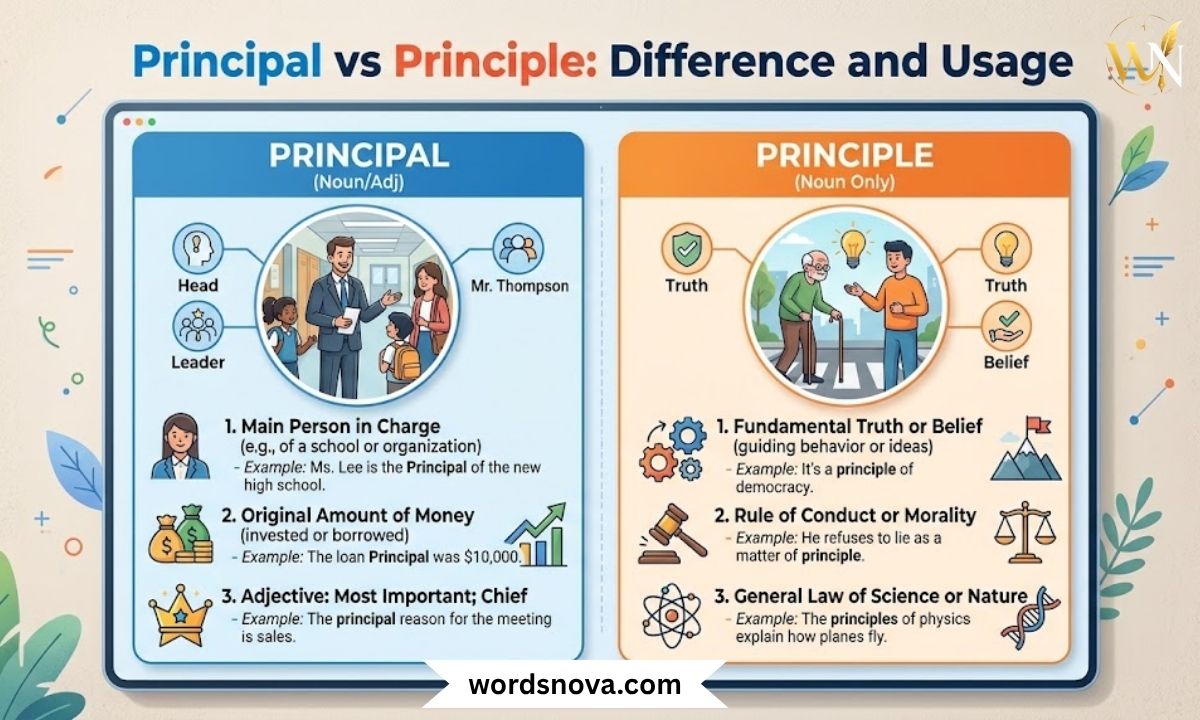
- Principal means main, most important, or the head of a school or organization. In finance, it is the original sum of money borrowed or invested.
- Principle means a rule, belief, or basic truth.
| Word | Part of speech | Core meaning | Example |
| Principal | Noun, adjective | Main; person in charge; original amount of money | The principal spoke at the assembly. |
| Principle | Noun only | Rule, belief, or fundamental truth | Honesty is a principle I live by. |
Principal vs Principle: The Key Difference
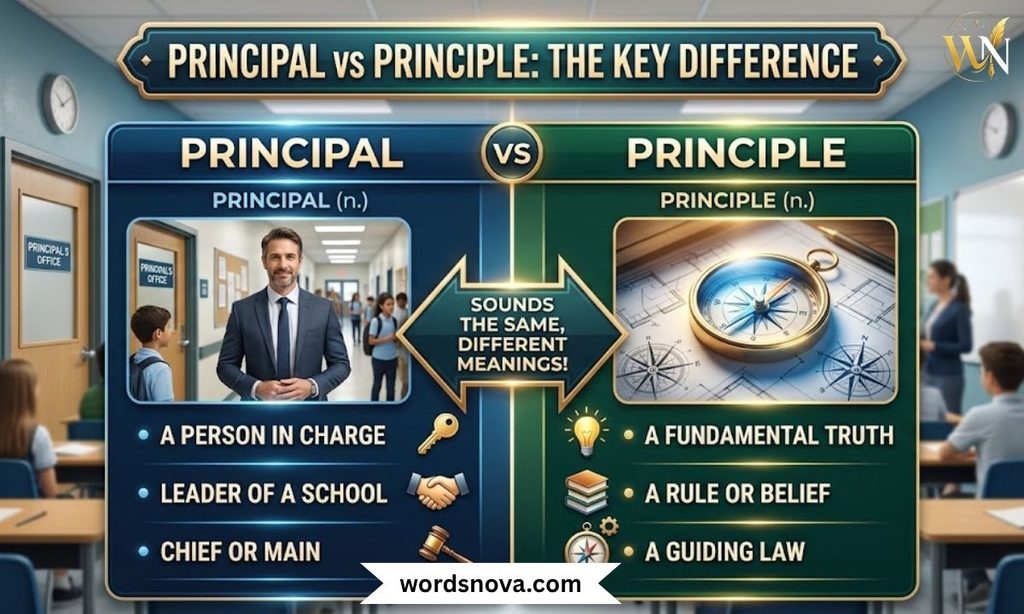
The difference is in the meaning. Principal points to importance or position: who is in charge, what is most important, or how much money is owed. Principle points to ideas: standards of behavior, laws of science, or beliefs that guide decisions.
If you can replace the word with “main” or “head,” use principal. If you can replace it with “rule” or “belief,” use principle.
Principal Meaning and Definition
Principal as a Noun
As a noun, principal has three common meanings:
- The head of a school. “The principal announced a new schedule.”
- The original amount of money in a loan or investment, excluding interest. “She paid $200 toward the principal.”
- A main person or party in a transaction or legal matter. “The principal signed the contract, and the agent handled the paperwork.”
Principal as an Adjective
As an adjective, principal means main, chief, or most important.
- “Poor planning was the principal cause of the delay.”
- “Her principal concern is safety.”
Principle Meaning and Definition
Principle as a Rule or Belief
Principle is always a noun. It has two main senses:
- A moral rule or belief that guides behavior. “He refused the bribe on principle.”
- A basic truth or law that explains how something works. “The principle of gravity explains why objects fall.”
Related phrases include guiding principles, core principles, moral principles, and scientific principle.
Principal vs Principle Difference at a Glance
| Feature | Principal | Principle |
| Part of speech | Noun and adjective | Noun only |
| Basic meaning | Main, head, or original sum | Rule, belief, or fundamental truth |
| Replace with | “main” or “head” | “rule” or “belief” |
| Typical contexts | Schools, loans, law, research | Ethics, science, philosophy, policies |
| Example | The principal reason is cost. | I follow the principle of fairness. |
Principal vs Principle in School
School is where most people first meet the confusion.
- The principal is the head of the school.
- A principle is something you learn in class, such as a principle of physics or grammar.
Example: “The principal praised the students who understood the principle of supply and demand.”
Principal vs Principle in Finance
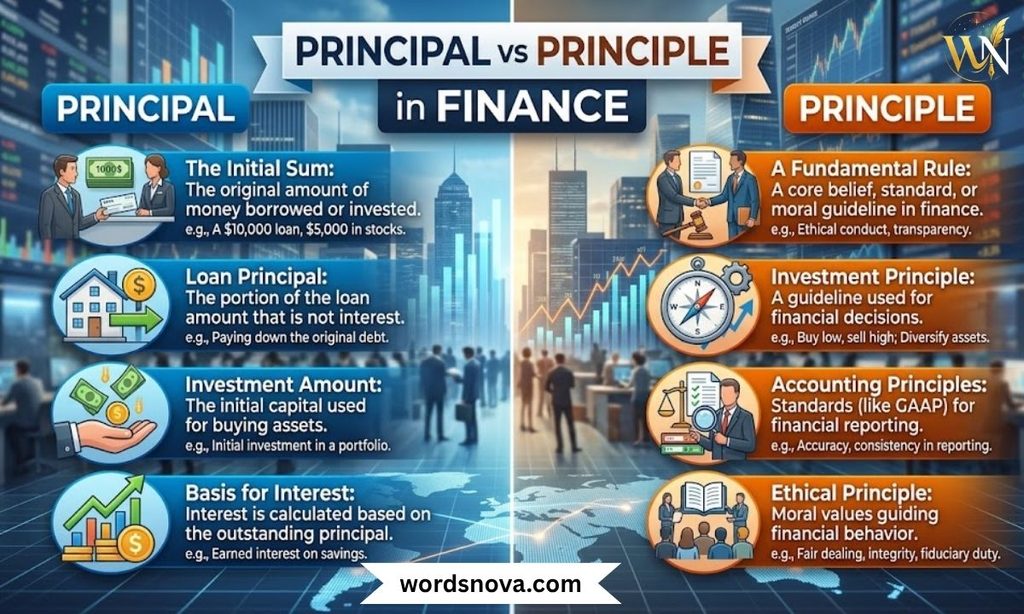
In finance, only principal is correct. Using principle here is a common spelling error.
Principal and Interest
Principal is the amount you borrow or invest. Interest is the cost of borrowing or the return on investing.
| Term | Meaning | Example |
| Principal | Original amount | You borrow $10,000. The principal is $10,000. |
| Interest | Extra money charged or earned | The bank charges 5% a year on that amount. |
Principal Payment and Principal Balance
- Principal payment: the part of a loan payment that reduces the amount you owe.
- Principal balance: the amount of the original loan that is still unpaid.
Each monthly payment usually covers both interest and principal. As the principal balance falls, the interest portion of each payment generally shrinks.
Example: “After five years, her principal balance dropped to $82,000.”
Principal vs Principle in Professional Writing
Principal Investigator
A principal investigator (PI) is the lead researcher responsible for a research project or grant. “Dr. Rao is the principal investigator on the study.”
Principal Office and Principal Party
- Principal office: the main office of a business. “The company’s principal office is in Chicago.”
- Principal party: a main party in a legal agreement or dispute, as opposed to a secondary party or agent.
In agency law, a principal is the person who authorizes an agent to act on their behalf.
Principal vs Principle Pronunciation
Both words are pronounced the same way: PRIN-suh-pul. They are homophones, so context is the only way to tell them apart in speech. The spelling is what you need to get right in writing.
Principal vs Principle Examples in Sentences
Principal vs Principle in a Sentence
| Sentence | Which word? | Why |
| The principal met with the parents. | Principal | Head of a school |
| Our principal goal is to reduce waste. | Principal | Main (adjective) |
| She paid down the loan principal early. | Principal | Original sum of money |
| He lives by the principle of honesty. | Principle | Moral belief |
| The principle of leverage is simple. | Principle | Basic scientific truth |
| I won’t lie, on principle. | Principle | Because of a belief |
Common Principal vs Principle Mistakes
| Incorrect | Correct | Reason |
| The school principle called a meeting. | The school principal called a meeting. | Head of a school |
| It’s a matter of principal. | It’s a matter of principle. | Moral belief |
| The principle reason for the delay was rain. | The principal reason for the delay was rain. | “Main” |
| She repaid the principle and interest. | She repaid the principal and interest. | Loan money |
How to Remember Principal vs Principle
- Principal ends in -pal. The principal is your school pal, or the main person.
- Principle ends in -ple, like the word rule. Both end in -le.
When to Use Principal vs Principle
Use principal when you mean:
- A school head or main person
- The main or chief item (adjective)
- The original amount of a loan or investment
Use principle when you mean:
- A rule or standard of behavior
- A belief or value
- A fundamental truth or law
Principal vs Principle: Which Is Correct?
Neither is correct in every case. The right word depends on your meaning. “The principal rule” (main rule) and “the principle of fairness” (a belief) can both be correct. Only context decides.
Principal vs Principle Usage in Everyday English
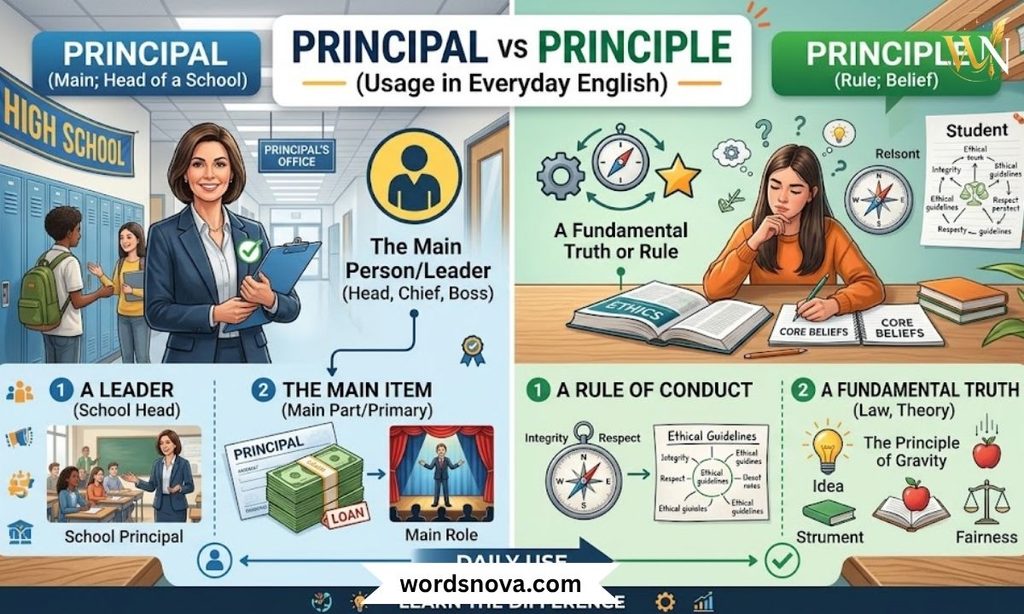
What Does “In Principle” Mean?
“In principle” means in theory or generally, though details may differ. “In principle, the plan works, but we need to test it.”
A related phrase is “on principle,” which means because of a firmly held belief: “She refuses to cheat on principle.”
Can Principal Be an Adjective?
Yes. Principal means “main” or “chief.” Examples: principal reason, principal dancer, principal source of income.
Can Principle Be an Adjective?
No. Principle is only a noun. The related adjective is principled, meaning guided by strong moral values. “She is a principled leader.”
Principal vs Principle: A Simple Decision Test
Ask yourself two questions:
- Does it mean main, head, or original money? → Principal
- Does it mean rule, belief, or basic truth? → Principle
Principal vs Principle: Final Rule
If it is a person, a sum of money, or the word “main,” write principal. If it is a rule or belief, write principle.
Principal vs Principle Practice Session

Choose the correct word.
- The school ______ welcomed the new students.
- Honesty is a ______ I never compromise.
- Her ______ concern is meeting the deadline.
- You must pay back the ______ plus interest.
- He quit the job on ______.
- The ______ of buoyancy explains why ships float.
- The ______ investigator presented the research findings.
- Fairness is a guiding ______ in our company.
Answers
- principal
- principle
- principal
- principal
- principle
- principle
- principal
- principle
Frequently Asked Questions
What is the difference between principal vs principle?
Principal refers to a person or something important, while principle means a rule or belief. Understanding principal, vs principle makes writing clearer.
What does principal mean?
Principal usually means a school leader or something most important. In principal vs principle, remember that principal can describe a person or priority.
What does principle mean?
A principle is a basic rule, belief, or moral idea. In principal ,vs principle, principle refers to values, guidelines, or accepted standards.
How can I remember principal vs principle?
Remember that a principal can be a person, while a principle is a belief or rule. This simple trick makes principal vs principle easier.
Is principal or principle correct?
Both words are correct, but they have different meanings. Principal vs principle depends on whether you mean a person, importance, rule, belief, or value.
How do you use principal in a sentence?
You can use principal for a school leader or something most important. For example, “The principal welcomed the students.” This helps explain principal vs principle.
How do you use principle in a sentence?
Use principle when discussing a rule, belief, or value. For example, “Honesty is an important principle.” This example clearly shows principal, vs principle.
Conclusion
Understanding principal vs principle makes writing clearer and more accurate. The principal vs principle meaning is easy once you know the basic difference. Principal refers to a person in charge or something most important.
Principle means a rule, belief, or moral idea that guides your actions. Learning principal vs principle helps you avoid common spelling mistakes. Keep the principal vs principle meaning in mind to choose the correct word confidently.