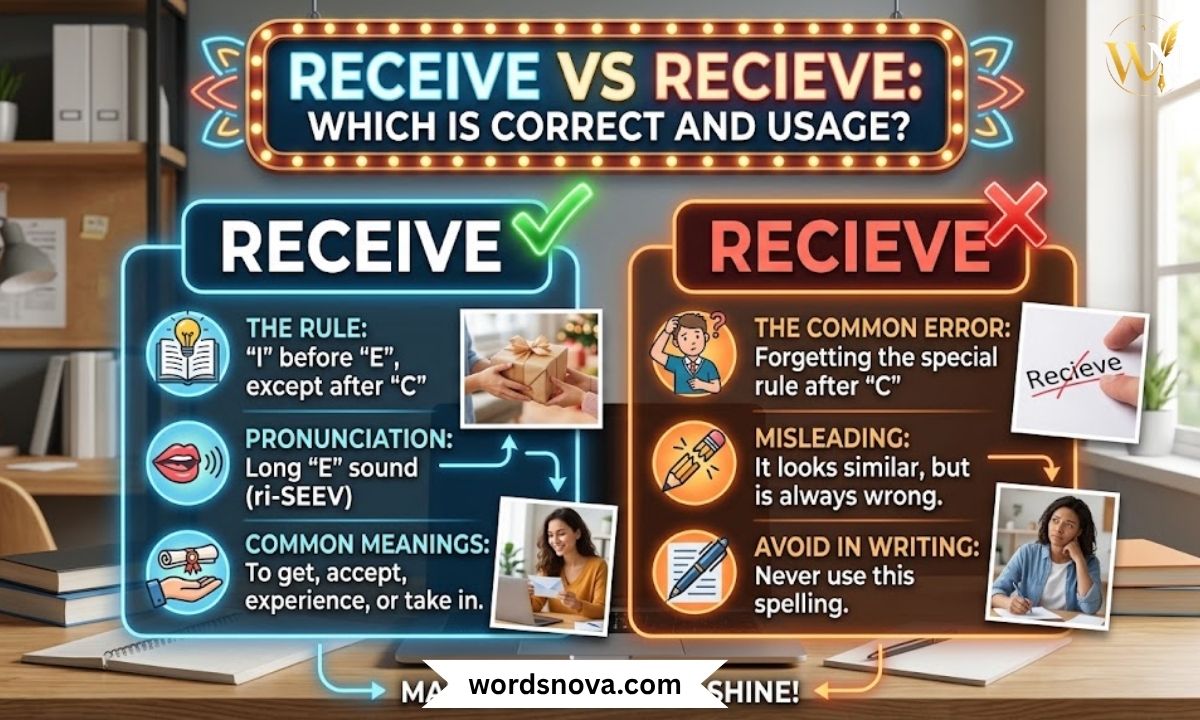
Have you ever paused while writing because you were unsure about receive vs recieve? You may wonder about the correct recieve spelling, how to spell receiving, or whether recieved or received is right. Questions like how do you spell receiving and how do you spell receive can make even simple writing confusing.
This guide makes receive vs recieve easy to understand. You will learn the correct spelling, meaning, and usage with simple examples. By the end, you will know which form to use and avoid this common spelling mistake.
Receive vs Recieve Quick Answer
| Spelling | Correct? | Note |
| Receive | ✅ Yes | Standard in American, British, Canadian, and Australian English |
| Recieve | ❌ No | Misspelling that breaks the “i before e, except after c” rule |
The short rule: after the letter c, write ei. So it is re-c-e-i-ve.
What Does Receive Mean?

Receive is a verb that means to be given, sent, or handed something, or to take something that comes to you.
Common meanings include:
- To get or be given something: She will receive her certificate on Friday.
- To take delivery of something: We received your package this morning.
- To experience or be subjected to something: The film received praise from critics.
- To welcome or greet someone: The principal received the guests in the main hall.
- To pick up a signal or message: The radio can receive signals from far away.
Its forms are receive (base), receives (third person singular), received (past), and receiving (present participle). Related words include the noun receipt, the noun receiver, and the noun reception.
Receive vs Recieve Meaning Explained
There is no difference in meaning, because “recieve” has no meaning at all. It is simply “receive” with two letters swapped. Spell checkers flag it for this reason.
| Word | Meaning | Example |
| Receive | To get, be given, or accept something that is sent or offered | I hope to receive your reply soon. |
| Recieve | No meaning (misspelling) | ❌ I hope to recieve your reply soon. |
Why People Confuse Receive Vs Recieve
Most people make this mistake for a few understandable reasons:
- The “i before e” rhyme is half remembered. Many people recall “i before e” and forget the “except after c” part.
- The sounds are identical. The word is pronounced with a long “ee” sound, which is spelled ie in words like believe and ei in receive. Your ear cannot tell you which is right.
- Fast typing swaps letters. The “ie” and “ei” pair is easy to transpose when typing quickly.
- Similar words use different patterns. Believe, relieve, and achieve use “ie,” so people assume receive does too.
The Grammar Rule Behind Receive
The rule is a familiar rhyme:
“I before E, except after C.”
It means that when the vowel sound is a long “ee,” you write ie unless the letter before it is c. Because “receive” has a c right before the vowel pair, it takes ei.
| Pattern | Words |
| ie (not after c) | believe, relieve, achieve, field, piece, thief |
| cei (after c) | receive, deceive, perceive, conceive, ceiling, receipt |
Exceptions to the rule
The rule is helpful but not perfect. These words break it:
- weird, seize, either, neither, leisure (the “ei” is not after c)
- science, species, ancient, society (the “ie” comes after c, but the sound is different)
The “except after c” part applies mainly when the vowel pair makes a long “ee” sound, and receive is a clear example of that.
Why “Recieve” Is Incorrect
“Recieve” is wrong for three simple reasons:
- It breaks the spelling rule. The letter c is followed by ie instead of ei.
- It is not listed in any standard dictionary. Merriam-Webster, Oxford, and Cambridge all list only receive.
- It looks unprofessional. Readers notice the error, especially in emails, resumes, and business documents.
The same mistake shows up in related words:
| Incorrect | Correct |
| recieve | receive |
| recieved | received |
| recieving | receiving |
| reciept | receipt |
| decieve | deceive |
| percieve | perceive |
British English vs American English Spelling

Good news: there is no difference. Unlike color/colour or center/centre, receive is spelled the same way in every major English-speaking country.
| Variety | Spelling |
| American English | receive |
| British English | receive |
| Canadian English | receive |
| Australian English | receive |
So if you are unsure which spelling to use for a particular audience, the answer is always receive.
Receive Pronunciation and Meaning
Receive is pronounced /rɪˈsiːv/, which sounds like rih-SEEV. The stress falls on the second syllable.
A quick note to avoid confusion: the phrase “Received Pronunciation” (RP) refers to a standard British accent. It uses the past participle received (meaning “widely accepted”), not the base verb receive. People often search for “receive pronunciation” when they mean this accent.
Receive Examples in Everyday Sentences
Here are natural examples for different situations.
| Situation | Example Sentence |
| I did not receive your message yesterday. | |
| Work | Employees will receive their salary on the first of the month. |
| School | Students who pass the exam will receive a certificate. |
| Gifts | She was thrilled to receive flowers on her birthday. |
| Feedback | The new design has received positive reviews. |
| Technology | My phone cannot receive a signal in the basement. |
| Welcoming | The mayor received the visitors with a warm speech. |
| Past tense | We received the invoice last week. |
| Progressive | He is receiving treatment at the clinic. |
Common Mistakes with Receive

Spelling is not the only place people slip up. Watch for these:
- Misspelling the word: recieve, recieved, receving
- Misspelling “receipt”: writing reciept instead of receipt
- Using the wrong preposition: we receive something from someone, not receive something by someone
- ✅ I received a letter from my teacher.
- Confusing “receive” with “recieve” in the past tense: the correct form is received, with a silent “e” and a “d”
- Wrong tense after “did”: after did not, use the base form: I did not receive it, not I did not received it.
Receive vs Accept vs Get
These three verbs overlap, but they are not interchangeable.
| Word | Meaning | Example |
| Receive | To be given or sent something; no choice is implied | She received a gift from her aunt. |
| Accept | To willingly take or agree to something offered | She accepted the gift graciously. |
| Get | A casual, flexible word for obtaining or receiving | I got a text from my brother. |
Key difference: you can receive something without accepting it. For example, you might receive a job offer and then decline it.
Also, receive sounds more formal than get. In professional writing, receive is usually the better choice.
Easy Tricks to Remember Receive Spelling
Try one of these memory aids:
- Use the rhyme: “I before E, except after C.” Since receive comes right after a c, it uses ei.
- Remember the key letters: “C comes before E in the word receive.” Think of c-e-i in alphabetical order (C, E, I).
- Pair it with its family: learn receive, deceive, perceive, conceive as one group that all share cei.
- Link it to “receipt”: both words start with rece-.
- Say it in syllables: re-CEIVE, and picture the C leading into EI.
Why Correct Spelling Matters in Professional Writing
A single typo can quietly weaken your message. Correct spelling helps because:
- It builds credibility. Error-free writing makes you look careful and trustworthy.
- It keeps communication clear. Readers focus on your message instead of the mistake.
- It protects your image. Resumes, cover letters, and client emails are judged on details.
- It helps search visibility. Search engines match content to correctly spelled queries, and well-edited pages tend to be seen as higher quality.
Make a habit of proofreading words you often get wrong. Receive is one of the most commonly misspelled words in English, so it is worth double-checking.
Receive in Digital Communication and Search Trends
People often type “recieve” in emails, texts, and search bars, and autocorrect usually fixes it silently. That is one reason many people never learn the correct spelling.
Searches like “receive vs recieve” and “is it recieve or receive” show how common the confusion is. In business, you will see receive in phrases such as:
- “Please confirm receipt of this email.”
- “You will receive a notification shortly.”
- “Did you receive my attachment?”
Even with autocorrect and spell check, it helps to know the rule, because tools can miss mistakes in unusual contexts or when you write by hand.
Receive Word Origin and Language History

Receive entered English in the Middle Ages through Old French (receivre), which came from the Latin recipere. That Latin word combines re- (“back”) and capere (“to take”), so the original sense was roughly “to take back” or “to take in.”
The same Latin root gave English many related words:
| Word | Link to the root |
| Receipt | Something received or a record of receiving |
| Reception | The act of receiving or welcoming |
| Recipient | A person who receives |
| Deceive | From decipere, “to catch or ensnare” |
| Perceive | From percipere, “to take in with the mind” |
The “ei” spelling reflects its French and Latin background.
Practice Session Receive vs Recieve
Test yourself with this short exercise.
Fill in the Blanks
Choose the correct spelling: receive or recieve.
- I hope to ______ your reply by Monday.
- Did you ______ the package yesterday?
- Students will ______ their results next week.
- She was excited to ______ the award.
- We have not ______ any updates yet. (write the past form)
- He is ______ medical care at the hospital. (write the -ing form)
- Please keep the ______ as proof of purchase. (write the noun form)
- The antenna can ______ signals from satellites.
Answers
- receive
- receive
- receive
- receive
- received
- receiving
- receipt
- receive
Remember that “recieve” is never correct in any of these.
Frequently Asked Questions
What is the correct spelling, receive or recieve?
In receive vs recieve, receive is the correct spelling. Recieve is incorrect. Remember the “i before e” pattern changes after c in receive.
Is recieve a correct spelling?
In receive vs recieve, recieve is not correct. The correct spelling is receive. Use receive when you mean to get, accept, or take something.
How do you spell receive?
If you are confused about receive vs recieve, spell it receive. The letters are r-e-c-e-i-v-e. Recieve is a common spelling mistake in English.
How do you spell receiving?
For receive vs recieve, remember that receiving keeps the correct spelling pattern. Write receiving, not recieving. The word comes from the correct spelling, receive.
Is it received or recieved?
When checking receive vs recieve, the correct past tense is received. Recieved is incorrect. Remember that received keeps the same spelling pattern as receive.
Why do people confuse receive and recieve?
The confusion in receive vs recieve happens because English spelling rules can be tricky. Many writers remember “i before e,” but receive follows a different pattern.
How can I remember receive vs recieve?
To remember receive vs recieve, think of the letter c before e. Write receive, received, and receiving. Avoid recieve, recieved, and recieving in writing.
Conclusion
The receive vs recieve spelling confusion is common, but the correct word is receive. The word recieve is incorrect. Remember the “i before e” rule does not work here because receive follows “i before e, except after c.” If you wonder about recieve spelling, use receive. To spell receiving, keep the same order of letters. If you ask, how do you spell receiving, the answer is receiving. The same pattern helps you remember how do you spell receive correctly.
Understanding receive vs recieve can help you avoid simple spelling mistakes. When writing about something you get, choose receive. For the past tense, use received, not recieved. So, if you ask recieved or received, the correct choice is received. Keep these forms in mind whenever you write, and receive vs recieve will become much easier to remember and use correctly.