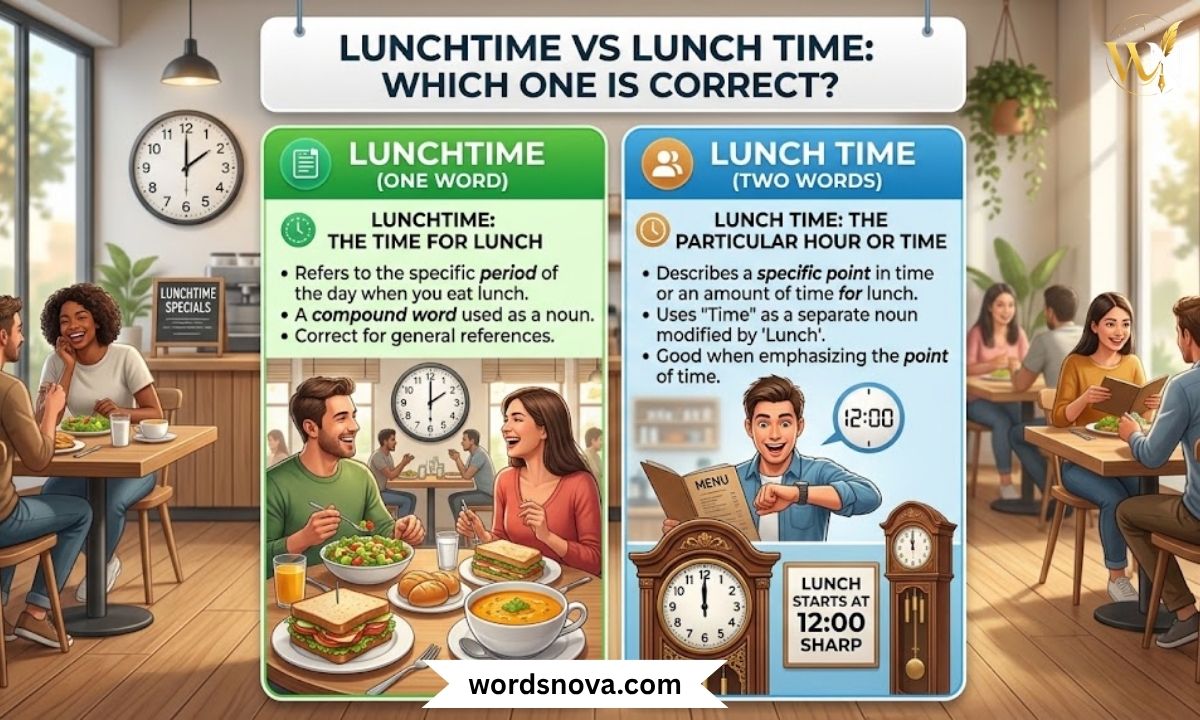
Have you ever paused while writing and wondered about lunchtime vs lunch time? It is easy to get confused about whether lunch time should be one word or two, especially when you see both forms online. You may ask, lunchtime or lunch time, is lunchtime one word, what is lunch time, or is lunch time one word?
We will make lunchtime vs lunch time simple and clear. You will learn the correct spelling, understand when to use each form, and see easy examples that make the difference easier to remember. By the end, you will feel confident using the right form in your writing.
Understanding Lunchtime vs. Lunch Time
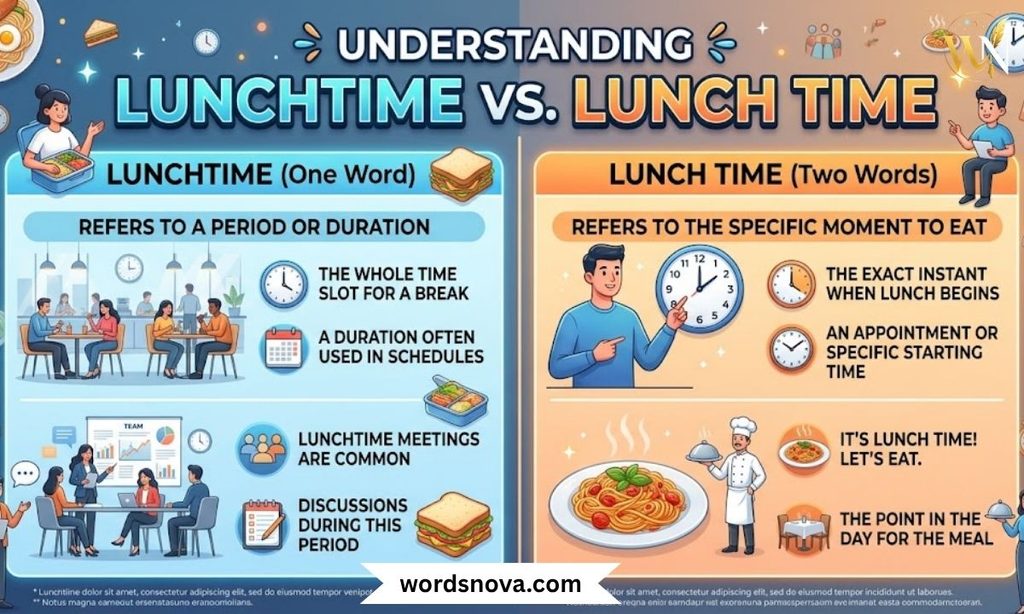
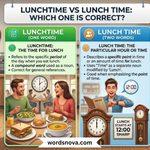
Both forms look almost identical, so it’s easy to wonder whether one is a mistake. Neither is wrong, but they are not always interchangeable. Major dictionaries list lunchtime as a single word, and most editors and style guides prefer it for the general meaning of “the period when lunch is eaten.”
What Each Term Really Means
| Term | Part of speech | Core meaning | Typical use |
| Lunchtime | Noun (closed compound) | The period of the day when people eat lunch | “I’ll call you at lunchtime.” |
| Lunch time | Noun phrase (lunch + time) | The specific time for lunch, or time spent on lunch | “Lunch time is 12:30 sharp.” |
Definition of “Lunchtime”
Lunchtime is a noun meaning the part of the day, usually around midday, when people normally have lunch. It can also describe the break from work or school set aside for eating.
Quick Example
- “The café gets crowded at lunchtime.”
- “She goes for a walk every lunchtime.”
Definition of “Lunch Time”
Lunch time is a phrase in which lunch works almost like an adjective describing time. It points to a particular moment or amount of time linked to lunch, and it often appears after “is,” “at,” or “of.”
Quick Example
- “Is it lunch time yet?”
- “Our lunch time is 45 minutes long.”
Grammar Rules Behind Both Forms
Compound Nouns Becoming One Word
English compound nouns tend to move through three stages: two separate words (lunch time), a hyphenated form (lunch-time), and a single word (lunchtime). The more common and settled a compound becomes, the more likely it is to close up. Bedtime, daytime, mealtime, and breakfast time follow similar patterns, and lunchtime has largely completed the move.
Hyphenation Notes
Lunch-time with a hyphen appears in older texts and is now considered dated. Use it only if a particular style guide or publisher requires it. Hyphens are still useful in compound modifiers, such as “a lunch-hour crowd.”
Formality Levels
| Form | Formality | Where you’ll see it |
| Lunchtime | Neutral, suits formal and informal writing | Reports, emails, news, schedules |
| Lunch time | Neutral to casual | Conversation, texts, signs, notes |
| Lunch-time | Dated | Older books, some legacy style guides |
Practical Usage: When to Choose One Over the Other

A simple test works well. Ask whether you mean the general period of the day or a specific time that belongs to lunch.
- If you mean “around midday, when people eat,” use lunchtime.
- If “time” stands on its own (a clock time, a duration, a deadline), lunch time works.
- If you’re unsure, lunchtime is almost always safe.
Everyday Usage
In daily writing, lunchtime is the default. It appears in phrases like “lunchtime meeting,” “lunchtime special,” “lunchtime rush,” and “lunchtime crowd.” Spellcheckers and dictionaries recognize it without complaint.
When “Lunch Time” Makes Sense
Use two words when time carries its own meaning:
- A clock time: “Lunch time is 1:15 p.m. on Fridays.”
- A duration: “We get an hour of lunch time.”
- An announcement: “It’s lunch time, everyone!”
- A comparison with other mealtimes: “Breakfast time, lunch time, and dinner time are posted on the door.”
Historical Development of the Term
Early Appearances
Lunch itself began as a short, informal snack and gradually became a standard midday meal. As the word grew common, speakers naturally combined it with time to name the hour when people ate it. Early writers often used two words or a hyphen; the closed form became standard over time as dictionaries and publishers adopted it.
Language Trend
English tends to merge frequently used word pairs into single words. Lunchtime follows the same path as bedtime and playtime. The two-word form survives mainly where the meaning calls for it.
Regional and Cultural Usage Differences
Usage in English-Speaking Countries
The spelling choice is not a regional split. Lunchtime is standard everywhere English is spoken. What differs is how people use the word and when lunch happens.
United States
Americans use lunchtime freely (“lunchtime rush”) and also say “lunch hour” or “lunch break.” The two-word form appears in casual speech and signage.
United Kingdom
Lunchtime is very common in British English, especially in phrases like “at lunchtime” and “lunchtime news.” Britons often say “at lunchtime” where Americans might say “at lunch.”
Canada
Canadian usage matches American and British norms. Lunchtime is the standard spelling, and “lunch hour” is common in workplaces.
Australia
Australians use lunchtime the same way, often with “lunch break” in work settings.
Cross-Cultural Interpretations of Lunchtime
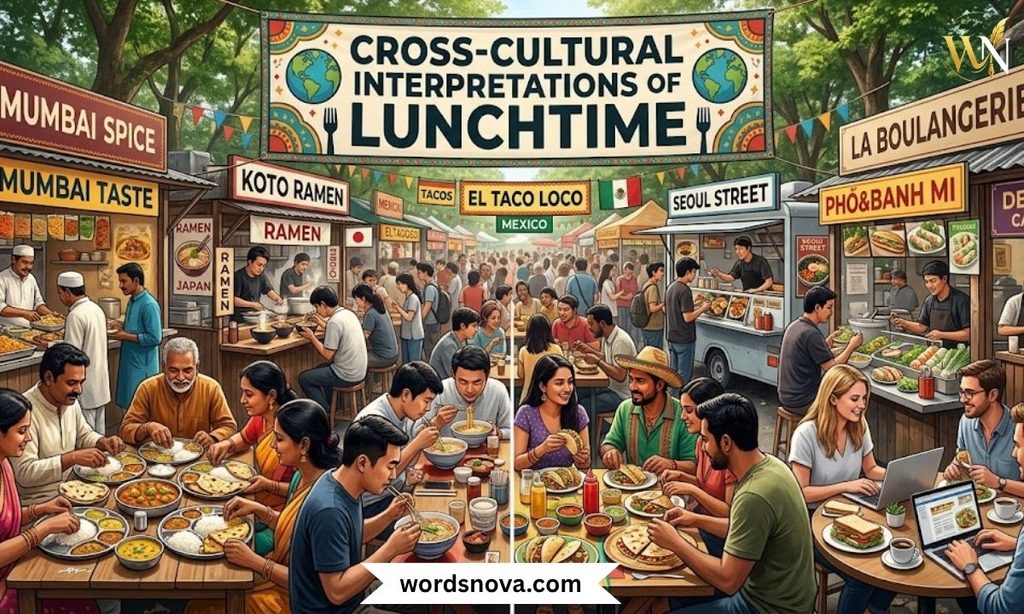
The word is the same, but the meal and its timing vary widely.
Mediterranean Countries
Lunch is often the main meal of the day, eaten later and enjoyed over a longer break. In Spain, it commonly falls in the mid-afternoon.
Northern Europe
Lunch tends to be earlier and shorter, often a lighter meal or a set daily dish, eaten in the late morning to early afternoon.
Asian Countries
Practices vary by country. Japanese workers and students often eat a packed bento or a quick set meal around midday, while in India many people eat lunch in the early afternoon, sometimes from a carried tiffin.
Lunchtime in Daily Life
Workplace Lunchtimes
Most workplaces schedule a fixed break, often 30 to 60 minutes, though length and legal requirements vary by country and employer.
Interesting Workplace Patterns
- Staggered lunches keep services running and avoid crowding.
- Many people use lunchtime for errands, exercise, or a walk.
- “Working lunches” blur the line between break and meeting.
School Lunchtimes
Schedules depend on the school, but general patterns exist.
Elementary School
Younger children usually eat earlier, often in the late morning, and have a supervised recess nearby.
Middle & High School
Lunch is typically split into several shorter shifts because many students share the cafeteria.
University
Lunchtime is flexible. Students eat between classes, and campus food services stay open across a wide window.
Lunchtime Etiquette and Social Expectations
General Etiquette
- Respect the length of the break and return on time.
- Keep strong-smelling food in mind in shared spaces.
- Don’t schedule meetings during someone’s lunch without checking.
- Clean up shared tables and microwaves.
Cultural Etiquette Examples
| Setting | Common expectation |
| Many Mediterranean countries | Lunch is unhurried and social |
| Parts of Northern Europe | Eating on time and finishing efficiently is valued |
| Japan | Bento or shared meals are eaten calmly; tidy up afterward |
| Business lunches (widely) | Wait for the host to begin, and avoid rushing the conversation |
Common Misconceptions
❌ “Lunchtime” always means noon.
It doesn’t. Lunchtime is a period, not a fixed hour. It varies by country, job, and school.
❌ “Lunch time” is incorrect.
It isn’t. The two-word form is correct when time is a separate idea, though lunchtime is the better default.
❌ Both terms mean the exact same thing.
They overlap heavily, but lunchtime names a general period while lunch time can point to a specific time or amount of time.
❌ “Lunchtime” is British and “lunch time” is American.
Neither is tied to one country. Lunchtime is standard in both American and British English.
Related Mealtime Expressions
| Expression | Meaning | Example |
| Lunch break | Pause from work to eat | “I’m on my lunch break.” |
| Lunch hour | The hour set aside for lunch | “She spends her lunch hour reading.” |
| Mealtime | Any time for eating | “Mealtime is at six.” |
| Breakfast time | Time for breakfast | “It’s breakfast time.” |
| Dinnertime | Period when dinner is eaten | “We’re home by dinnertime.” |
| Teatime | Time for afternoon tea (mainly British) | “Join us at teatime.” |
Examples in Real Sentences
Using “Lunchtime”
- The bank is busiest at lunchtime.
- We have a lunchtime yoga class on Tuesdays.
- He checks his messages at lunchtime.
Using “Lunch Time”
- Is it lunch time yet?
- Our lunch time starts at 12:30.
- Please finish before lunch time.
Side-by-Side Comparison
| Situation | Better choice | Example |
| General period of the day | Lunchtime | “See you at lunchtime.” |
| Modifier before a noun | Lunchtime | “A lunchtime meeting” |
| Announcing the meal hour | Lunch time | “It’s lunch time!” |
| A specific hour or duration | Lunch time | “Lunch time is 45 minutes.” |
Frequently Asked Questions
Is lunchtime one word?
Lunchtime vs lunch time can be confusing, but lunchtime is usually written as one word. It commonly refers to the period when people eat lunch.
Is lunch time one word?
In lunchtime vs lunch time, lunchtime is the standard one-word form. However, lunch time can appear in some contexts when the phrase needs separate emphasis.
What is the difference between lunchtime and lunch time?
The main difference in lunchtime vs lunch time is usage. Lunchtime is a standard noun, while lunch time is simply the same phrase written separately.
Which is correct, lunchtime or lunch time?
For lunchtime vs lunch time, lunchtime is generally the preferred spelling in modern English. It means the usual period when people have their midday meal.
Can I write lunch time as two words?
Yes, lunch time can be written as two words in certain contexts. Still, lunchtime is usually preferred when discussing the general midday meal period.
Should I use lunchtime in formal writing?
Yes, lunchtime works well in formal and informal writing. When comparing lunchtime vs lunch time, the one-word form is normally the safer standard choice.
Is lunchtime a noun?
Yes, lunchtime is a noun. In lunchtime vs lunch time, it describes the usual period for eating lunch and can fit naturally into everyday sentences.
What does lunchtime mean?
In lunchtime vs lunch time, lunchtime means the part of the day when people usually eat lunch. The exact time can vary by person.
How do you use lunchtime in a sentence?
When learning lunchtime vs lunch time, you can write, “We usually meet at lunchtime.” This sentence uses the standard one-word form naturally and clearly.
Is lunchtime or lunch time more common?
In lunchtime vs lunch time, lunchtime is generally more common as a standard noun. It is widely used to describe the usual period for eating lunch.
Conclusion
Understanding lunchtime vs lunch time can help you write more clearly. In most cases, lunchtime is the standard one-word form. It refers to the part of the day when people usually eat lunch. If you are asking is lunchtime one word, the answer is yes. However, lunch time can also appear when the words are used separately for emphasis or in a specific sentence. Knowing the difference makes your writing easier to understand.
When asking lunchtime or lunch time, remember that lunchtime is usually the better choice. If you wonder what is lunch time, it simply means the usual period for eating lunch. The question is lunch time one word can be confusing, but lunchtime vs lunch time becomes simple with context. Overall, lunchtime vs lunch time is mainly about standard usage, and lunchtime is generally preferred in everyday English.