Have you ever needed to share a file or document but struggled to find the right words? Please see attached and see attached are common phrases, but knowing when to use please see attached., please see attachments, or please see the attached can make your message sound clearer and more professional.
We’ll explain please see attached and share simple, useful alternatives you can use in emails and messages. You’ll learn how each phrase works, when to use it, and how to make your communication sound natural and polite.
What Does “Please See Attached” Mean?
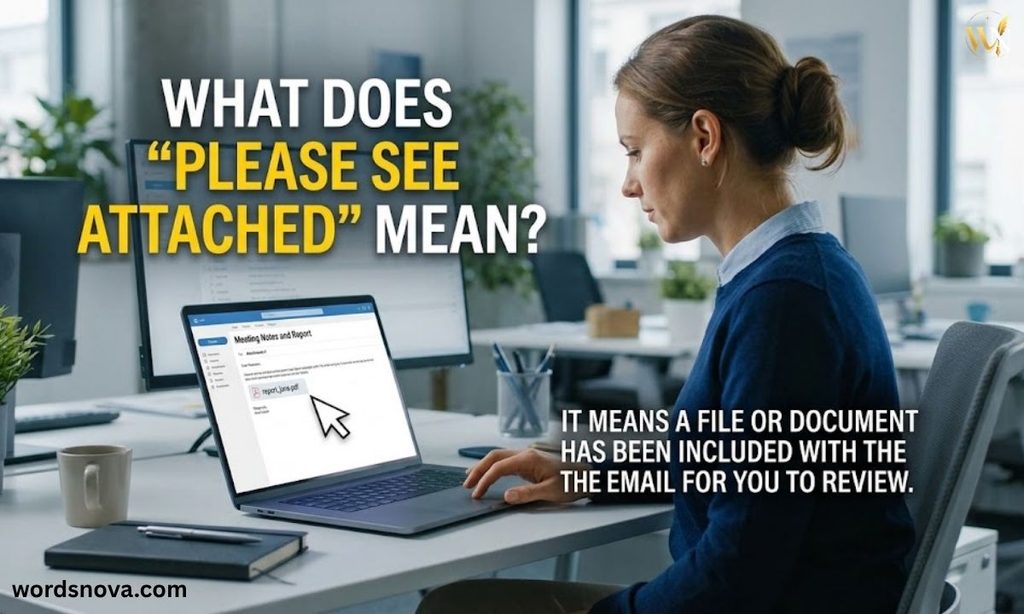
“Please see attached” is a short, common business phrase used to direct the reader’s attention to a file, document, or image included with an email or message. It essentially means “look at the file I’ve included with this message.” The phrase is a shorthand way of pointing to supporting material ,a report, invoice, resume, contract, or image ,without needing to describe it in detail within the body of the message.
Grammatically, it’s a slightly clipped construction (missing “the” before “attached”), which is why some writers prefer fuller alternatives like “please see the attached document” or “please find attached.”
When to Use “Please See Attached”
This phrase ,and its many alternatives ,fits naturally in situations such as:
- Sending a report, invoice, or proposal to a colleague or client
- Submitting a resume or cover letter for a job application
- Forwarding a contract, agreement, or official document for review
- Sharing images, screenshots, or design files
- Providing supporting evidence or data referenced in the email body
- Sending meeting notes, agendas, or presentation slides
It works best when the attachment is the main point of the email, or when you need the reader to open a file before taking further action.
Is It Professional/Polite to Say “Please See Attached”?
Yes ,”please see attached” is widely accepted as professional and polite in business and formal communication. It’s direct, efficient, and instantly understood. However, because it’s so commonly used, it can feel a little generic or impersonal, especially in client-facing or high-stakes emails. Using varied alternatives ,matched to the right tone and context ,can make your writing feel more thoughtful, natural, and less like a template.
Synonyms for “Please See Attached” ,Quick Overview
| Phrase | Tone | Best Use |
| I’ve attached… | Friendly, conversational | Everyday emails to colleagues |
| Please find attached… | Formal, traditional | Client or official correspondence |
| Attached is… | Neutral, direct | Single-file emails |
| I’m sharing… | Warm, collaborative | Team updates |
| Enclosed is… | Formal | Mailed or PDF documents |
| Here is… | Casual, simple | Quick internal emails |
| I’ve included… | Neutral, informative | Reports and supporting files |
| I’m sending… | Friendly | General correspondence |
| For your reference… | Professional | Documents for future use |
| Please review the attached… | Formal, action-oriented | Requests requiring feedback |
| For your convenience… | Courteous | Optional or helpful attachments |
| Attached for your review… | Formal | Drafts and proposals |
| Kindly find attached… | Very formal, polite | Traditional business emails |
| Enclosed you will find… | Formal | Detailed formal letters |
| Please find the attached… | Formal | Client communication |
| I’ve sent you… | Casual | Team or peer emails |
| Attached please find… | Formal, old-fashioned | Legal or corporate emails |
| I’ve included it for your review… | Formal, courteous | Documents needing approval |
| Attached for your convenience… | Polite, helpful | Optional reference material |
| Here are… | Casual, plural items | Multiple attachments |
| You’ll find attached… | Neutral | General business use |
| I am forwarding… | Neutral, procedural | Passing along received files |
| Please take a look at the attached… | Friendly, direct | Requesting feedback |
| For your action… | Formal, urgent | Tasks requiring response |
| For your consideration… | Formal, respectful | Proposals and applications |
| Here is a copy of… | Neutral | Providing duplicates/records |
| Attached herewith… | Very formal, legal | Legal and official letters |
| For your information (FYI)… | Casual, informal | Internal updates |
| I’ve provided… | Neutral, professional | Supplying requested data |
| For your records… | Formal | Receipts, confirmations |
1. I’ve Attached…
Meaning: A simple, direct way of telling the reader that a file has been included with the message.
Best Use: Everyday professional emails to colleagues, managers, or familiar clients.
Tone: Friendly and conversational, while still professional.
Explanation: “I’ve attached” uses the present perfect tense to show that the action (attaching the file) has just been completed and is relevant now. It’s slightly more personal than “please see attached” because it starts with “I,” making the sender sound approachable.
Scenario: You’re emailing a coworker the final version of a project timeline they asked for earlier that day.
Examples:
- I’ve attached the updated timeline for your review.
- I’ve attached the invoice for last month’s services.
- I’ve attached a copy of the signed agreement.
- I’ve attached the presentation slides we discussed.
- I’ve attached my resume and portfolio for your consideration.
- I’ve attached the revised budget spreadsheet.
2. Please Find Attached…
Meaning: A formal request for the reader to locate and open the attached file.
Best Use: Client emails, official business correspondence, and first-time communications.
Tone: Formal and traditional.
Explanation: This phrase has been a staple of business English for decades. While some style guides consider it slightly outdated, it remains widely used and understood in formal settings, especially in industries like law, finance, and government.
Scenario: You’re sending a signed contract to a new client for their records.
Examples:
- Please find attached the signed contract for your files.
- Please find attached the quotation you requested.
- Please find attached our company brochure.
- Please find attached the minutes from today’s meeting.
- Please find attached the requested financial statements.
- Please find attached the updated terms and conditions.
3. Attached Is…

Meaning: A short, neutral phrase pointing directly to a single attached item.
Best Use: Emails with one clear attachment, such as a form or single document.
Tone: Neutral and direct.
Explanation: “Attached is” works well when you’re referring to one specific file by name, making the sentence clear and grammatically simple. Use “attached are” instead if you’re referring to multiple items.
Scenario: You’re sending a single PDF form that a client needs to fill out.
Examples:
- Attached is the form you’ll need to complete and return.
- Attached is the itinerary for next week’s trip.
- Attached is a summary of our conversation.
- Attached is the design mockup for the homepage.
- Attached is the certificate of completion.
- Attached is the checklist for the onboarding process.
4. I’m Sharing…
Meaning: A warm way of saying that you’re providing a file for the recipient’s benefit.
Best Use: Team updates, collaborative projects, and informal client relationships.
Tone: Warm and collaborative.
Explanation: “I’m sharing” emphasizes cooperation and openness rather than simply transferring a file. It works especially well when the attachment is meant to be useful or informative rather than purely transactional.
Scenario: You’re sending your team a helpful resource you found during research.
Examples:
- I’m sharing the research summary I put together this week.
- I’m sharing some photos from the site visit.
- I’m sharing the draft outline for feedback.
- I’m sharing a template that might help with your report.
- I’m sharing the recording from yesterday’s webinar.
- I’m sharing the checklist we use for new hires.
5. Enclosed Is…
Meaning: A formal term originally used for physical mail, now also applied to email attachments.
Best Use: Formal letters, PDFs styled as documents, or emails mimicking traditional correspondence.
Tone: Formal.
Explanation: “Enclosed” technically refers to something physically placed inside an envelope, but it has carried over into digital communication as a formal alternative to “attached.” It’s most common in legal, HR, and government writing.
Scenario: You’re emailing an official offer letter to a new employee.
Examples:
- Enclosed is your official offer of employment.
- Enclosed is the receipt for your recent payment.
- Enclosed is a copy of your insurance policy.
- Enclosed is the notarized document you requested.
- Enclosed is the tax form for this fiscal year.
- Enclosed is a summary of your account activity.
6. Here Is…
Meaning: A simple, everyday way to point to an attached file.
Best Use: Quick internal emails or casual exchanges with familiar colleagues.
Tone: Casual and simple.
Explanation: “Here is” strips away formality entirely, making it ideal for fast-paced, low-stakes communication where clarity matters more than polish.
Scenario: You’re quickly sending a teammate a file they just asked for over chat.
Examples:
- Here is the file you asked for.
- Here is the updated version of the doc.
- Here is my availability for next week.
- Here is the screenshot showing the error.
- Here is the link and the attachment together.
- Here is the report from this morning’s meeting.
7. I’ve Included…
Meaning: Indicates that a file has been added to the email as supporting material.
Best Use: Reports, applications, or emails where the attachment supports the main message.
Tone: Neutral and informative.
Explanation: “I’ve included” suggests that the attachment adds extra value or detail to what’s already been said in the email, rather than being the sole focus of the message.
Scenario: You’re explaining a project update and adding supporting data as a file.
Examples:
- I’ve included the data behind these figures for transparency.
- I’ve included a few additional examples in the document.
- I’ve included my references along with my resume.
- I’ve included screenshots to illustrate the issue.
- I’ve included a breakdown of the costs involved.
- I’ve included the source files in case you need them.
8. I’m Sending…
Meaning: A friendly statement announcing that a file is being transmitted with the message.
Best Use: General correspondence with clients, vendors, or colleagues.
Tone: Friendly and approachable.
Explanation: This phrase focuses on the action of sending rather than the file itself, which can feel more personal and less transactional than purely formal alternatives.
Scenario: You’re emailing a supplier the purchase order they requested.
Examples:
- I’m sending the purchase order as discussed.
- I’m sending over the files from our last call.
- I’m sending the invoice a little early this month.
- I’m sending you the latest version for approval.
- I’m sending the photos from the event.
- I’m sending a draft for your initial thoughts.
9. For Your Reference…
Meaning: Indicates that the attachment is meant to be kept or consulted later, not necessarily acted on immediately.
Best Use: Documents the recipient may need to look back on, such as guides or policies.
Tone: Professional and helpful.
Explanation: This phrase signals that the file is informational rather than requiring urgent action, which helps set the right expectations for the reader.
Scenario: You’re sending a new employee the company handbook.
Examples:
- For your reference, I’ve attached the employee handbook.
- For your reference, here is last quarter’s report.
- For your reference, the pricing guide is attached.
- For your reference, I’ve included our previous correspondence.
- For your reference, attached is a map of the venue.
- For your reference, here are the meeting notes from March.
10. Please Review the Attached…
Meaning: A direct request for the recipient to examine the file and likely respond with feedback.
Best Use: Drafts, proposals, or documents requiring approval or comments.
Tone: Formal and action-oriented.
Explanation: Unlike phrases that simply announce an attachment, this one explicitly asks the reader to take action ,reviewing the content ,which sets clear expectations.
Scenario: You’re sending a draft proposal to a manager before it goes to a client.
Examples:
- Please review the attached proposal and share your thoughts.
- Please review the attached contract before our call.
- Please review the attached draft and mark any changes.
- Please review the attached budget for accuracy.
- Please review the attached design before we proceed.
- Please review the attached agenda ahead of tomorrow’s meeting.
11. For Your Convenience…
Meaning: Signals that the attachment is being provided to make things easier for the recipient.
Best Use: Optional attachments, such as printable versions or summaries.
Tone: Courteous and considerate.
Explanation: This phrase highlights that the sender is thinking about the reader’s ease of use, which adds a thoughtful, service-oriented tone to the message.
Scenario: You’re offering a printable version of an online form.
Examples:
- For your convenience, I’ve attached a printable copy.
- For your convenience, here is a summary of the key points.
- For your convenience, the document is also available as a PDF.
- For your convenience, I’ve attached both file formats.
- For your convenience, a checklist is included below.
- For your convenience, I’ve combined everything into one file.
12. Attached for Your Review…
Meaning: Similar to “please review the attached,” but phrased as a statement rather than a request.
Best Use: Formal drafts, proposals, or documents awaiting feedback.
Tone: Formal.
Explanation: Placing “attached” at the start of the sentence gives it a slightly more formal, businesslike rhythm, often used in reports or structured correspondence.
Scenario: You’re circulating a policy update to department heads for comments.
Examples:
- Attached for your review is the updated policy document.
- Attached for your review is the revised marketing plan.
- Attached for your review is the latest contract draft.
- Attached for your review is the annual performance summary.
- Attached for your review is the proposed project timeline.
- Attached for your review is the client feedback report.
13. Kindly Find Attached…
Meaning: A very polite, formal version of “please find attached.”
Best Use: Traditional business emails, especially in more formal or hierarchical workplace cultures.
Tone: Very formal and courteous.
Explanation: Adding “kindly” softens the request and adds a layer of politeness, though some modern style guides consider it slightly old-fashioned compared to simpler alternatives.
Scenario: You’re writing to a senior executive or an unfamiliar formal contact.
Examples:
- Kindly find attached the requested documentation.
- Kindly find attached our latest company profile.
- Kindly find attached the signed memorandum of understanding.
- Kindly find attached the invoice for your reference.
- Kindly find attached the updated schedule.
- Kindly find attached the report you requested last week.
14. Enclosed You Will Find…
Meaning: A formal phrase indicating that a specific item is included with the message.
Best Use: Detailed formal letters, HR documents, or official notices.
Tone: Formal.
Explanation: This construction is common in traditional business writing and works well when introducing a document that the reader needs to examine closely.
Scenario: You’re sending a formal notice along with supporting paperwork.
Examples:
- Enclosed you will find the necessary paperwork to proceed.
- Enclosed you will find a detailed breakdown of charges.
- Enclosed you will find the terms of the agreement.
- Enclosed you will find your updated membership card.
- Enclosed you will find the results of the recent audit.
- Enclosed you will find instructions for next steps.
15. Please Find the Attached…
Meaning: A close variation of “please find attached,” adding “the” for grammatical completeness.
Best Use: Client communication and formal business emails.
Tone: Formal.
Explanation: Adding “the” before “attached” turns it into an adjective modifying an implied noun, making the sentence read slightly more naturally to some readers, though both versions are acceptable.
Scenario: You’re sending a client the final invoice for a completed project.
Examples:
- Please find the attached invoice for this month’s services.
- Please find the attached report on project progress.
- Please find the attached copy of your certificate.
- Please find the attached updated price list.
- Please find the attached summary of our discussion.
- Please find the attached slides from the presentation.
16. I’ve Sent You…
Meaning: A casual statement confirming that a file has been delivered to the recipient.
Best Use: Team or peer-to-peer emails and internal messaging.
Tone: Casual.
Explanation: This phrase works well in informal settings where the relationship between sender and recipient is relaxed, such as between close colleagues.
Scenario: You’re letting a teammate know you’ve emailed them a file they asked for.
Examples:
- I’ve sent you the file you needed for the meeting.
- I’ve sent you a copy just in case you lost the first one.
- I’ve sent you the updated version with your edits.
- I’ve sent you both documents in one email.
- I’ve sent you the recording from earlier today.
- I’ve sent you everything you’ll need for tomorrow.
17. Attached Please Find…
Meaning: A formal, somewhat old-fashioned way of directing attention to an attachment.
Best Use: Legal, corporate, or highly traditional business correspondence.
Tone: Formal and old-fashioned.
Explanation: This inverted structure was once extremely common in business letters. While still understood and used today, many modern style guides suggest simpler alternatives for everyday communication.
Scenario: You’re sending a formal legal notice to another party.
Examples:
- Attached please find the legal notice referenced above.
- Attached please find the notarized agreement.
- Attached please find our formal response to your inquiry.
- Attached please find the compliance documentation.
- Attached please find the executed copy of the lease.
- Attached please find the official statement of account.
18. I’ve Included It for Your Review…
Meaning: Confirms that a specific item has been added to the email so the recipient can examine it.
Best Use: Documents needing approval, such as drafts or applications.
Tone: Formal and courteous.
Explanation: This phrase is useful when referring back to something already mentioned earlier in the conversation, making the reference feel connected and intentional.
Scenario: Following a phone call, you email the document that was discussed.
Examples:
- As discussed, I’ve included it for your review.
- I’ve included it for your review ahead of Friday’s deadline.
- I’ve included it for your review, along with my comments.
- I’ve included it for your review before we finalize the plan.
- I’ve included it for your review; let me know if changes are needed.
- I’ve included it for your review prior to submission.
19. Attached for Your Convenience…
Meaning: Indicates that an optional or supporting file has been added to make the recipient’s task easier.
Best Use: Reference material, printable versions, or supplementary files.
Tone: Polite and helpful.
Explanation: Similar to “for your convenience,” but placed at the start of the sentence for a more formal, structured tone often used in official communication.
Scenario: You’re offering an editable version of a document alongside a PDF.
Examples:
- Attached for your convenience is an editable version of the form.
- Attached for your convenience is a quick reference sheet.
- Attached for your convenience is a condensed summary.
- Attached for your convenience is the schedule in calendar format.
- Attached for your convenience is a printable checklist.
- Attached for your convenience is a translated copy of the document.
20. Here Are…
Meaning: A plural version of “here is,” used when multiple files are attached.
Best Use: Emails containing several documents or images.
Tone: Casual and straightforward.
Explanation: Use “here are” instead of “here is” whenever you’re referring to more than one attached item, to keep the grammar correct.
Scenario: You’re sending several photos from a recent event.
Examples:
- Here are the photos from yesterday’s event.
- Here are the documents you requested.
- Here are a few options for the new logo.
- Here are the reports for the last three months.
- Here are the files we discussed on the call.
- Here are the samples for your review.
21. You’ll Find Attached…
Meaning: A neutral phrase letting the reader know a file is included, phrased from their perspective.
Best Use: General business communication, especially when guiding the reader through the email.
Tone: Neutral and clear.
Explanation: By starting with “you’ll,” this phrase focuses on the recipient’s experience, which can make the message feel slightly more reader-centered.
Scenario: You’re wrapping up an email that already explained the attachment in detail.
Examples:
- You’ll find attached the full report we discussed.
- You’ll find attached a summary of the changes made.
- You’ll find attached the latest version of the contract.
- You’ll find attached a list of upcoming deadlines.
- You’ll find attached the images for the new campaign.
- You’ll find attached my detailed notes from the site visit.
22. I Am Forwarding…
Meaning: Indicates that the sender is passing along a file or message originally received from someone else.
Best Use: Situations where you’re relaying information rather than creating it yourself.
Tone: Neutral and procedural.
Explanation: This phrase is specifically useful when the attachment didn’t originate with you, helping set clear context for the recipient about where the file came from.
Scenario: You received a document from another department and need to pass it to a client.
Examples:
- I am forwarding the report I received from the finance team.
- I am forwarding this email for your awareness.
- I am forwarding the client’s original request for context.
- I am forwarding the document as requested by management.
- I am forwarding the attachment sent by our supplier.
- I am forwarding this message so you have the full history.
23. Please Take a Look at the Attached…

Meaning: A friendly, direct request for the recipient to examine the file.
Best Use: Requesting feedback or informal reviews from colleagues.
Tone: Friendly and direct.
Explanation: This phrase is less formal than “please review the attached,” making it well suited to casual but still professional exchanges.
Scenario: You’re asking a colleague to glance over a document before a meeting.
Examples:
- Please take a look at the attached draft when you get a chance.
- Please take a look at the attached mockup and let me know your thoughts.
- Please take a look at the attached numbers before our call.
- Please take a look at the attached schedule and confirm availability.
- Please take a look at the attached photos and pick your favorites.
- Please take a look at the attached outline before tomorrow.
24. For Your Action…
Meaning: Signals that the attachment requires the recipient to do something, not just read it.
Best Use: Tasks, approvals, or documents needing a response.
Tone: Formal and urgent.
Explanation: This phrase is common in workplace and government communication when a deadline or decision is involved, clearly flagging that passive reading isn’t enough.
Scenario: You’re sending a form that needs to be signed and returned.
Examples:
- For your action, please sign and return the attached form.
- For your action, the attached invoice is due by Friday.
- For your action, please approve the attached budget.
- For your action, kindly complete the attached survey.
- For your action, the attached contract requires your signature.
- For your action, please respond to the attached request by Monday.
25. For Your Consideration…
Meaning: Indicates that the attachment is being submitted for evaluation or decision-making.
Best Use: Proposals, applications, or pitches.
Tone: Formal and respectful.
Explanation: This phrase works well when you’re not certain of the outcome and are asking the reader to weigh or judge the material, rather than simply act on it.
Scenario: You’re submitting a proposal for a new project idea.
Examples:
- For your consideration, I’ve attached a proposal for the new initiative.
- For your consideration, here is my application and resume.
- For your consideration, attached is our updated pricing plan.
- For your consideration, I’ve included two design options.
- For your consideration, please find our partnership proposal attached.
- For your consideration, attached is a summary of potential vendors.
26. Here Is a Copy of…
Meaning: Clarifies that the attached file is a duplicate of an original document.
Best Use: Providing records, receipts, or confirmations.
Tone: Neutral.
Explanation: This phrase is useful when it’s important to specify that the recipient is receiving a copy rather than an original, which can matter in legal or financial contexts.
Scenario: A customer asks for proof of a payment they made last month.
Examples:
- Here is a copy of your receipt from last month.
- Here is a copy of the signed agreement for your records.
- Here is a copy of the certificate you requested.
- Here is a copy of your booking confirmation.
- Here is a copy of the original invoice.
- Here is a copy of the letter sent to your address.
27. Attached Herewith…
Meaning: A very formal, somewhat legalistic way of saying a file is included with the message.
Best Use: Legal notices, contracts, and official government or corporate letters.
Tone: Very formal and legal.
Explanation: “Herewith” is a formal adverb meaning “with this,” commonly found in legal and official writing. It’s rarely used in casual business emails.
Scenario: A law firm is sending a formal notice along with supporting documents.
Examples:
- Attached herewith is the notice of termination.
- Attached herewith is the executed contract for your records.
- Attached herewith is our formal response to your claim.
- Attached herewith is the affidavit as required.
- Attached herewith is the certified copy of the deed.
- Attached herewith is the official notification of the decision.
28. For Your Information (FYI)…
Meaning: Indicates that the attachment is being shared purely for awareness, not necessarily action.
Best Use: Internal updates, casual notifications, or informational emails.
Tone: Casual and informal.
Explanation: “FYI” is a widely recognized abbreviation in workplace communication, signaling that no response is strictly required ,the reader simply needs to be aware of the content.
Scenario: You’re looping a coworker in on a document they might find useful.
Examples:
- FYI, I’ve attached the notes from today’s stand-up.
- For your information, the updated policy is attached.
- FYI, attached is the report mentioned in our chat.
- For your information, here’s the schedule for next week.
- FYI, I’ve included the client’s original request.
- For your information, attached is a summary of the changes.
29. I’ve Provided…
Meaning: Indicates that requested information or documentation has been supplied.
Best Use: Responding to a specific request for data, evidence, or documents.
Tone: Neutral and professional.
Explanation: This phrase works especially well when directly answering a question or fulfilling a request, since it emphasizes that you’ve completed what was asked of you.
Scenario: A client asked for supporting data behind a report you sent earlier.
Examples:
- I’ve provided the supporting data as requested.
- I’ve provided a breakdown of all associated costs.
- I’ve provided both the summary and the full report.
- I’ve provided references along with my application.
- I’ve provided screenshots to clarify the issue.
- I’ve provided the documentation required for approval.
30. For Your Records…
Meaning: Indicates that the attachment is meant to be kept for future reference or documentation purposes.
Best Use: Receipts, confirmations, contracts, or compliance documents.
Tone: Formal.
Explanation: This phrase is ideal when the recipient doesn’t need to take immediate action but should retain the file for later use, such as tax season or audits.
Scenario: You’re sending a customer their finalized purchase agreement after a sale closes.
Examples:
- For your records, I’ve attached the finalized agreement.
- For your records, here is your payment confirmation.
- For your records, attached is a copy of the warranty.
- For your records, please keep the attached receipt.
- For your records, I’ve included the signed release form.
- For your records, attached is your official certificate.
Frequently Asked Questions
What does “please see attached” mean?
“Please see attached” tells the reader that a file or document is included with your message. It is commonly used in professional emails and workplace communication.
Is “please see attached” correct?
Yes, “please see attached” is correct and widely used in emails. It politely asks the reader to check the attached document, file, image, or other material.
When should I use “please see attached”?
Use “please see attached” when sending important files by email. It works well for reports, invoices, applications, documents, images, and other useful attachments.
Is “please see attached” professional?
Yes, “please see attached” sounds professional, polite, and clear. It is especially common in business emails when you want someone to review an attached file.
What can I say instead of “please see attached”?
You can replace “please see attached” with phrases like “I’ve attached the document,” “Please find the attached file,” or “The requested file is attached.”
Conclusion
Using please see attached is a simple way to share files in an email. You can also use see attached for a short and direct message. Please see attached. sounds polite and professional. For multiple files, please see attachments is a clear choice.
You can write please see the attached document when referring to one file. These phrases make emails clear and easy to understand. Choose please see attached for a simple and polite tone. The right phrase can make your message sound more natural and professional.