Sometimes, finding the right words can feel difficult when you are waiting for your response or waiting for your reply. Whether you are waiting for a response, saying we are waiting for your response, or simply waiting for your response, you may want a better phrase to use. That is why learning other ways to say waiting for your response can be helpful.
This blog post shares useful and polite other ways to say waiting for your response for different situations. You will find simple alternatives that sound professional, friendly, and natural. Keep reading to choose the right phrase for your message.
What Does “Waiting for Your Response” Mean?
“Waiting for your response” is a closing statement used at the end of an email, message, or letter to indicate that the sender expects a reply from the recipient. It signals that the conversation is not yet finished and that the sender is pausing further action until they hear back.
The phrase itself is neutral in meaning, but it can sound a little abrupt or even impatient depending on the context, tone of voice, and relationship between the two people communicating. That’s why so many professionals look for softer, warmer, or more tailored alternatives.
When to Use “Waiting for Your Response”
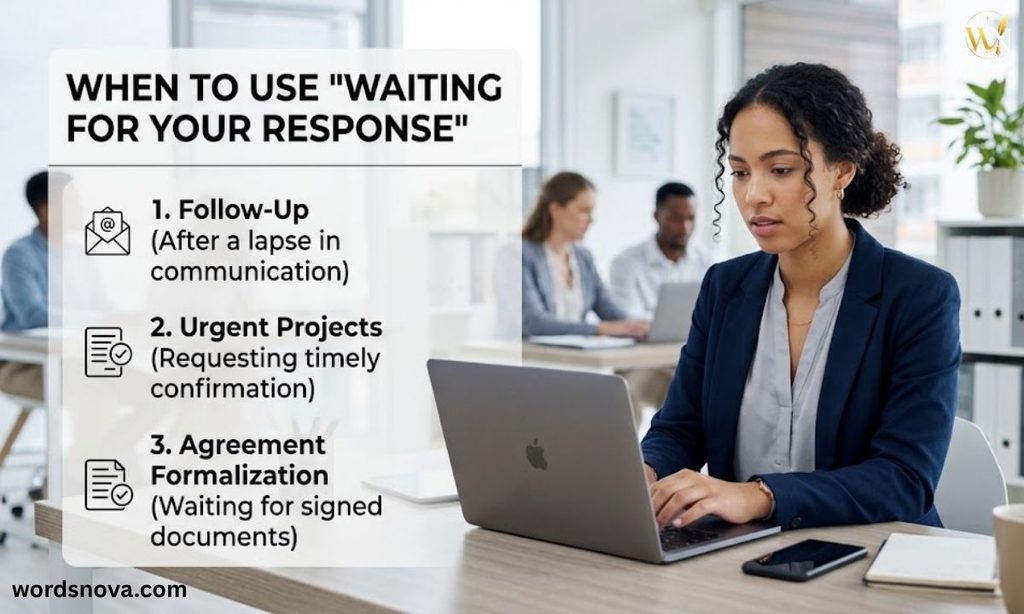
This phrase , and its many alternatives , typically appears in situations such as:
- Following up on a business proposal or job application
- Closing a customer service email
- Requesting approval or feedback from a manager or client
- Ending a formal letter that requires action from the reader
- Reminding someone about a pending decision or deadline
- Wrapping up a casual message where you still expect a reply
The right version to use depends on your relationship with the recipient, the urgency of the matter, and how formal the setting is.
Is It Professional/Polite to Say “Waiting for Your Response”?
Yes, “waiting for your response” is generally considered professional and polite, especially in formal or business emails. However, it can sometimes come across as blunt or slightly demanding, particularly in written English where tone is harder to read.
For that reason, many communication experts recommend varying your phrasing depending on the situation:
- Use warmer alternatives (like “looking forward to your reply”) for client-facing or relationship-building messages.
- Use direct alternatives (like “please advise at your earliest convenience”) when a decision is time-sensitive.
- Use softer alternatives (like “whenever you get a chance, I’d appreciate your thoughts”) for casual or internal team communication.
Below is a quick-reference table before we explore each phrase in depth.
| # | Phrase | Tone | Best For |
| 1 | Looking forward to your reply | Warm, professional | Client and business emails |
| 2 | Awaiting your feedback | Formal, neutral | Requesting evaluations or reviews |
| 3 | Eager to hear from you | Friendly, enthusiastic | Networking or sales follow-ups |
| 4 | Hoping to hear from you soon | Polite, gentle | Follow-up emails |
| 5 | Anticipating your response | Formal | Business correspondence |
| 6 | Your response would be appreciated | Polite, formal | Requests and approvals |
| 7 | Kindly reply at your convenience | Courteous, formal | Non-urgent professional emails |
| 8 | I would value your input | Respectful, collaborative | Feedback requests |
| 9 | Please get back to me | Direct, casual-formal | Quick internal communication |
| 10 | When you have a moment, please respond | Relaxed, considerate | Low-urgency requests |
| 11 | I look forward to your thoughts | Warm, collaborative | Opinion or feedback requests |
| 12 | Waiting for your thoughts | Neutral, casual | Informal check-ins |
| 13 | Excited to hear your response | Enthusiastic, informal | Casual or creative teams |
| 14 | Hoping for your feedback | Polite, neutral | Reviews and evaluations |
| 15 | Your input would be greatly appreciated | Formal, respectful | Surveys, formal requests |
| 16 | Awaiting your kind response | Formal, courteous | Traditional business letters |
| 17 | I await your response | Formal, slightly stiff | Legal or official communication |
| 18 | Looking forward to your feedback | Warm, professional | Performance reviews, proposals |
| 19 | Please advise at your earliest convenience | Formal, urgent | Time-sensitive business matters |
| 20 | Eagerly awaiting your response | Enthusiastic, formal | Important business deals |
| 21 | Would love to hear your thoughts | Casual, friendly | Team or peer communication |
| 22 | Hoping for your prompt reply | Polite, urgent | Deadline-driven emails |
| 23 | Your guidance would be appreciated | Respectful, formal | Requesting advice from seniors |
| 24 | Waiting to hear from you | Neutral, everyday | General follow-ups |
| 25 | Anxiously awaiting your reply | Emotional, informal | Personal or high-stakes messages |
| 26 | Kindly provide your feedback | Formal, direct | Structured feedback requests |
| 27 | Awaiting your valued input | Formal, respectful | Committee or team decisions |
| 28 | Looking forward to your guidance | Respectful, formal | Mentorship or advisory contexts |
| 29 | Please share your thoughts | Casual, open | Brainstorming and discussions |
| 30 | Awaiting your kind feedback | Formal, courteous | Client or customer emails |
1. Looking forward to your reply
Meaning: This phrase expresses positive anticipation for the recipient’s response, without sounding demanding.
Scenario: Best used when closing a professional email where you want to sound approachable, not pushy.
Best Use: Client communication, sales follow-ups, and business proposals.
Tone: Warm and professional.
Explanation: Unlike “waiting for your response,” this version replaces passive waiting with active anticipation, which feels more positive and less demanding to the reader.
Examples:
- Thank you for considering our proposal , looking forward to your reply.
- I’ve attached the revised contract and am looking forward to your reply.
- Looking forward to your reply so we can move forward with the project.
- Please review the details below; looking forward to your reply this week.
- It was great speaking with you today , looking forward to your reply soon.
- Looking forward to your reply regarding the meeting date.
2. Awaiting your feedback
Meaning: This phrase indicates that the sender is specifically waiting for the recipient’s opinion, review, or evaluation.
Scenario: Ideal when you’ve submitted work, a draft, or a proposal and need the reader’s assessment.
Best Use: Design reviews, editorial submissions, performance evaluations.
Tone: Neutral and formal.
Explanation: “Feedback” narrows the request specifically to opinions or evaluations, making it clearer than a general response is expected.
Examples:
- I’ve completed the first draft and am awaiting your feedback.
- The design mockups are ready , awaiting your feedback before we proceed.
- Awaiting your feedback on the proposed budget changes.
- Please let me know your thoughts; awaiting your feedback at your convenience.
- Awaiting your feedback so I can finalize the report.
- The team submitted the plan and is awaiting your feedback.
3. Eager to hear from you

Meaning: This expresses genuine enthusiasm about receiving a reply, adding a friendly, energetic tone to the message.
Scenario: Works well in networking emails, sales pitches, or when trying to build rapport.
Best Use: Cold outreach, partnership proposals, relationship-building emails.
Tone: Friendly and enthusiastic.
Explanation: The word “eager” conveys genuine interest rather than obligation, making the sender appear more personable and engaged.
Examples:
- I really enjoyed our conversation and am eager to hear from you.
- Eager to hear from you about the collaboration opportunity.
- We’ve reviewed your application and are eager to hear from you soon.
- Eager to hear from you regarding your availability next week.
- I’m eager to hear from you once you’ve had a chance to review this.
- Eager to hear from you , this could be a great partnership.
4. Hoping to hear from you soon
Meaning: This phrase gently expresses a wish for a timely response without setting a strict deadline.
Scenario: Suitable for polite follow-ups when you don’t want to sound demanding but still want a reasonably quick reply.
Best Use: Follow-up emails, gentle reminders, customer service closings.
Tone: Polite and gentle.
Explanation: The word “hoping” softens the request, making it feel like a wish rather than an expectation, which suits situations where pressure isn’t appropriate.
Examples:
- Just checking in , hoping to hear from you soon.
- Hoping to hear from you soon regarding the invoice.
- I sent this last week and am hoping to hear from you soon.
- Hoping to hear from you soon so we can confirm the schedule.
- Thanks again for your time; hoping to hear from you soon.
- Hoping to hear from you soon about the next steps.
5. Anticipating your response
Meaning: This phrase formally conveys that the sender expects a reply and is preparing for it.
Scenario: Common in formal business letters, legal correspondence, and official communication.
Best Use: Contracts, formal requests, official notices.
Tone: Formal.
Explanation: “Anticipating” is a more sophisticated synonym for “waiting,” often used in traditional or official writing to sound composed and professional.
Examples:
- We are anticipating your response regarding the contract terms.
- Anticipating your response before the end of the fiscal quarter.
- The board is anticipating your response to the proposal.
- Anticipating your response so we can finalize the agreement.
- Please review the attached documents; anticipating your response shortly.
- Anticipating your response on the matter discussed above.
6. Your response would be appreciated
Meaning: This phrase politely states that a reply is welcomed and valued, without directly demanding one.
Scenario: Useful in formal requests where you want to remain courteous while still prompting action.
Best Use: Requesting approvals, permissions, or confirmations.
Tone: Polite and formal.
Explanation: Framing the request around appreciation rather than expectation makes the tone softer and more considerate, especially useful with senior contacts.
Examples:
- Your response would be appreciated by the end of the week.
- Your response would be appreciated so we can proceed accordingly.
- Your response would be appreciated regarding the attached form.
- Your response would be appreciated at your earliest convenience.
- Your response would be appreciated before our next meeting.
- Your response would be appreciated to help us move forward.
7. Kindly reply at your convenience
Meaning: This phrase politely asks for a response whenever the recipient has time, without pressure or urgency.
Scenario: Best used for non-urgent matters where flexibility is acceptable.
Best Use: Internal memos, casual business updates, low-priority requests.
Tone: Courteous and formal.
Explanation: The phrase “at your convenience” removes any sense of urgency, signaling patience and respect for the recipient’s schedule.
Examples:
- Kindly reply at your convenience once you’ve reviewed the file.
- There’s no rush , kindly reply at your convenience.
- Kindly reply at your convenience regarding the venue options.
- Please kindly reply at your convenience with your preferred date.
- Kindly reply at your convenience so we can update our records.
- Kindly reply at your convenience to confirm receipt.
8. I would value your input
Meaning: This phrase expresses respect for the recipient’s opinion and invites them to contribute their thoughts.
Scenario: Ideal when seeking advice, suggestions, or expertise from a colleague or expert.
Best Use: Requesting advice, brainstorming sessions, collaborative projects.
Tone: Respectful and collaborative.
Explanation: “Value” emphasizes that the recipient’s perspective genuinely matters, which builds goodwill and encourages a thoughtful reply.
Examples:
- I would value your input on this marketing strategy.
- Before we finalize the plan, I would value your input.
- I would value your input given your experience in this area.
- I would value your input on how to improve the process.
- I would value your input; please share your thoughts when free.
- I would value your input on the attached proposal.
9. Please get back to me
Meaning: This is a direct, straightforward request for a reply.
Scenario: Suitable for internal communication or informal professional settings where directness is acceptable.
Best Use: Quick internal emails, team communication, casual reminders.
Tone: Direct, casual-to-formal.
Explanation: This phrase is simple and clear, making it effective when clarity matters more than diplomatic softening.
Examples:
- Please get back to me as soon as you can.
- Please get back to me with your decision by Friday.
- I need this confirmed , please get back to me today.
- Please get back to me regarding the schedule change.
- Please get back to me once you’ve spoken with the team.
- Please get back to me so we can wrap this up.
10. When you have a moment, please respond
Meaning: This phrase acknowledges the recipient’s busy schedule while still requesting a reply.
Scenario: Useful when you want to be considerate of someone’s time without seeming pushy.
Best Use: Messages to busy managers, executives, or clients.
Tone: Relaxed and considerate.
Explanation: By recognizing the recipient’s time constraints, this phrase reduces pressure while still keeping the request on their radar.
Examples:
- When you have a moment, please respond to the email below.
- No rush at all , when you have a moment, please respond.
- When you have a moment, please respond with your availability.
- When you have a moment, please respond regarding the invoice.
- When you have a moment, please respond so I can update the file.
- When you have a moment, please respond to confirm the details.
11. I look forward to your thoughts
Meaning: This phrase invites the recipient’s opinion or reaction in a warm, engaging way.
Scenario: Great for sharing ideas, drafts, or plans and wanting genuine feedback.
Best Use: Creative projects, strategy discussions, collaborative writing.
Tone: Warm and collaborative.
Explanation: “Thoughts” feels more personal and open-ended than “response,” inviting a genuine opinion rather than a simple yes or no.
Examples:
- I’ve shared the outline above , I look forward to your thoughts.
- I look forward to your thoughts on the new design direction.
- Take a look when you can; I look forward to your thoughts.
- I look forward to your thoughts on how we can improve this.
- I look forward to your thoughts after the presentation.
- I look forward to your thoughts on the proposed changes.
12. Waiting for your thoughts
Meaning: A simple, direct way of saying you’re expecting the recipient’s opinion or reaction.
Scenario: Works well in casual professional settings or quick check-ins.
Best Use: Informal team chats, quick opinion requests.
Tone: Neutral and casual.
Explanation: This is a lighter variation of “waiting for your response,” softened slightly by focusing on “thoughts” rather than a formal reply.
Examples:
- Waiting for your thoughts on the new logo design.
- I sent the draft over , waiting for your thoughts.
- Waiting for your thoughts before we move to the next step.
- Waiting for your thoughts on the plan we discussed.
- Just checking in , waiting for your thoughts on this one.
- Waiting for your thoughts whenever you get a chance.
13. Excited to hear your response
Meaning: This phrase conveys genuine excitement about receiving the recipient’s reply.
Scenario: Fits informal or creative work environments where enthusiasm is welcomed.
Best Use: Startups, creative teams, casual client relationships.
Tone: Enthusiastic and informal.
Explanation: The word “excited” adds emotional energy, making the message feel more personal and engaging than a neutral closing.
Examples:
- Excited to hear your response to the new campaign idea.
- We just finished the prototype , excited to hear your response.
- Excited to hear your response once you’ve had a look.
- Excited to hear your response about joining the project.
- Excited to hear your response, this could be a great fit.
- Excited to hear your response on the pitch deck.
14. Hoping for your feedback
Meaning: This phrase politely expresses a wish to receive the recipient’s evaluation or opinion.
Scenario: Suitable when requesting reviews or assessments without sounding demanding.
Best Use: Peer reviews, product testing, editorial feedback.
Tone: Polite and neutral.
Explanation: Combining “hoping” with “feedback” softens the request while still making clear that an evaluation is expected.
Examples:
- Hoping for your feedback on the attached document.
- Hoping for your feedback before we publish the article.
- Hoping for your feedback on how the trial run went.
- Hoping for your feedback so we can refine the product.
- Hoping for your feedback at your earliest convenience.
- Hoping for your feedback on the revised timeline.
15. Your input would be greatly appreciated
Meaning: This phrase formally emphasizes how much the recipient’s contribution matters.
Scenario: Ideal for formal requests such as surveys, committee decisions, or structured feedback processes.
Best Use: Surveys, formal proposals, committee reviews.
Tone: Formal and respectful.
Explanation: Adding “greatly” intensifies the appreciation, making this phrase especially effective when addressing senior stakeholders or formal panels.
Examples:
- Your input would be greatly appreciated on this policy update.
- Your input would be greatly appreciated before the vote.
- Your input would be greatly appreciated given your expertise.
- Your input would be greatly appreciated in shaping the final version.
- Your input would be greatly appreciated by our committee.
- Your input would be greatly appreciated as we finalize the report.
16. Awaiting your kind response
Meaning: A formal, courteous way of stating you’re waiting for a reply, often used in traditional business writing.
Scenario: Fits well in official letters, especially in more formal or international business contexts.
Best Use: Formal letters, cross-cultural business communication.
Tone: Formal and courteous.
Explanation: The word “kind” adds a layer of politeness, which is common in traditional business English and appreciated in more formal cultures.
Examples:
- Awaiting your kind response regarding the enclosed documents.
- We remain awaiting your kind response on this matter.
- Awaiting your kind response so we may proceed further.
- Awaiting your kind response at your earliest opportunity.
- Awaiting your kind response to confirm the shipment details.
- Awaiting your kind response before finalizing the agreement.
17. I await your response
Meaning: A concise, formal statement indicating that the sender expects a reply.
Scenario: Common in legal, official, or highly formal correspondence.
Best Use: Legal notices, official government or institutional letters.
Tone: Formal, slightly stiff.
Explanation: This phrasing is grammatically formal and direct, often used when tone needs to sound authoritative or official rather than warm.
Examples:
- I await your response regarding the terms outlined above.
- I await your response before proceeding with legal action.
- I await your response to confirm compliance with this notice.
- I await your response within the specified timeframe.
- I await your response on behalf of the organization.
- I await your response to finalize the official record.
18. Looking forward to your feedback
Meaning: This phrase positively anticipates the recipient’s evaluation or opinion.
Scenario: Suitable for professional settings such as performance reviews or proposal evaluations.
Best Use: Performance reviews, business proposals, project evaluations.
Tone: Warm and professional.
Explanation: Similar to “looking forward to your reply,” but specifically targets evaluative feedback rather than a general response.
Examples:
- Looking forward to your feedback on my performance this quarter.
- Looking forward to your feedback on the proposal we submitted.
- Looking forward to your feedback once you’ve reviewed the samples.
- Looking forward to your feedback so we can adjust accordingly.
- Looking forward to your feedback on the revised draft.
- Looking forward to your feedback after the client demo.
19. Please advise at your earliest convenience
Meaning: This phrase formally requests guidance or a decision as soon as reasonably possible.
Scenario: Best for time-sensitive business matters requiring a decision or instruction.
Best Use: Urgent business requests, approvals, deadline-driven communication.
Tone: Formal and urgent.
Explanation: “Advise” implies the sender needs direction or a decision, not just acknowledgment, making it useful when action is required.
Examples:
- Please advise at your earliest convenience on how to proceed.
- Please advise at your earliest convenience regarding the budget approval.
- Please advise at your earliest convenience if changes are needed.
- Please advise at your earliest convenience so we can meet the deadline.
- Please advise at your earliest convenience on the next course of action.
- Please advise at your earliest convenience whether the terms are acceptable.
20. Eagerly awaiting your response
Meaning: This phrase intensifies anticipation, showing strong interest in receiving a reply.
Scenario: Useful for important business deals or high-stakes communication where enthusiasm matters.
Best Use: Major deals, investment discussions, high-priority negotiations.
Tone: Enthusiastic and formal.
Explanation: The word “eagerly” adds intensity to the anticipation, signaling that the matter is important to the sender without sounding impatient.
Examples:
- Eagerly awaiting your response on the partnership agreement.
- Eagerly awaiting your response to move forward with the deal.
- Eagerly awaiting your response given the tight timeline.
- Eagerly awaiting your response regarding the investment proposal.
- Eagerly awaiting your response so we can finalize terms.
- Eagerly awaiting your response on this exciting opportunity.
21. Would love to hear your thoughts
Meaning: A casual, friendly way of inviting the recipient’s opinion or reaction.
Scenario: Great for peer-to-peer communication or informal team settings.
Best Use: Team discussions, casual client relationships, creative brainstorming.
Tone: Casual and friendly.
Explanation: “Would love” adds warmth and enthusiasm, making the request feel more like an invitation than an obligation.
Examples:
- Would love to hear your thoughts on this new idea.
- Would love to hear your thoughts once you’ve read it through.
- Would love to hear your thoughts on how we can improve.
- Would love to hear your thoughts before we go ahead.
- Would love to hear your thoughts on the design changes.
- I would love to hear your thoughts whenever you’re free.
22. Hoping for your prompt reply
Meaning: This phrase politely but clearly requests a quick response.
Scenario: Useful when there’s a deadline or urgency involved but you still want to remain courteous.
Best Use: Deadline-driven emails, urgent client requests.
Tone: Polite but urgent.
Explanation: “Prompt” signals urgency while “hoping” maintains politeness, striking a balance between directness and courtesy.
Examples:
- Hoping for your prompt reply given the approaching deadline.
- Hoping for your prompt reply so we can proceed on schedule.
- Hoping for your prompt reply regarding the urgent matter.
- Hoping for your prompt reply as the client is waiting.
- Hoping for your prompt reply to avoid any delays.
- Hoping for your prompt reply on this time-sensitive issue.
23. Your guidance would be appreciated

Meaning: This phrase respectfully requests advice or direction from someone more experienced or senior.
Scenario: Ideal when seeking mentorship, approval, or expert advice.
Best Use: Communication with managers, mentors, or senior stakeholders.
Tone: Respectful and formal.
Explanation: “Guidance” implies you’re seeking direction rather than just information, which is appropriate when addressing someone with more authority or expertise.
Examples:
- Your guidance would be appreciated on how to handle this situation.
- Your guidance would be appreciated before I proceed further.
- Your guidance would be appreciated given your experience with this client.
- Your guidance would be appreciated on the best approach to take.
- Your guidance would be appreciated as I finalize the strategy.
- Your guidance would be appreciated regarding the next steps.
24. Waiting to hear from you
Meaning: A simple, everyday way of saying you expect a reply.
Scenario: Works in almost any context, from casual to semi-formal.
Best Use: General follow-ups, everyday professional emails.
Tone: Neutral and everyday.
Explanation: This is one of the most versatile alternatives, close in meaning to the original phrase but slightly softer and more conversational.
Examples:
- Waiting to hear from you about the meeting time.
- Just following up , waiting to hear from you.
- Waiting to hear from you regarding the order status.
- Waiting to hear from you before we finalize the plan.
- Waiting to hear from you on the next steps.
- Waiting to hear from you whenever you’re ready.
25. Anxiously awaiting your reply
Meaning: This phrase expresses a stronger, more emotional sense of anticipation, sometimes bordering on nervousness.
Scenario: Suitable for personal messages or situations where the outcome genuinely matters to the sender.
Best Use: Personal emails, high-stakes applications, emotionally significant requests.
Tone: Emotional and informal.
Explanation: “Anxiously” conveys genuine nervous anticipation, which fits personal or emotionally invested situations but should be used carefully in strictly formal business settings.
Examples:
- Anxiously awaiting your reply about the scholarship decision.
- Anxiously awaiting your reply after the interview yesterday.
- Anxiously awaiting your reply on whether the offer still stands.
- Anxiously awaiting your reply since this means a lot to me.
- Anxiously awaiting your reply regarding the application results.
- Anxiously awaiting your reply about the adoption process.
26. Kindly provide your feedback
Meaning: A polite, direct request for the recipient’s evaluation or opinion.
Scenario: Useful in structured processes where feedback is formally required.
Best Use: Formal feedback forms, structured reviews, official evaluations.
Tone: Formal and direct.
Explanation: “Kindly provide” softens a direct request while still making clear that feedback is expected as part of a process.
Examples:
- Kindly provide your feedback on the attached evaluation form.
- Kindly provide your feedback by the end of the review period.
- Kindly provide your feedback so we can close out this project.
- Kindly provide your feedback regarding the training session.
- Kindly provide your feedback on the vendor’s performance.
- Kindly provide your feedback within the next five business days.
27. Awaiting your valued input
Meaning: This phrase formally acknowledges the importance of the recipient’s contribution while waiting for their reply.
Scenario: Appropriate for committee decisions, group projects, or formal collaborative processes.
Best Use: Committee reviews, board decisions, group proposals.
Tone: Formal and respectful.
Explanation: The word “valued” reinforces that the recipient’s perspective genuinely matters, which is especially effective in group or organizational settings.
Examples:
- Awaiting your valued input before the committee meets again.
- Awaiting your valued input on the proposed changes.
- Awaiting your valued input as we shape the final policy.
- Awaiting your valued input regarding the budget allocation.
- Awaiting your valued input to complete the board report.
- Awaiting your valued input on this important decision.
28. Looking forward to your guidance
Meaning: This phrase expresses positive anticipation for advice or direction from someone experienced.
Scenario: Fits mentorship relationships or situations involving senior advisors.
Best Use: Mentorship communication, advisory board discussions.
Tone: Respectful and formal.
Explanation: Combining “looking forward” with “guidance” creates a tone that is both warm and deferential, ideal for hierarchical or mentoring relationships.
Examples:
- Looking forward to your guidance on this new challenge.
- Looking forward to your guidance as I navigate this decision.
- Looking forward to your guidance regarding the career path options.
- Looking forward to your guidance before the presentation.
- Looking forward to your guidance on how best to proceed.
- Looking forward to your guidance throughout this project.
29. Please share your thoughts

Meaning: A casual, open invitation for the recipient to express their opinion.
Scenario: Works well in brainstorming sessions or open discussions where multiple viewpoints are welcome.
Best Use: Team brainstorming, open forums, collaborative discussions.
Tone: Casual and open.
Explanation: This phrase invites open dialogue rather than a simple yes-or-no answer, making it ideal for discussions rather than approvals.
Examples:
- Please share your thoughts on the ideas discussed today.
- Please share your thoughts once you’ve reviewed the options.
- Please share your thoughts on how we can move forward.
- Please share your thoughts in the comments below.
- Please share your thoughts before our next meeting.
- Please share your thoughts on the new proposal.
30. Awaiting your kind feedback
Meaning: A formal, courteous way of saying you’re waiting for the recipient’s evaluation or opinion.
Scenario: Common in customer service or client-facing communication that requires politeness.
Best Use: Client emails, customer service closings, formal reviews.
Tone: Formal and courteous.
Explanation: Adding “kind” softens the request, making it feel considerate and respectful, which works well in customer-facing communication.
Examples:
- Awaiting your kind feedback on the service you received.
- Awaiting your kind feedback so we can improve our offerings.
- Awaiting your kind feedback regarding your recent experience.
- Awaiting your kind feedback at your earliest convenience.
- Awaiting your kind feedback on the resolution provided.
- Awaiting your kind feedback to help us serve you better.
Frequently Asked Questions
What are other ways to say waiting for your response?
There are many other ways to say waiting for your response, ” including “I look forward to hearing from you” or “I await your reply” politely.
How can I politely say I am waiting for your response?
You can use other ways to say waiting for your response, such as “I look forward to your reply” to sound polite, professional, and friendly.
What is a professional way to say waiting for your response?
Other professional ways to say waiting for your response include “I look forward to hearing from you” or “I would appreciate your timely response” in emails.
Can I say waiting for your response in an email?
Yes, but other ways to say waiting for your response can sound more natural, such as “I look forward to your response” in professional emails.
How do I end an email while waiting for a reply?
Use other ways to say waiting for your response, like “I look forward to hearing from you soon,” to end your email politely and professionally.
Conclusion
Finding other ways to say waiting for your response can help you write better emails and messages. The right words can make your message sound polite, friendly, and professional. Instead of always waiting for your response, you can choose a phrase that fits the situation. You may write awaiting for your response, waiting for your reply, or waiting for response when appropriate.
Learning other ways to say waiting for your response also helps you avoid repeating the same phrase. Whether you write we are waiting for your response to a team or send a personal email, your tone matters. Try different expressions based on your purpose. Simple and polite words leave a good impression when you are waiting for your response.