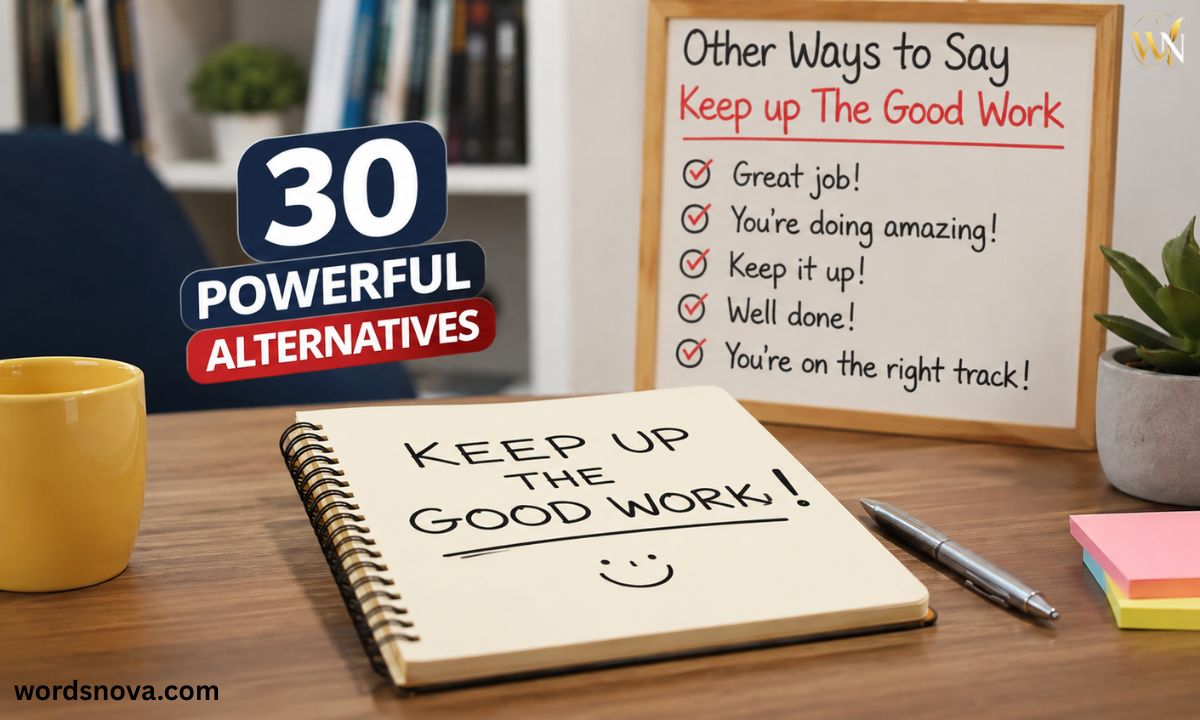
Finding the right words to praise someone can be harder than it sounds. If you are looking for Other Ways to Say Keep up The Good Work, you may want something warmer than “keep up the good work,” “keep up the great work,” or “keep up the great work!” You may also need another way to say keep up the good work or a simple keep up the good work synonym.
You will find useful and natural phrases for different situations. These Other Ways to Say Keep up The Good Work can help you sound friendly, professional, and encouraging while keeping your message simple and clear.
What Does “Keep up the Good Work” Mean?
“Keep up the good work” is an encouraging phrase used to acknowledge that someone is performing well and to motivate them to continue at the same standard. It combines two ideas in one sentence: praise for what has already been done, and encouragement to maintain that same level of effort going forward.
Grammatically, it’s an imperative sentence , a command form , but it’s used in a friendly, supportive way rather than as an order. The phrase works because it does two jobs at once: it says “well done” and “don’t stop” in a single, easy-to-say sentence.
When to Use “Keep up the Good Work”
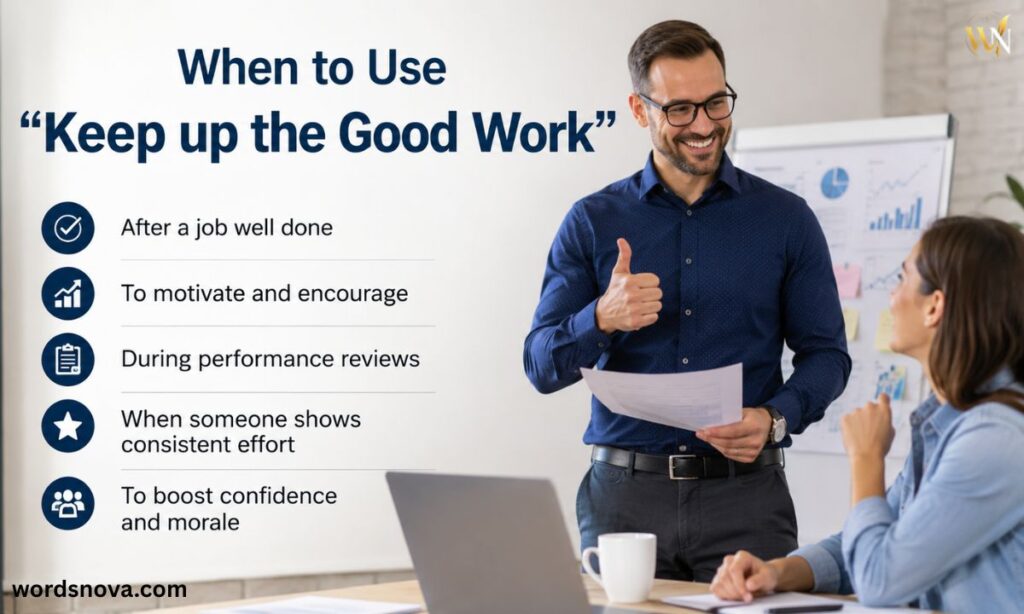
This phrase fits naturally in situations where consistent effort or performance deserves recognition. Common contexts include:
- Workplace feedback:after a manager reviews a project, report, or ongoing task
- Academic settings:teachers encouraging students who are improving or performing well
- Coaching and sports:motivating athletes during training or after a good performance
- Everyday encouragement:supporting a friend or family member working toward a goal
It’s best used for ongoing or repeated effort, rather than a single, one-time achievement. For a single big win, phrases like “great job” or “well done” often fit better, since “keep up” implies continuity.
Is It Professional/Polite to Say “Keep up the Good Work”?
Yes, “keep up the good work” is generally considered professional and polite, especially in casual to moderately formal workplace communication, such as team chats, quick check-ins, or verbal praise. However, it can come across as slightly generic or impersonal in more formal settings like written performance reviews, promotion letters, or client-facing communication, where specific, detailed feedback is usually expected.
In those more formal cases, it’s often better to pair the phrase with a specific detail (“Keep up the good work , your attention to client deadlines has really paid off this quarter”) or to swap it for a more tailored alternative from the list below.
| Setting | Is It Appropriate? | Better Alternative If Not |
| Casual team chat or email | Yes | , |
| Verbal praise in meetings | Yes | , |
| Formal written performance review | Use with caution | Pair with specific detail or use a formal synonym |
| Client-facing communication | Use with caution | “We appreciate your continued excellent work” |
| Teacher-to-student feedback | Yes | , |
Synonyms for “Keep up the Good Work”
Below are 30 alternative expressions you can use instead of “keep up the good work.” Each entry includes the meaning, the best situation to use it in, the tone it carries, a short explanation, and five example sentences.
1. Great Job!
Meaning: A short, direct way of praising someone for doing something well.
Best Use: Ideal for quick, informal recognition of a task, project, or achievement , in person, in chat, or in email.
Tone: Casual, warm, enthusiastic.
Explanation: “Great job” is one of the most common praise phrases in English because it’s short, positive, and works for almost any achievement, big or small. It doesn’t necessarily imply ongoing effort the way “keep up the good work” does, so it’s better suited to praising a specific result.
Examples:
- Great job on the presentation today , the client loved it.
- Great job finishing the report ahead of schedule!
- You handled that difficult customer really well. Great job.
- Great job, team! We hit our target for the month.
- Great job on your exam results this semester.
2. Well Done!
Meaning: An expression of approval for successfully completing a task.
Best Use: Works well for both small wins and major accomplishments, in professional and personal settings.
Tone: Polite, respectful, slightly more formal than “great job.”
Explanation: “Well done” is versatile and widely understood, making it a safe choice in almost any context, from a text message to a formal email. It emphasizes that something was done correctly and effectively.
Examples:
- Well done on closing that deal , it wasn’t easy.
- Well done, everyone. The launch went smoothly.
- Well done on your promotion; you’ve earned it.
- Well done for staying calm under pressure today.
- Well done , your code passed every test on the first try.
3. Excellent Work!
Meaning: A stronger form of praise indicating that the quality of the work was outstanding.
Best Use: Best for recognizing high-quality, polished work rather than just effort.
Tone: Formal, professional, appreciative.
Explanation: Unlike simpler phrases, “excellent work” specifically highlights quality. It’s a good choice for performance reviews or feedback where you want to acknowledge a high standard of output.
Examples:
- Excellent work on the quarterly financial report.
- Your excellent work on this project didn’t go unnoticed.
- Excellent work, the design exceeded our expectations.
- The client praised your excellent work on the campaign.
- Excellent work , this is exactly the level of detail we needed.
4. Outstanding Effort!
Meaning: Praise that focuses on the amount of effort someone put in, not just the result.
Best Use: Ideal when someone worked especially hard, even if the final outcome is still in progress.
Tone: Encouraging, motivational, sincere.
Explanation: This phrase is useful when you want to acknowledge hard work specifically, separate from the final result. It’s great for situations where effort matters as much as, or more than, the outcome.
Examples:
- Outstanding effort from the whole team this week.
- That was an outstanding effort, even though we came up just short.
- Outstanding effort on your first solo project.
- Your outstanding effort during crunch time made a real difference.
- Outstanding effort in training , it’s really showing in your performance.
5. You’re Doing Amazing!
Meaning: A warm expression of encouragement affirming that someone’s current performance is impressive.
Best Use: Best for casual, supportive check-ins with friends, coworkers, or students who may need a confidence boost.
Tone: Friendly, uplifting, personal.
Explanation: This phrase leans more emotional and supportive than purely professional. It’s especially useful when someone might be doubting themselves and needs reassurance.
Examples:
- You’re doing amazing , don’t be so hard on yourself.
- Halfway through the marathon and you’re doing amazing!
- You’re doing amazing in your new role already.
- Just checking in , you’re doing amazing with this project.
- You’re doing amazing at balancing work and studies.
6. Fantastic Performance!

Meaning: Recognition of an impressive display of skill or ability, often used for a specific event or moment.
Best Use: Great for presentations, sports, performances, or any time-limited display of skill.
Tone: Enthusiastic, celebratory.
Explanation: “Performance” implies a specific occasion rather than ongoing work, so this phrase suits one-time events like a talk, game, or interview more than continuous tasks.
Examples:
- Fantastic performance in today’s match!
- That was a fantastic performance during the client pitch.
- Fantastic performance on the piano recital tonight.
- The team gave a fantastic performance under pressure.
- Fantastic performance in the interview , you nailed it.
7. Impressive Work!
Meaning: An acknowledgment that the work produced was better than expected.
Best Use: Works well when a result exceeds expectations or shows notable skill.
Tone: Respectful, slightly formal, genuine.
Explanation: “Impressive” carries a sense of surprise or exceeding expectations, making this phrase feel more specific and sincere than generic praise.
Examples:
- Impressive work on such a tight deadline.
- This is impressive work for a first attempt.
- Impressive work , the data analysis is spot on.
- Impressive work turning around the failing project.
- Impressive work on the redesign; it looks fantastic.
8. Keep It Going!
Meaning: Encouragement to maintain current momentum and not slow down.
Best Use: Ideal for ongoing projects, streaks, or continuous improvement situations.
Tone: Motivational, energetic, informal.
Explanation: Like “keep up the good work,” this phrase focuses on continuity, but it feels more energetic and is often used in fast-paced or competitive environments.
Examples:
- Sales are up two months in a row , keep it going!
- Great progress on the app, keep it going!
- You’re on a roll with your workouts , keep it going!
- Keep it going, we’re almost at the finish line.
- The team’s momentum is great this quarter, keep it going!
9. Way to Go!
Meaning: A casual, celebratory way of congratulating someone on an accomplishment.
Best Use: Best for informal settings, casual congratulations, and everyday achievements.
Tone: Casual, cheerful, enthusiastic.
Explanation: “Way to go” is common in spoken English and casual writing, and it works well for both small and large wins without sounding overly formal.
Examples:
- Way to go on passing your driving test!
- You finished the puzzle , way to go!
- Way to go, you finally beat your personal best.
- Way to go on landing that new client.
- Way to go, team , great win today!
10. Hats Off to You!
Meaning: An expression of respect and admiration for someone’s achievement.
Best Use: Best for acknowledging a notable or difficult accomplishment that deserves genuine respect.
Tone: Respectful, admiring, slightly formal.
Explanation: This idiom comes from the tradition of removing one’s hat as a sign of respect. It works well when you want praise to sound more heartfelt or significant than a simple “good job.”
Examples:
- Hats off to you for managing this project solo.
- Hats off to you for staying so patient through the delays.
- Hats off to the whole team for pulling off the event.
- Hats off to you for finishing the certification while working full-time.
- Hats off to you , that was a tough call to make, and you handled it well.
11. You Nailed It!
Meaning: A casual way of saying someone did something perfectly or exactly right.
Best Use: Best for informal praise after a specific task, presentation, or performance is completed successfully.
Tone: Casual, confident, friendly.
Explanation: “Nailed it” implies precision and success, often used right after something is finished, rather than for ongoing effort.
Examples:
- You nailed it in there , the client is thrilled.
- That was a tricky question, but you nailed it.
- You nailed it on the first try!
- The presentation was flawless , you nailed it.
- You nailed it with that fix; the bug is completely gone.
12. Superb Job!
Meaning: Praise indicating that work was done to an exceptionally high standard.
Best Use: Suitable for both spoken and written praise when quality stands out clearly.
Tone: Formal-leaning, appreciative, polished.
Explanation: “Superb” is a stronger adjective than “great,” making this phrase useful when you want to emphasize just how well something was done.
Examples:
- Superb job on the annual report.
- Superb job navigating that difficult negotiation.
- The kitchen did a superb job with tonight’s menu.
- Superb job on your dissertation defense.
- Superb job managing the event logistics.
13. Remarkable Effort!

Meaning: Recognition of effort that stands out as unusual or exceptional.
Best Use: Best when someone’s dedication or persistence was especially noteworthy, regardless of the final outcome.
Tone: Sincere, respectful, encouraging.
Explanation: Like “outstanding effort,” this phrase focuses on the process rather than the result, but “remarkable” adds a sense that the effort was unusually impressive.
Examples:
- Remarkable effort getting the product ready in time.
- That was a remarkable effort, considering the obstacles.
- Remarkable effort from every member of the team.
- Your remarkable effort this season really paid off.
- Remarkable effort learning a new skill so quickly.
14. Brilliant Work!
Meaning: High praise for work that shows exceptional skill, creativity, or intelligence.
Best Use: Best for creative, technical, or intellectually demanding work.
Tone: Enthusiastic, admiring, warm.
Explanation: “Brilliant” suggests not just competence but genuine talent or cleverness, making it a strong choice for standout achievements.
Examples:
- Brilliant work on the new marketing strategy.
- That solution was brilliant work under time pressure.
- Brilliant work on the illustrations for the book.
- Brilliant work solving that bug so quickly.
- Brilliant work, the whole design concept really works.
15. Keep Shining!
Meaning: Encouragement to continue standing out and doing well.
Best Use: Best for personal, warm, informal encouragement rather than formal workplace feedback.
Tone: Uplifting, friendly, motivational.
Explanation: “Shining” is a metaphor for standing out positively, so this phrase works well for personal encouragement, social media captions, or supportive messages to friends and students.
Examples:
- You’ve grown so much this year , keep shining!
- Keep shining, your hard work is inspiring others.
- Keep shining in everything you do.
- Your positivity lights up the room, keep shining!
- Keep shining, we’re all cheering you on.
16. You’re on the Right Track!
Meaning: Confirmation that someone’s current approach or progress is heading in the right direction.
Best Use: Best when giving feedback on progress that isn’t finished yet.
Tone: Encouraging, supportive, reassuring.
Explanation: This phrase is especially useful mid-project or mid-process, when the outcome isn’t final but the direction is promising.
Examples:
- Your draft looks good , you’re on the right track.
- You’re on the right track with this budget plan.
- Keep going, you’re on the right track with your training.
- You’re on the right track; just tighten up the conclusion.
- You’re on the right track with your research approach.
17. Tremendous Job!
Meaning: Strong praise for a task or project completed exceptionally well.
Best Use: Suitable for formal recognition of major accomplishments.
Tone: Formal, appreciative, respectful.
Explanation: “Tremendous” adds intensity to standard praise, making this phrase feel more significant than “great job” or “good job.”
Examples:
- Tremendous job leading the migration project.
- The team did a tremendous job under the circumstances.
- Tremendous job on your first year in the role.
- Tremendous job coordinating the volunteers today.
- Tremendous job, the results speak for themselves.
18. Keep Excelling!
Meaning: Encouragement to continue performing at a high level.
Best Use: Best for high-achieving employees or students who consistently perform above average.
Tone: Formal, motivational, respectful.
Explanation: “Excelling” implies performance well above average, so this phrase fits best when praising someone who is already a strong performer.
Examples:
- Keep excelling, your results this quarter were the best on the team.
- Keep excelling in your studies , it’s clearly paying off.
- Keep excelling, we’re proud of your progress.
- Keep excelling in your new leadership role.
- Keep excelling, your growth this year has been outstanding.
19. You’re Doing Fantastic!
Meaning: A warm, informal way of affirming that someone is performing very well.
Best Use: Best for casual encouragement, check-ins, or supportive conversations.
Tone: Friendly, warm, casual.
Explanation: Similar to “you’re doing amazing,” this phrase is personal and supportive, often used to reassure someone during an ongoing effort or challenge.
Examples:
- You’re doing fantastic with the new system, don’t worry.
- Three weeks in and you’re doing fantastic.
- You’re doing fantastic , the client feedback has been great.
- You’re doing fantastic managing the new team.
- You’re doing fantastic, just keep asking questions when you need to.
20. Exceptional Performance!
Meaning: Recognition that someone’s performance was well above the expected standard.
Best Use: Best for formal reviews, evaluations, or recognizing standout results.
Tone: Formal, professional, precise.
Explanation: “Exceptional” is a strong, formal word often used in performance reviews and official recognition, making this phrase well-suited to written workplace feedback.
Examples:
- Exceptional performance this quarter across every metric.
- Your exceptional performance earned you this year’s award.
- Exceptional performance during the product launch.
- The report highlighted your exceptional performance this year.
- Exceptional performance from the entire sales team.
21. You’re Killing It!
Meaning: A very informal, enthusiastic way of saying someone is doing extremely well.
Best Use: Best for casual, energetic praise among peers or close colleagues.
Tone: Casual, energetic, playful.
Explanation: This slang expression is popular in casual workplace culture and social settings but should be avoided in formal writing or with audiences who may find slang inappropriate.
Examples:
- You’re killing it on social media this month.
- Seriously, you’re killing it with these new designs.
- You’re killing it in the gym lately.
- You’re killing it , three deals closed this week alone.
- You’re killing it as team lead, honestly.
22. Admirable Effort!

Meaning: Recognition that someone’s effort deserves respect and admiration.
Best Use: Best when the effort itself, rather than the outcome, deserves recognition.
Tone: Respectful, sincere, formal-leaning.
Explanation: “Admirable” suggests something worth respecting, making this phrase suitable when acknowledging perseverance, especially in the face of difficulty.
Examples:
- Admirable effort keeping the project on track despite the setbacks.
- That was an admirable effort from a first-year student.
- Admirable effort staying composed during the crisis.
- Admirable effort supporting the new hires this month.
- Admirable effort, even though the final result was close.
23. Keep Up the Momentum!
Meaning: Encouragement to maintain current progress and energy.
Best Use: Best for ongoing projects, sales streaks, or team performance that’s currently trending upward.
Tone: Motivational, energetic, professional.
Explanation: This phrase is nearly identical in meaning to “keep up the good work” but emphasizes momentum and pace, making it especially fitting for goal-driven or results-based contexts.
Examples:
- Great numbers this month , keep up the momentum!
- Keep up the momentum, we’re ahead of schedule.
- The team has real energy right now, keep up the momentum!
- Keep up the momentum into next quarter.
- Keep up the momentum, this project is really coming together.
24. You’ve Got This!
Meaning: An expression of confidence and support, reassuring someone that they’re capable of succeeding.
Best Use: Best for encouragement before or during a challenge, rather than after completion.
Tone: Supportive, warm, motivational.
Explanation: Unlike most phrases on this list, “you’ve got this” is typically used before or during a task, not after, making it useful for encouragement rather than praise for completed work.
Examples:
- Big presentation today? You’ve got this.
- It’s a tough exam, but you’ve got this.
- You’ve got this , just take it one step at a time.
- Nervous about the interview? Don’t be, you’ve got this.
- You’ve got this, we believe in you.
25. Consistently Great Work!
Meaning: Recognition that someone maintains a high standard of performance over time.
Best Use: Best for long-term feedback, such as performance reviews or ongoing project recognition.
Tone: Formal, appreciative, professional.
Explanation: This phrase highlights reliability and consistency rather than a single achievement, making it especially useful for recognizing dependable, steady performers.
Examples:
- Consistently great work throughout the entire project.
- Your consistently great work has made you a key member of this team.
- Consistently great work, quarter after quarter.
- It’s rare to see consistently great work like this from a new hire.
- Consistently great work is exactly why you were promoted.
26. Stellar Job!
Meaning: Praise indicating that work was outstanding, comparable to something star-like or extraordinary.
Best Use: Best for casual to semi-formal praise of impressive results.
Tone: Enthusiastic, appreciative, upbeat.
Explanation: “Stellar” is an informal but expressive way to say something was excellent, often used in creative or fast-paced work environments.
Examples:
- Stellar job on the campaign launch.
- Stellar job pulling that report together so quickly.
- Stellar job, the client had nothing but praise.
- Stellar job on your first solo presentation.
- Stellar job wrapping up the project ahead of deadline.
27. Keep It Up!
Meaning: A short, direct way of encouraging someone to continue their current effort.
Best Use: Best for quick, informal encouragement in everyday conversations.
Tone: Casual, friendly, supportive.
Explanation: This is one of the closest and most natural alternatives to “keep up the good work,” but shorter and slightly more casual, making it useful for quick check-ins or messages.
Examples:
- Great progress this week, keep it up!
- Keep it up, you’re almost done with the course.
- Nice improvement in your grades, keep it up!
- Keep it up, the team really notices your effort.
- Keep it up, we’re proud of how far you’ve come.
28. Wonderful Work!
Meaning: A warm, appreciative way of praising the quality of someone’s work.
Best Use: Best for personal or semi-formal praise where warmth matters as much as professionalism.
Tone: Warm, kind, appreciative.
Explanation: “Wonderful” adds an emotional warmth that makes this phrase feel more personal than purely professional praise like “excellent work.”
Examples:
- Wonderful work on the charity event this year.
- Wonderful work, the classroom display looks amazing.
- Wonderful work supporting the new volunteers.
- Wonderful work on your art submission.
- Wonderful work bringing the whole team together.
29. You’re Doing Wonderfully!

Meaning: Reassurance and praise affirming that someone’s current performance or progress is excellent.
Best Use: Best for supportive, encouraging conversations, especially during an ongoing process.
Tone: Warm, personal, encouraging.
Explanation: This phrase is well suited to moments when someone may need reassurance mid-task, such as during training, recovery, or a challenging project.
Examples:
- You’re doing wonderfully in your new role so far.
- Don’t worry about the mistake, you’re doing wonderfully overall.
- You’re doing wonderfully adjusting to the new schedule.
- You’re doing wonderfully with your recovery.
- You’re doing wonderfully, just keep at this pace.
30. Keep Achieving!
Meaning: Encouragement to continue reaching goals and accomplishing meaningful results.
Best Use: Best for goal-oriented feedback, such as in coaching, mentoring, or performance-based contexts.
Tone: Motivational, formal-leaning, forward-looking.
Explanation: Unlike phrases that focus on effort or quality, “keep achieving” specifically emphasizes results and goals, making it ideal for closing out feedback tied to targets or milestones.
Examples:
- You hit every target this year , keep achieving!
- Keep achieving, your growth has been incredible to watch.
- Keep achieving, one milestone at a time.
- Keep achieving, the sky’s the limit for you.
- Keep achieving, we can’t wait to see what’s next.
Quick Reference Table
| # | Phrase | Best For | Tone |
| 1 | Great Job! | Quick, informal recognition | Casual |
| 2 | Well Done! | General praise, any setting | Polite |
| 3 | Excellent Work! | High-quality output | Formal |
| 4 | Outstanding Effort! | Hard work, in-progress tasks | Encouraging |
| 5 | You’re Doing Amazing! | Emotional support/encouragement | Friendly |
| 6 | Fantastic Performance! | One-time events, presentations | Enthusiastic |
| 7 | Impressive Work! | Exceeding expectations | Respectful |
| 8 | Keep It Going! | Ongoing momentum | Energetic |
| 9 | Way to Go! | Casual congratulations | Cheerful |
| 10 | Hats Off to You! | Notable, difficult achievements | Admiring |
| 11 | You Nailed It! | Precision, completed tasks | Confident |
| 12 | Superb Job! | High standard of work | Polished |
| 13 | Remarkable Effort! | Noteworthy dedication | Sincere |
| 14 | Brilliant Work! | Creative/technical skill | Warm |
| 15 | Keep Shining! | Personal encouragement | Uplifting |
| 16 | You’re on the Right Track! | Mid-progress feedback | Reassuring |
| 17 | Tremendous Job! | Major accomplishments | Formal |
| 18 | Keep Excelling! | High achievers | Motivational |
| 19 | You’re Doing Fantastic! | Casual check-ins | Warm |
| 20 | Exceptional Performance! | Formal reviews | Professional |
| 21 | You’re Killing It! | Casual, peer praise | Playful |
| 22 | Admirable Effort! | Perseverance under difficulty | Respectful |
| 23 | Keep Up the Momentum! | Trending progress | Professional |
| 24 | You’ve Got This! | Before/during a challenge | Supportive |
| 25 | Consistently Great Work! | Long-term reliability | Professional |
| 26 | Stellar Job! | Impressive results | Upbeat |
| 27 | Keep It Up! | Quick, everyday encouragement | Casual |
| 28 | Wonderful Work! | Warm, personal praise | Kind |
| 29 | You’re Doing Wonderfully! | Reassurance mid-process | Personal |
| 30 | Keep Achieving! | Goal-oriented feedback | Motivational |
Frequently Asked Questions
What are other ways to say keep up the good work?
Other Ways to Say Keep up The Good Work include “keep it up,” “great job,” “you’re doing well,” and “keep going.” These phrases sound friendly and encouraging.
What is another way to say keep up the good work?
Another way to say keep up the good work is “keep up the great work,” “you’re doing amazing,” or “keep moving forward.” These Other Ways to Say Keep up The Good Work fit many situations.
What is a professional way to say keep up the good work?
A professional option is “excellent work, please continue,” “keep up your strong performance,” or “your efforts are appreciated.” These Other Ways to Say Keep up The Good Work sound respectful and positive.
What is a nice way to say keep up the good work?
A nice way to say it is “you’re doing a fantastic job,” “keep going,” or “I’m proud of your progress.” These Other Ways to Say Keep up The Good Work feel warm.
What is a synonym for keep up the good work?
A simple synonym is “keep it up,” “continue doing great work,” or “stay on track.” Other Ways to Say Keep up The Good Work can make your praise sound more natural.
Conclusion
The right words can make your praise sound warm and genuine. Other Ways to Say Keep up The Good Work give you simple options when you want to encourage someone. You can say keep up the good work or keep up the great work to show your support. Both phrases are positive and easy to use. They work well at school, work, or in everyday conversations.
When you need another way to say keep up the good work, choose words that fit the moment. Keep up the great work! It is a friendly and cheerful option. You can also use a keep up the good work synonym to make your message sound different. Other Ways to Say Keep up The Good Work help you express appreciation in a fresh way. A few simple words can encourage someone to continue doing their best.